Google released its August 2025 spam update today, the company announced at 12:05 p.m. This is Google’s first announced algorithm update since the June 2025 core update. It is Google’s first spam update of 2025 and the first since December.
Timing. Google called this a “normal spam update” and it will take a “few weeks” to finish rolling out.
“Today we released the August 2025 spam update. It may take a few weeks to complete. This is a normal spam update, and it will roll out for all languages and locations. We’ll post on the Google Search Status Dashboard when the rollout is done.”
Why we care. This is the first Google algorithm update since the June 2025 core update. It’s unclear what type of spam this update is targeting, but if you see any ranking or traffic changes in the next few weeks, it could be due to this update.
Over the last 30 years, we’ve seen nonstop shifts and transformations in platforms and tactics.
Search, social, and mobile have each gone through their own waves of evolution.
But AI represents something bigger – not just another tactic, but a fundamental shift in how people research, evaluate, and buy products and services.
Estimates vary, but Gartner projects that AI-driven search could account for 25% of search volume by the end of 2026.
I suspect the true share will be much higher as Google weaves AI deeper into its results.
For digital marketers, it can feel like we need a crystal ball to predict what’s next.
While we don’t have magical foresight, we do have the next best thing: lessons from the past.
This article looks back at the early days of search, how user behavior evolved alongside technology, and what those patterns can teach us as we navigate the AI era.
The early days: Wild and wonderful queries
If you remember the early web – AltaVista, Lycos, Yahoo, Hotbot – search was a free-for-all.
People typed in long, rambling queries, sometimes entire sentences, other times just a few random words that “felt” right.
There were no search suggestions, no “people also ask,” and no autocorrect.
It was a simpler time, often summed up as “10 blue links.”
Searchers had to experiment, refine, and iterate on their own, and the variance in query wording was huge.
For marketers, that meant opportunity.
You could capture traffic in all sorts of unexpected ways simply by having relevant pages indexed.
Back then, SEO was, in large part, about one thing: existing in the index.
Or are the results as good as ever, but the underlying sites have declined in quality?
It’s tricky to call.
What is certain is that as traffic declined, many sites got more aggressive – adding more ads, more pop-ups, and sneakier lead gen CTAs to squeeze more value from fewer clicks.
The search results themselves have also become a bewildering mix of ads, organic listings, and SERP features.
To deliver better results from shorter queries, search engines have had to guess at intent while still sending enough clicks to advertisers and publishers to keep the ecosystem running.
And as traffic-starved publishers got more desperate, user experience took a nosedive.
Anyone who has had to scroll through a food blogger’s life story – while dodging pop-ups and auto-playing ads – just to get to a recipe knows how painful this can be.
It’s this chaotic landscape that, in part, has driven the move to answer engines like ChatGPT and other large language models (LLMs).
People are simply tired of panning for gold in the search results.
The AI era: From compression back to conversation
Up to this point, the pattern has been clear: the average query length kept getting shorter.
But AI is changing the game again, and the query-length pendulum is now swinging sharply in the opposite direction.
Tools like ChatGPT, Claude, Perplexity, and Google’s own AI Mode are making it normal to type or speak longer, more detailed questions again.
We can now:
Ask questions instead of searching for keywords.
Refine queries conversationally.
Ask follow-ups without starting over.
And as users, we can finally skip the over-optimized lead gen traps that have made the web a worse place overall.
Here’s the key point: we’ve gone from mid-length, varied queries in the early days, to short, refined queries over the last 12 years or so, and now to full, detailed questions in the AI era.
The way we seek information has changed once more.
We’re no longer just searching for sources of information. We’re asking detailed questions to get clear, direct answers.
And as AI becomes more tightly integrated into Google over the coming months and years, this shift will continue to reshape how we search – or, more accurately, how we question – Google.
Now, we can ask more detailed, multi-part questions and get thorough answers – without battling through the lead gen traps that clutter so many websites.
The reality is simple: this is a better system.
This is progress.
Want to know the best way to boil an egg – and whether the process changes for eggs stored in the fridge versus at room temperature? Just ask.
Google will often decide if an AI Overview is helpful and generate it on the fly, considering both parts of your question.
What is the best way to boil an egg?
Does it differ if they are from the fridge?
The AI Overview answers the question directly.
And if you want to keep going, you can click the bold “Dive deeper in AI Mode” button to continue the conversation.
Inside AI Mode, you get streamlined, conversational answers to questions that traditional search could answer – just without the manual trawling or the painfully over-optimized, pop-up-heavy recipe sites.
From shorter queries to shorter journeys
Stepping back, we can see how behavior is shifting – and how it ties to human nature’s tendency to seek the path of least resistance.
The “easy” option used to be entering short queries and wading through an increasingly complex mix of results to find what you needed.
Now, the path of least resistance is to put in a bit more effort upfront – asking a longer, more refined question – and let the AI do the heavy lifting.
A search for the best steak restaurant nearby once meant seven separate queries and reviewing over 100 sites. That’s a lot of donkey work you can now skip.
It’s a subtle shift: slightly more work up front, but a far smoother journey in return.
This change also aligns with a classic computing principle: GIGO – garbage in, garbage out.
A more refined, context-rich question gives the system better input, which produces a more useful, accurate output.
Historic recurrence: The pattern revealed
Looking back, it’s clear there’s a repeating cycle in how technology shapes search behavior.
The early web (1990s)
Behavior: Long, experimental, often clumsy queries.
Why: No guidance, poor relevance, and lots of trial-and-error.
Marketing lesson: Simply having relevant content was often enough to capture traffic.
Google + Autocomplete (2000s)
Behavior: Queries got shorter and more standardized.
Why: Google Suggest and smarter algorithms nudged users toward the most common phrases.
Marketing lesson: Keyword targeting became more focused, with heavier competition around fewer, high-volume terms.
Mobile and voice era (2010s–early 2020s)
Behavior: Even shorter, highly predictable queries.
Why: Tiny keyboards, voice assistants, and SERP features that answered questions directly.
Marketing lesson: The long tail collapsed into clusters. Zero-click searches rose. Winning visibility meant optimizing for snippets and structured data.
AI conversation era (2023–present)
Behavior: Longer, natural-language queries return – now in back-and-forth conversations.
Why: Generative AI tools like ChatGPT, Gemini, and Perplexity encourage refinement, context, and multi-step questions.
Marketing lesson: It’s no longer about just showing up. It’s about being the best answer – authoritative, helpful, and easy for AI to surface.
Technology drives change
The key takeaway is that technology drives changes in how people ask questions.
And tactically, we’ve come full circle – closer to the early days of search than we’ve been in years.
Despite all the doom and gloom around SEO, there’s real opportunity in the AI era for those who adapt.
What this means for SEO, AEO, LLMO, GEO – and beyond
The environment is changing.
Technology is reshaping how we seek information – and how we expect answers to be delivered.
Traditional search engine results are still important. Don’t abandon conventional SEO.
But now, we also need to optimize for answer engines like ChatGPT, Perplexity, and Google’s AI Mode.
That means developing deeper insight into your customer segments and fully understanding the journey from awareness to interest to conversion.
Talk to your customers.
Run surveys.
Reach out to those who didn’t convert and ask why.
Then weave those insights into genuinely helpful content that can be found, indexed, and surfaced by the large language models powering these new platforms.
It’s a brave new world – but an incredibly exciting one to be part of.
https://i0.wp.com/dubadosolutions.com/wp-content/uploads/2025/08/Google-Search-10-blue-links-sIsPKU.webp?fit=583%2C601&ssl=1601583http://dubadosolutions.com/wp-content/uploads/2017/05/dubado-logo-1.png2025-08-26 13:00:002025-08-26 13:00:00Historic recurrence in search: Why AI feels familiar and what’s next
The issue isn’t that automation makes mistakes. It’s that those mistakes compound over time.
Left unchecked, that drift can quietly inflate your CPAs, waste spend, or flood your pipeline with junk leads.
Automation isn’t the enemy, though. The real challenge is knowing when it’s helping and when it’s hurting your campaigns.
Here’s how to tell.
When automation is actually failing
These are cases where automation isn’t just constrained by your inputs. It’s actively pushing performance in the wrong direction.
Performance Max cannibalization
The issue
PMax often prioritizes cheap, easy traffic – especially branded queries or high-intent searches you intended to capture with Search campaigns.
Even with brand exclusions, Google still serves impressions against brand queries, inflating reported performance and giving the illusion of efficiency.
On top of that, when PMax and Search campaigns overlap, Google’s auction rules give PMax priority, meaning carefully built Search campaigns can lose impressions they should own.
A clear sign this is happening: if you see Search Lost IS (rank) rising in your Search campaigns while PMax spend increases, it’s likely PMax is siphoning traffic.
Recommendation
Use brand exclusions and negatives in PMax to block queries you want Search to own.
Segment brand and non-brand campaigns so you can track each cleanly. And to monitor branded traffic specifically, tools like the PMax Brand Traffic Analyzer (by Smarter Ecommerce) can help.
AARs can quietly restructure your campaigns without you even noticing. This includes:
Adding broad match keywords.
“Upgrading” existing keywords to broader match types.
Adding new keywords that are sometimes irrelevant to your targeting.
Google has framed these “optimizations” as efficiency improvements, but the issue is that they can destabilize performance.
Broad keywords open the door to irrelevant queries, which then can spike CPA and waste budget.
Recommendation
First, opt out of AARs and manually review all recommendations moving forward.
Second, audit the changes that have already been made by going to Campaigns > Recommendations > Auto Apply > History.
From there, you can see what change happened on what date, which allows you to go back to your campaign data and see if there are any performance correlations.
For example, you may see a surge in reported leads or purchases in your ads account, but when you look at your CRM, the numbers don’t match up.
This happens because Google uses modeling to estimate conversions where direct measurement isn’t possible.
If Google doesn’t have full tracking, it fills gaps by estimating conversions it can’t directly track, based on patterns in observable data.
When left unchecked, the automation will double down on these patterns (because it assumes they’re correct), wasting budget on traffic that looks good but won’t convert.
Recommendation
Tell the automation what matters most to your business.
Import offline or qualified conversions (via Enhanced Conversions, manual uploads, or CRM integration).
This will ensure that Google optimizes for real revenue and not modeled noise.
When automation is boxed in: Reading the signals
Not every warning in Google means automation is failing.
Sometimes the system is limited by the goals, budget, or inputs you’ve set – and it’s simply flagging that.
These diagnostic signals help you understand when to adjust your setup instead of blaming the algorithm.
Limited statuses (red vs. yellow)
The issue
A Limited status doesn’t always mean your campaign is broken.
If you see a red Limited label, this means your settings are too strict. That could mean that your CPA or ROAS targets are unrealistic, your budget is too low, etc.
Seeing a yellow Limited label is more of a caution sign. It’s usually tied to low volume, limited data, or the campaign is still learning.
Recommendation
If the status is red, loosen constraints gradually: raise your budget and ease up CPA/ROAS targets by 10–15%.
If the status is yellow, don’t panic. This is Google’s version of telling you that they could use more money, if possible, but it’s not vital to your campaign’s success.
Responsive search ads (RSAs) inputs
The issue
RSAs are built in real-time from the headlines and descriptions you have already provided Google.
At a minimum, advertisers are required to write 3 headlines with a maximum of 15 (and up to 4 descriptions). The fewer the assets you give the system, the less flexibility it will have.
On the other hand, if you’re running a small budget and give the RSAs all 15 headlines and 4 descriptions, there is no way Google will be able to collect enough data to figure out which combinations actually work.
The automation isn’t failing with either. You’ve either given it too little information or too much with too little spending.
Recommendation
Match asset volume to the budget allocated to the campaign.
If you’re unsure, aim to write between 8-10 headlines and 2-4 descriptions.
If each headline/description isn’t distinct, don’t use it.
Conversion reporting lag and attribution issues
The issue
Sometimes, Google Ads reports fewer conversions than your business actually sees.
This isn’t necessarily an automation failure. It’s often just a matter of when the conversion is counted.
By default, Google reports conversions on the day of the click, not the day the actual conversion happened.
That means if you check performance mid-week, you might see fewer conversions than your campaign has actually generated because Google attributes them back to the click date.
The data usually “catches up” as lagging conversions are processed.
Recommendation
Use the Conversions (by conversion time) column alongside the standard conversion column.
This helps you separate true performance drops from simple reporting delays.
If discrepancies persist beyond a few days, investigate the tracking setup or import accuracy. Just don’t assume automation is broken just because of timing gaps.
Automation leaves a clear trail within Google Ads if you know where to look.
Here are some reports and columns to help spot when automation is drifting.
Bid Strategy report: Top signals
The issue
The bid strategy report shows some of the signals Smart Bidding relies on when there is enough data.
The “top signals” can sometimes make sense, and at other times, they can be a bit misleading.
If the algorithm relies on weak signals (e.g., broad search themes and a lack of first-party data), its optimizations will be weak, too.
Recommendation
Make checking your Top Signals a regular activity.
If they don’t align with your business, fix the inputs.
Improve conversion tracking.
Import offline conversions.
Reevaluate search themes.
Add customer/remarketing lists.
Expand your negative keyword list(s).
Impression share metrics
The issue
When a campaign underdelivers, it’s tempting to assume automation is failing, but looking at Impression Share (IS) metrics tends to reveal the real bottleneck.
By looking at Search Lost IS (budget), Search Lost IS (rank), and Absolute Top IS together, you can separate automation problems from structural or competitive ones.
How to use IS metrics as a diagnostic tool.
Budget problem
High Lost IS (budget) + low Lost IS (rank): Your campaign isn’t struggling. It just doesn’t have enough budget to run properly.
Recommendation: Raise the budget or accept capped volume.
Targets too aggressive
High Lost IS (rank) + low Absolute Top IS: If your Lost IS (rank) is high and your budget is adequate, your CPA/ROAS targets are likely too aggressive, causing Smart Bidding to underbid in auctions.
Scripts give you early warnings so you can step in before wasted spend piles up.
Anomaly detection
The issue: Automation can suddenly overspend or underspend when conditions in the marketplace change, but you often won’t notice until reporting lags.
Recommendation: Use an anomaly detection script to flag unusual swings in spend, clicks, or conversions so you can investigate quickly.
Query quality (N-gram analysis)
The issue: Broad match and PMax can drift into irrelevant themes (“free,” “jobs,” “definition”), wasting budget on low-quality queries.
Recommendation: Run an N-gram script to surface recurring poor-quality terms and add them as negatives before automation optimizes toward them.
Budget pacing
The issue: Google won’t exceed your monthly cap, but daily spend will be uneven. Pacing scripts help you spot front-loading.
Recommendation: A pacing script shows you how spend is distributed so you can adjust daily budgets mid-month or hold back funds when performance is weak.
Turning automation into an asset
Automation rarely fails in dramatic ways – it drifts.
Your job isn’t to fight it, but to supervise it:
Supply the right signals.
Track when it goes off course.
Step in before wasted spend compounds.
The diagnostics we covered – impression share, attribution checks, PMax insights, and scripts – help you separate real failures from cases where automation is simply following your inputs.
The key takeaway: automation is powerful, but not self-policing.
With the right guardrails and oversight, it becomes an asset instead of a liability.
https://i0.wp.com/dubadosolutions.com/wp-content/uploads/2025/08/Conversions-by-conversion-time-column-PXvM27.png?fit=278%2C327&ssl=1327278http://dubadosolutions.com/wp-content/uploads/2017/05/dubado-logo-1.png2025-08-26 12:00:002025-08-26 12:00:00How to tell if Google Ads automation helps or hurts your campaigns
Performance Max (PMax) advertisers just got a major visibility upgrade: Channel Reporting is now available at the account level, not just within individual campaigns.
How it works:
View and compare all PMax campaigns in a single reporting overview.
Segment by conversion metrics to understand what’s driving results.
Identify performance patterns across channels without jumping campaign to campaign.
Why we care. Until now, channel performance data was siloed within each PMax campaign. The new account-level reporting makes it easier to spot trends, compare results, and optimize across campaigns.
The big picture. Google notes that channel data is available for PMax campaigns “at this time” — a phrasing that suggests the feature could expand to other campaign types down the road.
Bottom line. More visibility, less friction. This change gives advertisers a faster, more complete view of PMax performance — and hints at broader reporting upgrades ahead.
First seen. This update was first picked up by Jun von Matt IMPACT’s Head of Google Ads, Thomas Eccel.
If you have been working in digital marketing, you already know how much hinges on showing up in search. For years, SEO has been the way to get there. Now, GEO vs SEO is the conversation that matters, because generative AI has introduced a new way for people to get answers.
The rise of generative engine optimization (GEO) does not mean SEO is dead. It means you cannot treat them as the same thing. SEO is about earning visibility in search engine results pages. GEO is about making sure your content shows up inside AI-generated answers.
Marketers who get this right capture attention in both worlds. Everyone else is left wondering why traffic is slipping, even when rankings look fine.
Key Takeaways
GEO vs SEO is not either-or. SEO drives visibility in search engines, while GEO ensures your content appears in AI-generated answers.
Both GEO and SEO aim to satisfy user intent. High-quality, structured content is the foundation for success with both.
The differences matter. SEO measures success in rankings and traffic, while GEO focuses on citations inside AI-driven outputs.
E-E-A-T is critical for both. Strong signals of experience, expertise, authority, and trust help improve rankings and AI citations alike.
Optimization is ongoing. Neither GEO nor SEO is “set it and forget it.” Both require consistent updates as algorithms and AI models evolve.
You need both strategies. Together, they maximize reach across traditional search and generative platforms.
GEO and SEO explained
SEO, or search engine optimization, is the process of improving your site so it ranks higher in search results. It relies on content quality, site structure, backlinks, and technical performance to earn visibility in Google and other engines.
GEO, or generative engine optimization, works differently. Instead of chasing rankings in a results page, GEO prepares your content so AI-driven platforms like ChatGPT, Perplexity, and Google’s AI Overviews can interpret and cite you in their responses.
Both share the same end goal: connect your expertise with the people searching for it. The difference is in delivery. SEO surfaces website links. GEO delivers answers.
GEO vs SEO: The Similarities
GEO and SEO share the same mission: get useful, credible content in front of the right audience. The mechanics differ, but the fundamentals overlap in important ways.
Both are built around user intent. You win by matching the question behind the query, not by chasing vague head terms. Clear problem-solution framing and direct answers perform well in search results and inside AI summaries.
Content quality drives outcomes. Original research, step‑by‑step guidance, current stats, and real examples increase usefulness, similar to the example below. Thin copy gets ignored by ranking systems and by generative engines.
Structure increases visibility. Descriptive headings, short paragraphs, ordered lists, and clear tables help crawlers understand content and make it easier for AI models to process and reuse Clean formatting reduces ambiguity and improves the chances your content is surfaced accurately.
E‑E‑A‑T signals matter. Named authors with credentials, transparent sourcing, solid About and Contact pages, and real brand mentions build confidence for search evaluators and increase the likelihood your content is surfaced in AI outputs.
Keywords still count. You need the keywords your audience actually uses. Target natural variations, long‑tail questions, and entity terms. Avoid stuffing. Prioritize clarity.
Strong technical foundations help both. Fast load times, mobile readiness, logical internal linking, and clean URLs make content easier to discover and parse. Fix crawl issues before you expect traction anywhere.
Clear titles and concise meta descriptions improve interpretation.
Multimedia boosts understanding. Diagrams, short videos, and annotated screenshots clarify complex steps.
Ensure you include transcripts and alt text so systems can interpret non‑text assets.
Neither is set‑and‑forget. Algorithms and models change. Refresh outdated stats, expand sections that underperform, and retire content that no longer fits searcher needs.
Measurement principles overlap. Track engagement, clarity of answers, and query coverage. For both approaches, the consistent signal is simple: content that helps users is more likely to be surfaced. The good news here is that on the GEO side, we are seeing more tools emerge to track AI platform visibility, such as Profound.
GEO vs SEO: The Differences
Although GEO and SEO share a foundation, the way they operate, and the way you measure success, is very different.
Focus of optimization. SEO is about ranking well in search engine results pages. GEO is about being increasing visibility in AI-generated answers, whether through citations or inclusion in responses.
Output style. SEO aims to win clicks from a list of website links. GEO focuses on being included in summaries, snippets, or conversational responses in AI-driven platforms. With SEO, visibility is measured in ranking position. With GEO, it is measured in whether your content is referenced or surfaced.
Signals of value. Traditional SEO still leans heavily on backlinks as proof of authority. GEO shifts more weight to content clarity, structured formatting, and topical alignment. Clean HTML, schema markup, and well-labeled sections give AI systems clearer context, making your content easier to interpret and surface.
Measurement of success. In SEO, key metrics include keyword rankings, organic traffic, and click-through rate. For GEO, success is measured by brand visibility in AI outputs, including citations, mentions in AI results like AI Overviews, and sustained brand presence across AI-driven platforms.
Best practices. SEO requires long-term link building, technical health, and evergreen content. GEO adds new priorities: question-based keyword targeting, multimedia elements that AI can parse, and wider distribution across platforms AI systems draw from for answers.
Think of it this way: SEO gets you discovered. GEO gets you included in the answer. You need both.
How Does GEO Impact SEO?
GEO does not replace SEO, but it is changing how SEO delivers results. Traditional search rankings still matter, yet more searches are ending in AI-driven answers that do not send clicks or traffic to websites.
High rankings used to mean visibility. Now, visibility also depends on whether AI engines surface you in their summaries. That forces your content to be structured in ways AI can easily reuse.
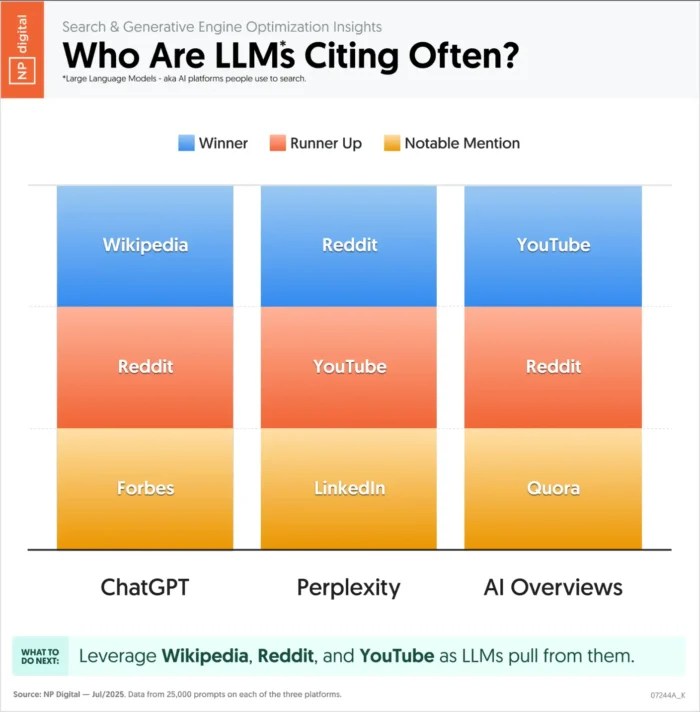
It also changes the kinds of sources search engines value. AI platforms pull heavily from community-driven sites like Reddit and Quora, along with news outlets and trusted publishers.
If your brand is only visible in your own blog, you risk being left out of those AI answers. Expanding into these other ecosystems helps both GEO and SEO.
The takeaway: SEO still builds the foundation. GEO makes sure the foundation carries into AI-driven search.
How To Make GEO and SEO Work Together
The best strategy is not choosing one. It is making them work together.
Start with a solid SEO foundation. Your site still needs clean technical performance, smart keyword targeting, and high-quality content that demonstrates topical authority.
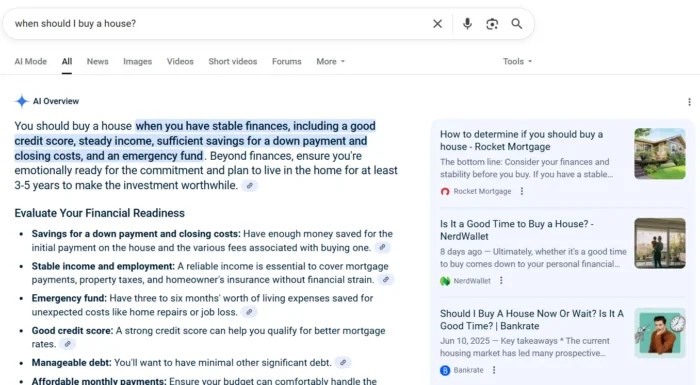
From there, layer on GEO tactics. Structure content around real questions. It’s no small surprise that when you type in “when should I buy a house?” the Google AI Overview citations align with actual questions.
Add schema where it fits. Include multimedia formats like charts, transcripts, or short videos so AI systems can interpret your work more effectively.
Do not keep your content siloed, either. Expand your presence to forums, social platforms, and multimedia channels.
That distribution helps your search everywhere optimization efforts, making sure that you’re appearing on platforms that your audience may be searching on outside of Google. This ties neatly into GEO because it gives AI engines more chances to surface your brand.
The overlap is clear: SEO helps your content get discovered, GEO helps it get included in answers. When you execute both together, you maximize visibility across traditional search and the new wave of AI-driven platforms.
FAQs
What is the difference between GEO and SEO?
SEO focuses on ranking in traditional search results, while GEO focuses on being cited in AI-generated answers from platforms like ChatGPT, Perplexity, and Google’s AI Overviews.
Do I need GEO if I already do SEO?
Yes. SEO ensures visibility in search results, but as more searches are now answered directly in AI summaries, GEO helps increase your chances of being included in those responses.
Does GEO replace SEO?
No. GEO builds on a strong SEO foundation. You still need SEO for rankings and discovery. GEO adds an extra layer to make your content usable in AI-driven outputs.
What metrics measure GEO success?
While SEO tracks rankings, organic traffic, and click-through rate, GEO success is measured by citations in AI responses, brand mentions, and visibility across AI-powered platforms.
How can businesses start with GEO?
Begin with your best-performing SEO content. Reformat it with clear headings, FAQ sections, schema markup, and question-based targeting to make it easier for AI engines to interpret and surface in their responses.
Conclusion
The GEO vs SEO debate is not about picking sides. It is about realizing they work together. SEO still drives discovery. GEO ensures your brand is part of the answer.
Ignore GEO, and your rankings may look fine while your traffic keeps sliding. Ignore SEO, and you will not have the authority or structure needed for AI engines to trust you. The opportunity is to combine both into a strategy that covers search engines and AI-driven platforms.
This shift is already showing up in user behavior. Nearly 60% of searches end without a click, a trend driven by zero-click searches and AI summaries. If your content is not built to be cited, you are invisible where people stop their journey.
It also reinforces the importance of semantic search. Both search engines and AI engines are getting better at understanding meaning, not just keywords. Content that clearly explains concepts, uses natural language, and ties ideas together stands a much better chance of being surfaced.
Start small. Update a handful of pages. Track where you appear in AI summaries and search results. Double down on what works.
The marketers who adapt early will not just keep their visibility. They will be the ones AI engines and search engines both continue to cite.
http://dubadosolutions.com/wp-content/uploads/2017/05/dubado-logo-1.png00http://dubadosolutions.com/wp-content/uploads/2017/05/dubado-logo-1.png2025-08-25 19:00:002025-08-25 19:00:00GEO vs SEO: Understanding the Differences
If you do any kind of marketing, you’ve probably come across at least one of these acronyms recently:
GEO: Generative Engine Optimization
AEO: Answer Engine Optimization
LLMO: Large Language Model Optimization
AIO: Artificial Intelligence Optimization
Here’s the truth:
They all mean essentially the same thing.
But they are subtly different from SEO (search engine optimization). This article will tell you where they’re similar, where they’re different, and what you need to know as a marketer.
SEO vs. Everything Else Explained
There might be shades of nuance between these acronyms, but the goal with all of them is the same. They all aim to optimize your (or your client’s) online presence to appear in more AI responses in tools like ChatGPT, Perplexity, and Google’s AI Mode.
Okay, so if they’re so similar: why the need for all these acronyms in the first place?
Why All the Acronyms?
The main reason we have so many acronyms like GEO, AIO, LLMO, and AEO is that AI optimization in general is still very new. This means people from all corners of marketing have been coming across new concepts, ideas, and techniques at the same time.
Naturally, people call things different names as they try to differentiate themselves from traditional SEO — and all the other new acronyms appearing on the scene.
Why do they do that?
Various reasons:
They want to appear to be at the forefront of digital marketing
Their bosses have told them they need to do it
They’re trying to offer new services in a volatile marketplace
There’s nothing wrong with any of these reasons. But it does make it confusing for the rest of us.
And it’s clear that a lot of people are searching for these new terms:
And the trends over time are clear too, as search demand for these new terms has skyrocketed in the past year:
One term in particular, “AI Optimization,” has really exploded:
Are They Replacing SEO?
Short answer: no.
Can you guess which keyword I blurred out in the first screenshot above?
That’s right: search engine optimization.
More than 40K searches each month. And the acronym “SEO”?
Almost a quarter of a million searches each month in the US alone:
(The other acronyms aren’t “mainstream” enough to use as a data point here. For example, AEO is American Eagle Outfitters, and GEO can mean a hundred different things.)
Clearly, search volumes don’t tell the whole story, but SEO is definitely still the more popular term right now.
And the Google Trend graph is the final nail in the “Is SEO Dead?” coffin:
That’s right, search demand for SEO has actually grown over the past year. But you’ll see here that “AI Optimization” is arguably “trendier” right now than SEO.
And that makes sense, because people and businesses are concerned about how to optimize for AI systems. There is a shift in the industry from pure SEO to some form of optimization for the likes of ChatGPT and AI Mode.
Businesses are even hiring for “GEO Experts”:
And agencies are pivoting to offer AI search services:
So what these acronyms are all about is a very real thing. But it’s not a complete revolution when you compare it to search engine optimization.
Quick Summary of SEO vs. GEO/AEO/LLMO/AIO
Here’s what’s actually happening. There are really only two distinct approaches, SEO vs. the rest:
Aspect
Classic SEO
AI Optimization (GEO/AEO/LLMO/AIO)
Insight
Goal
Rank high in search results
Get cited in AI-generated responses
Both matter. Create content that ranks AND gets cited.
How Users Search
Keywords and short phrases, like: “email marketing tools”
Complete questions and context: “Which email marketing tool is best for a small nonprofit?”
Research actual questions your audience asks. Don’t just rely on keywords with high search volume.
Success Metric
Click-through traffic to your site
Being quoted/referenced by AI
Go beyond website visits and start tracking brand mentions across AI tools.
User Journey
User clicks > visits your page > converts
User gets answer > may never visit your site, may click through for details, or may visit directly later
Make your brand memorable through a compelling product, service, or content — even in brief AI mentions.
Content Focus
Optimize full pages (titles, headers, meta tags)
Create clear, quotable passages that answer specific questions
Write self-contained sections. Each paragraph should make sense on its own.
Main Platforms
Google, Bing search results
ChatGPT, Claude, Perplexity, Google AI Mode, AI Overviews
You need visibility across all platforms where your audience seeks information.
Key Factors
Links and overall authority
Citations and brand sentiment
Build authority through quality backlinks AND consistent messaging everywhere.
Where Content Lives
Primarily on your website
Websites, plus YouTube, forums, and social platforms
One thoughtful Reddit comment might drive more AI citations than five blog posts.
Measurement Tools
Google Analytics, Search Console
Brand monitoring tools, AI citation tracking
Set up tracking for both classic SEO and AI visibility.
Where They’re Actually the Same (Spoiler: Almost Everything)
Despite the different names, these approaches share most of the same features and tactics:
The goal is the same: While visibility is perhaps the word you’ll see associated with success in the AI era, the goal for businesses is still to get more customers and drive revenue. Whether that’s from search engines or ChatGPT, it’s still the bottom-line number that business owners care about.
Content quality is paramount: All of these optimization methods prioritize high-quality, authoritative content. Whether you’re targeting Google’s search results or ChatGPT’s responses, you need genuine expertise and accurate information.
Structure matters everywhere: Clear headings, logical flow, and well-organized information help both search engines and AI systems understand your content. A messy blog post won’t rank well anywhere.
Authority signals are universal:Backlinks, domain authority, and expertise signals matter across all platforms. AI systems often rely on the same trust signals that traditional search engines use (although citations, not just links, matter more for AI optimization).
User intent drives everything: Whether someone types a query into Google or asks ChatGPT a question, they want a useful answer. Content that genuinely helps people will generally perform well regardless of the platform.
Where They Actually Differ (The Few Real Distinctions)
The differences between these approaches are smaller than the marketing suggests:
Links vs. citations: In traditional SEO, a big driver of your authority and whether you’ll rank is the quality of your backlink profile. In AI optimization, where you’re cited across the web matters more than just the links you have.
Traffic vs. citations: The broader business goals are still the same (to get customers and make money). But SEO is clearly more focused on driving traffic while AI optimization is, at least on the surface, about getting cited in AI responses.
Response format: Keyword-optimized, long-form content was often the winning strategy for SEO. AI-optimized content focuses on direct, quotable answers to specific questions.
Measurement challenges: You can easily track your SEO performance with tools like Google Analytics. Measuring AI visibility requires newer tools and different metrics, and it’s not always possible to accurately map out the customer journey.
But here’s what’s important: you don’t choose between these approaches. A well-optimized piece of content will perform across all these platforms simultaneously.
What This Means for Your Business
Now you know where there is and isn’t overlap between SEO, GEO, AIO, and all the other acronyms.
But what do you actually do with this information?
Content Research Gets More Complex
You can’t just look at keyword search volume anymore. You need to understand what questions people are asking AI systems and what answers those systems are currently providing.
This means your content team needs to research across multiple platforms:
You need to understand where you’re being cited and where you’re not. But you also need to understand why other sites are being mentioned. This way, you can create content that’s also more likely to get cited.
Writing Becomes Answer-First
Writers need to structure content so AI systems can easily extract quotable segments for their answers.
That means:
Descriptive subheadings
Clear transitions between sections
Direct answers early in each section
Simple language where possible
Short sentences and paragraphs
Editor’s Note: This is one that we feel quite strongly about at Backlinko. This is NOT new: it’s just good writing practice. But it is more important than ever, and if you weren’t already doing these things, you need to start now.
Content Investment Increases
Creating content that performs well across multiple search platforms requires more time and expertise. And you might even need to start creating content on different platforms too.
Why?
Because appearing in AI responses isn’t just about writing great blog posts. These tools love to reference user-generated content, forums like Reddit, and YouTube videos.
This means you’ll need to consider creating content beyond your website.
New KPIs to Track
Website traffic is still important, but it’s not the only success metric. You need to start measuring:
Brand mention frequency in AI responses
Citation accuracy across AI platforms (i.e., are the tools saying the right things about your brand?)
It’ll show your brand’s overall visibility and share of voice in AI tools like ChatGPT, Google AI Mode, and Perplexity:
You can also see how these tools perceive your brand versus your rivals:
The tool also shows you how often you’re cited compared to your competitors:
Finally, you can also find out the questions real users are asking about your industry:
You can use the AI SEO Toolkit’s insights to create and optimize your content for the questions users are asking. And you can optimize your overall visibility to ensure AI tools are saying the right things about your brand.
How to Explain It All to Your Boss/Stakeholders
Your boss and stakeholders in your business are going to hear about the likes of GEO and AIO and have questions for you. There’s no avoiding that.
This means you need to be able to explain the shift in plain business language — without the jargon and without triggering panic.
Here’s how to do it.
Lead with the Reality, Not the Acronym
Your CMO doesn’t care if it’s SEO, GEO, or AEO.
They care if your brand is visible when it matters.
Don’t start with “We need to do GEO now.” Start with “Our customers are getting answers from AI systems, and we need to make sure we’re part of those answers.”
This immediately connects to business outcomes instead of marketing tactics.
Be Honest About the Uncertainty
Don’t pretend you have a perfect read on how AI engines source answers. (Nobody does.)
Say:
“Some factors are proven — authority, relevance, clarity, and trust. Others are emerging, and we’re still testing things. Here’s what we know, and here’s what we’re learning.”
That honesty builds more trust than overconfidence.
Leadership teams have seen too many “revolutionary” marketing tactics fizzle out. Make it clear you’re being strategic, not just chasing trends.
Anchor to Business Impact
Shift the conversation from traffic to results that leadership cares about:
Revenue from organic sources
Pipeline influenced by organic visibility
Brand lift and share of voice
Cost per acquisition trends
Customer lifetime value from organic channels
Instead of saying “We need to optimize for ChatGPT,” say:
“We expect fewer casual visits but higher conversion rates from people who find us through these new channels.”
This frames the expected change as quality improvement, not traffic loss.
Highlight the Win-Win Investments
Lay out the actions that are worth investing in, no matter what:
Deeper audience research: Understanding exactly what questions your prospects ask (across all platforms) improves everything from product development to sales conversations
Answer-ready content: Content that directly addresses customer questions performs better everywhere: traditional search, social media, sales enablement, and AI systems
Brand and topic mentions in trusted sources: Getting coverage and citations from authoritative websites helps with traditional SEO, brand awareness, and AI visibility
Strong UX and review presence: Better website experience and more customer reviews can improve conversion rates, regardless of where the traffic comes from
Measuring what matters: Tracking brand mentions, share of voice, and conversion quality gives you better business intelligence for any marketing channel
These efforts are likely to work in SEO, GEO, or any other flavor of optimization. They’re just good marketing practices.
Highlighting these gives leadership confidence that you’re not betting everything on one unproven tactic. And it tells them that no matter what, these are things you should be doing anyway.
Position the Expansion as an Advantage
Make it clear this isn’t about more work for the same payoff.
It’s about capturing market share while competitors are still figuring things out:
“Most of our competitors are still focused only on traditional search. We have a 6-12 month window to establish authority in AI systems before they catch up.”
This positions your team as forward-thinking, not reactive.
Address the Obvious Concerns
You’re going to get questions, no doubt about it. Here’s how to answer the most common ones:
Question:“How much will this cost?”
Answer:“Most of the work builds on our existing content strategy. We’re expanding our definition of search optimization, not replacing it.”
Break down the investment:
Content creation (already budgeted)
New monitoring tools (modest monthly cost)
Team training (one-time investment)
Testing and optimization (part of ongoing marketing)
Question:“How do we measure success?”
Answer:“We’ll track traditional metrics plus brand visibility across AI platforms. Success means maintaining our current organic performance while building presence in emerging channels.”
Set up a dashboard that shows both traditional SEO metrics and AI citation tracking side by side. (Or use a tool like Semrush to do this for you.)
Question:“What if this is just a fad?”
Answer:“The underlying strategy — creating authoritative, helpful content and offering a great user experience — is the foundation of good marketing. We’re just making sure that our content performs well across more search platforms.”
Frame it as good marketing practices and risk mitigation, not trend-following.
When your job involves optimizing for AI systems, explaining what you actually do can be tricky. Here are a few ready-to-use scripts for different situations.
For Your Boss/Senior Stakeholders
“I’m expanding our search optimization strategy to include AI-powered platforms. We’re making sure our brand shows up when people ask ChatGPT, Perplexity, or Google’s AI Mode about our industry. The same content quality that drives our current organic success will now work across multiple new discovery channels.”
For Family and Friends
“You know how people used to only Google things? Now they ask ChatGPT or voice assistants as well, or even instead. I make sure our company shows up in those AI answers when people ask about our industry. It’s like SEO but for AI. Instead of trying to rank #1 on Google, I’m trying to get our company mentioned when AI gives people recommendations.”
For Professional Profiles (LinkedIn, Resume, etc.)
“I help companies maintain and expand their organic visibility as search evolves beyond traditional engines to include AI-powered platforms like ChatGPT, Claude, and Google’s AI Mode.”
For Prospective Clients/Customers
“We help companies get found by customers regardless of how they search — whether that’s Google, ChatGPT, or any other AI tool. Our approach combines traditional SEO with optimization for AI systems that are increasingly answering customer questions.”
For Industry Peers/Conferences
“The fundamentals of search optimization haven’t changed — authority, relevance, and user value still matter. But we’re now optimizing for systems that synthesize information rather than just ranking it. A lot of the tactics are familiar, but the platforms we’re optimizing for are expanding.”
How to Thrive in the AI Era of Search
Whether you call it SEO, GEO, AIO, or LLMO, the fundamentals of optimization and creating great content don’t change.
The goals shift a little, and how you measure success will differ compared to pure SEO.
But how you win in the AI era of search just requires an evolution of how you were doing things before.
To stay ahead of the game, check out these resources for more information:
http://dubadosolutions.com/wp-content/uploads/2017/05/dubado-logo-1.png00http://dubadosolutions.com/wp-content/uploads/2017/05/dubado-logo-1.png2025-08-25 13:41:012025-08-25 13:41:01SEO vs. GEO, AEO, LLMO: What Marketers Need to Know
If you’ve noticed your organic traffic shrinking even though you’re ranking well, you’re not imagining it. AI-driven engines like ChatGPT, Perplexity, and Google’s AI Overviews are answering questions before people click any links.
Generative engine optimization is how you fix this. It’s the practice of shaping your content so these AI systems pull it into their responses. Instead of someone getting a generic AI answer, your brand becomes part of that answer.
I’ve watched too many marketers ignore this shift because their SEO dashboards still look decent. The real problem? Clicks are happening inside the answer box now. If you want to stay visible where decisions actually start, you need GEO working alongside your traditional SEO.
Key Takeaways
Generative engine optimization puts your brand in AI answers, making your content easier for AI platforms to find, understand, and cite.
Search is no longer just about website links. People are getting answers from AI summaries without ever clicking to a website.
Traditional SEO still matters, but it’s not enough. GEO works alongside SEO to keep you visible in both search results and AI-generated responses.
Early adopters win the visibility battle. The sooner you adapt, the better your chances of being a source AI engines trust.
GEO is a new skillset for marketers. GEO requires smart keyword usage, creating strong E-E-A-T signals, and producing content formats AI can process.
Generative Engine Optimization Definition
Generative Engine Optimization (GEO) is how you shape your content so AI-driven platforms can easily pull it into their answers. These platforms don’t work like Google’s ranking algorithm. They combine semantic search with large language models to generate responses, pulling from sources they trust. Instead of giving you a list of website links, they often just give you the answer.
That changes everything. You’re not just trying to rank high anymore. You need to be a source the AI engine chooses to include. GEO builds on SEO basics like clean site structure, strong topical authority, and keyword alignment, but adds a layer focused on how AI systems interpret and present your expertise.
Why Generative Engine Optimization Is Important
AI-driven results are now part of search. Google’s AI Overviews, Bing’s Copilot, and platforms like Perplexity deliver full answers right in the results. Users often don’t click anything.
Nearly 60% of U.S. and EU searches end without an external click, according to SparkToro’s 2024 zero-click study. For marketers, that means less traffic from rankings alone.
GEO gives you another path. Structure your content so AI platforms can cite it, and you still get visibility even if users never leave the results page. In a zero-click world, being part of the answer matters as much as being part of the rankings.
How To Implement Generative Engine Optimization
GEO isn’t a single tactic. You’re better served treating it as a set of evolving practices that make your content easier for AI engines to find, interpret, and use in their answers. Like SEO, it combines strategic content creation, technical optimization, and authority building.
The next sections break down the core areas to focus on, starting with brand authority and moving through technical and content-based strategies.
Build Brand Authority
AI engines pull answers from sources they trust. If they don’t know you or can’t verify your expertise, you’re less likely to get cited.
Start by making your author profiles work harder. Put a name and face to your content, and back it up with credentials or proof you’ve done the work. Use examples from your own experience, share data you’ve collected, and show insights that are hard to fake.
Don’t stay in your own bubble. Get your name and brand into respected publications in your industry. Offer quotes, share original stats, or write guest content for sites your audience already trusts. Our VP of SEO, Nikki Lam, for example, is a regular contributor to Search Engine Land.
The more these connections appear online, the stronger your authority signal becomes, and the better your odds of showing up in AI-driven answers.
Show experience by sharing real examples, case studies, and first-hand insights. Make your expertise visible with clear author attribution, relevant credentials, and links to other respected work you have done. Build authority through backlinks from reputable sites in your field. Strengthen trust by being transparent with tactics like using HTTPS, list contact information, and publish accurate, well-sourced data.
Treat E-E-A-T as a checklist for every piece of content you publish. While not a direct ranking factor, it consistently improves your chances of performing well and increases your chances of showing up in tomorrow’s AI-generated results.
Reinforcing Your Site’s Technical SEO
If search engines cannot crawl, index, and understand your site, AI engines will not either. Technical SEO is the backbone that supports both.
Keep your site fast. Optimize images, reduce unused code, and use a content delivery network (CDN) if you have a global audience. Make sure your site works well on mobile and passes Core Web Vitals benchmarks. Use a logical URL structure and internal linking, so important pages are easy to find.
Regularly run site audits to catch broken links, duplicate content, or indexing issues before they hurt your visibility. Tools like Google Search Console, Screaming Frog, and Ubersuggest can make this part easier. The cleaner your technical setup, the better your chances of being surfaced in both search results and AI-generated answers.
Write Like People Talk
AI search engines handle queries differently from traditional search engines. People type full questions, not just keywords, into AI searches. To match that, your content needs to read like a direct answer.
Use long-tail, conversational phrases that mirror how someone would ask the question out loud. Include common “who,” “what,” “where,” “when,” and “how” formats in your headings and subheadings. Break down complex answers into short, scannable sections so AI can easily extract them.
Skip the keyword stuffing. Focus on clarity and context instead. Your content should sound like something a real person would say. That makes it more likely to align with how AI models interpret and deliver answers.
Moving Beyond Text
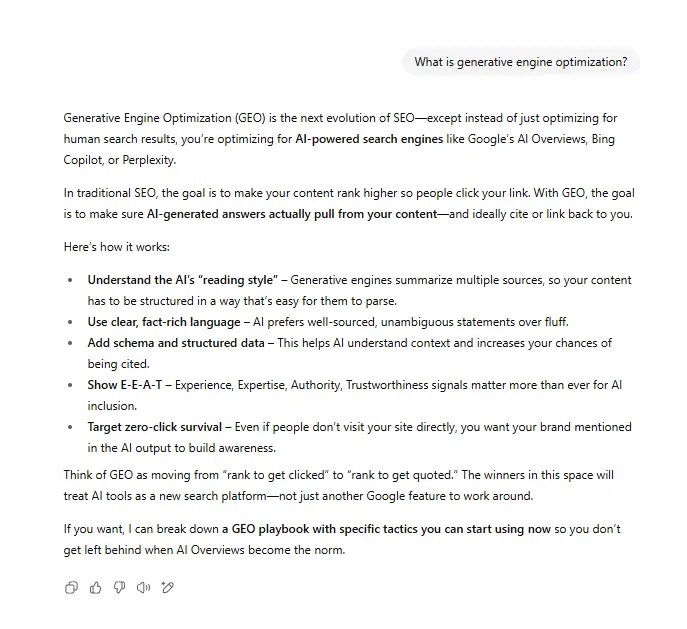
AI engines do not just pull from written articles. They can reference videos, podcasts, and visual content when it adds value to the answer. That means your expertise should show up in multiple formats. Certain types of videos are more likely to get citations, as you can see from the example below.
Add original images, charts, and infographics to explain complex points visually. Short videos or audio clips that summarize key takeaways from your content are valuable as well, but there’s some added nuance here. Right now, AI isn’t listening to podcasts or watching videos. It extracts info through optimizations like meta data, alt text, structured data, and captions. When all that’s done, host them on platforms like YouTube or as embedded media on your site so they are easy for AI search engines to find, like the example below..
Diversifying your formats helps you reach audiences who prefer to watch or listen, and it gives AI more ways to surface your content. If you are only publishing text, you are leaving potential visibility on the table.
Use Digital PR to Build Expertise
Digital PR is one of the fastest ways to build the kind of authority AI engines look for. When trusted publications, influencers, or industry sites talk about your brand, those mentions strengthen your credibility.
Pitch guest articles or expert quotes to sites your audience already reads. Share original research or unique data that journalists can cite. Monitor platforms like HARO or Qwoted for opportunities to contribute insights on relevant topics.
The goal is consistent, high-quality mentions across the web. Over time, this builds a visible footprint of credibility that tells AI models your expertise is recognized beyond your own website, making you a stronger candidate for citation in generated answers.
Vary Content Distribution
AI tools do not only pull from traditional websites. They scan public content on forums, Q&A platforms, and social channels. If your brand shows up in those spaces, you give the engines more opportunities to connect your name to your expertise.
Join relevant discussions on platforms like Reddit, Quora, and niche industry forums. Share insights, answer questions, and link to deeper resources when it adds value. Repurpose your blog posts into short LinkedIn updates or Twitter threads so your ideas travel beyond your own site.
The more your expertise appears across different platforms, the more signals AI engines have to work with, and the more likely they are to surface your content in their answers.
GEO and Search Everywhere Optimization
Search is no longer confined to Google. People look for answers on social media, YouTube, forums via AI searches and more. Search Everywhere Optimization is about showing up in all of those places.
Map out the platforms your audience uses most, then adapt your content for each one. That could mean shorter video explainers for social, structured Q&A formats for forums, and well-formatted long-form articles for web search. The more channels you optimize for, the more resilient your visibility becomes. GEO extends this strategy by making your content easy for AI systems to cite.
The Future of GEO
Search is changing fast, and GEO is going to change with it. Here are three shifts you cannot ignore if you want to stay in front of your audience.
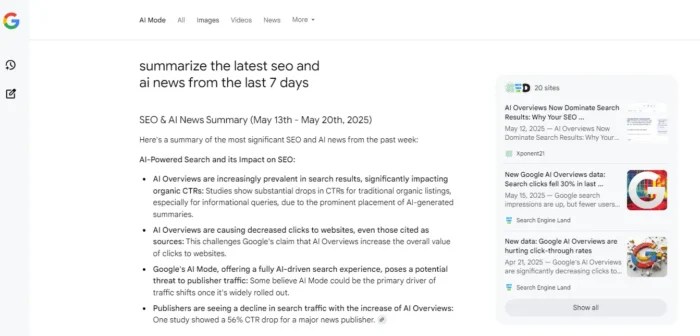
AI Mode in Google Google is testing AI Mode that gives people a complete AI-written answer before they ever see a list of website links. If this approach becomes permanent, those AI boxes will be the first thing people read — and if your brand is not in them, your visibility will shrink dramatically. To compete, you need content that is structured, well-sourced, and easy for Google’s systems to pull into those summaries.
Predictive and Multimodal Search Search is evolving to work ahead of the query. Predictive tools deliver answers based on a user’s behavior, location, and history. Multimodal search lets people combine text, images, and video into one request. To show up here, your content has to work in every format: clear copy, keyword-rich image descriptions, transcripts for videos, and structured data that connects it all together.
Voice and Visual Search More people are asking questions out loud to their phones or smart speakers. Others are pointing their camera at an object and letting a tool like Google Lens do the searching. To win here, you need natural, conversational answers for voice search and highly detailed, optimized, context-rich visuals for image search.
GEO is not standing still, and neither should you. Keep an eye on where people are searching, watch how AI answers are built, and adapt. The brands that move with the trend will keep showing up, no matter how search results evolve.
FAQs
What is generative engine optimization?
Generative engine optimization (GEO) is the process of creating and structuring content so AI-driven platforms, such as ChatGPT, Perplexity, and Google’s AI Overviews, can easily find, interpret, and cite it in their answers.
How is GEO different from SEO?
SEO focuses on improving rankings and visibility in traditional search results extends beyond that by targeting AI engines, ensuring your content appears in AI-generated answers.
Do I need to change my existing SEO strategy for GEO?
Not entirely. GEO builds on a strong SEO foundation. If your technical SEO, site structure, and content quality are already solid, the next step is formatting and distributing content in ways that AI systems can process and trust.
What types of content work best for GEO?
Clear, well-structured, and factually accurate content that answers specific questions tends to work best. Adding supporting data, original research, and multimedia formats can increase your chances of being cited.
How can I track GEO performance?
Tools in this area are still emerging. Some companies, like Profound, have technology specifically to help brands measure performance in LLMs and AI search. Additionally, there are traditional SEO tools that are expanding their capabilities. For example, Semrush now reports on AI Overview rankings in addition to standard SERP results.
Conclusion
GEO isn’t a “later” project. It’s already reshaping how people find information, and every month more searches are ending inside AI-generated answers. If your brand isn’t showing up there, you’re losing visibility you might not get back.
The shift is in how you present and distribute that expertise so AI engines can understand and trust it. That means stronger E-E-A-T signals, content in multiple formats, and a presence in the places your audience is asking questions.
You don’t have to overhaul everything at once. Start with your highest-value content, make it more AI-friendly, and track where it appears.
Trusted contributors get invited back and land bigger features faster.
-Send thank-yous
-Offer value beyond the pitch
-Track warm journalist relationships in a simple CRM
For instance, let’s say you’re a B2B SaaS marketer trying to rank a key feature page.
Look for HARO or Qwoted queries where the topic aligns with the problem your product solves.
If you can offer a helpful, relevant perspective — one that happens to mention your company or approach — that’s a win. Even if the link doesn’t show up right away.
The bottom line?
When you know what wins you’re aiming for, you’re far more likely to hit them.
Greg Heilers, co-founder of Jolly SEO, puts it simply:
“Depending on your criteria, writing skill, and site/figurehead optimization, you can achieve a win as frequently as 1 in every 3 pitches.”
Step 2: Establish Realistic Expectations (This Will Save Your Sanity)
Most people give up on journalist outreach too soon.
Not because the tactic doesn’t work — but because their expectations are wildly off.
They expect quick wins, a high response rate, and instant SEO impact.
The reality is slower, less glamorous, and a lot more sustainable if you approach it with the right mindset.
Typical Success Rates (and What to Expect Over Time)
Even top-tier media outreach experts don’t land every pitch.
For beginners, a 3–5% response rate is normal. As you gain experience, that can climb to 8–12%, and with refined systems and strong positioning, 15–20% is achievable.
That means you might need to send 10–30 pitches just to earn one mention.
This isn’t failure — it’s the math behind consistent results.
So, what does that actually look like over time?
Month 1: You’re learning the workflow. Scanning opportunities, testing your messaging, and getting familiar with the process. Landing even one or two mentions is a meaningful start.
Month 3: You start to see patterns. Which types of queries are worth your time. Which angles tend to get picked up. You might even get quoted by the same journalist twice.
Month 6: You have momentum. Pitches get easier. You might even start getting inbound requests from writers who’ve seen your previous contributions.
The payoff builds slowly — but it compounds.
Beyond the byline: Search is evolving fast. Journalist quotes are now surfacing in tools like ChatGPT, Perplexity, and Claude. If you’re featured in a top-tier article, there’s a real chance your name, company, or insight will show up in AI-generated answers.
Why Most Pitches Fail (And It’s Not Your Fault)
The biggest myth in journalist outreach is that great writing is enough.
Spoiler: It’s not.
Journalists get dozens — sometimes hundreds — of pitches for a single request.
Many already have sources in mind.
Others are on tight deadlines and go with the first relevant response they see. If your pitch arrives an hour late, it might not get opened at all.
This doesn’t mean your pitch was bad. It means timing and fit beat polish more often than not.
Step 3: Set Up Your Inbox and Tracking
The fastest way to burn out in journalist outreach?
Drowning in irrelevant pitches, deadlines you’ll never meet, and inbox chaos.
Here’s the good news: A few quick workflows can save you hours a week and help you stay consistent over time.
Make Your Emails Credible at a Glance
Journalists scan dozens of emails a day, and first impressions matter.
A polished inbox setup instantly signals trust and professionalism.
Include:
Branded email address: Avoid generic Gmail accounts when possible. Use a domain-linked email to show legitimacy.
Uploaded headshot: Many platforms now require it
Branded signature: Add your name, title, company, LinkedIn, and a link to your website. Make it easy for journalists to verify who you are.
You don’t need a huge platform. You just need to look like someone worth quoting.
Build a Simple Filtering System
Start by organizing your inbox to reduce the cognitive load.
Create folders or labels by platform (e.g., “HARO Outreach”), and add filters to automatically route incoming queries.
Then, block off 15-minute review windows, no more than three times a day.
You don’t need to monitor your inbox all day — just be consistent.
Use the “5-second scan” rule: if it’s not clearly relevant within a few seconds, archive and move on.
Use Fast, Practical Qualification Criteria
Not every opportunity is worth your time — and trying to pitch everything will tank your efficiency.
For each request, ask:
Is this in my area of expertise? If not, don’t force a fit. Weak relevance leads to ignored pitches.
Do I meet the specific requirements? Many queries ask for certain job titles or credentials. Skip it if you’re not eligible.
Is the deadline realistic? If you can’t hit the cutoff, don’t let it clog your pipeline.
Is the publication worth your time? Not every outlet will align with your goals. Use your win criteria (from Step 1) to filter.
For instance, if you’re a freelance content strategist, a request asking for insights from “Fortune 500 CEOs” is a clear pass.
Save your effort for a request that matches your actual experience.
Step 4: Choose Your Platforms Strategically
Not all journalist outreach platforms are created equal.
Some are great for quick wins. Others shine when you’re targeting high-authority publications or niche audiences.
The key isn’t choosing the platform with the most opportunities — it’s choosing the one that aligns with your actual goals.
That means considering more than just volume.
You’ll want to look at average link quality, pitch-to-publication turnaround, cost, and whether the requests match your expertise.
Note: We’re gathering updated data on additional platforms like Qwoted and will expand this comparison in future updates.
Platform
Best For
Avg DR
Cost
Turnaround
Featured
Easy wins, building confidence
70
Free/Paid
23 days
Help a B2B Writer
B2B content, SaaS brands
73
Free
44 days
ProfNet
Premium publications
79
Paid
39 days
HARO
Broad topics
76
Free/Paid
37 days
Source of Sources
Niche expertise
81
Free
35 days
Don’t feel like you need to master every platform out of the gate.
Start with one or two that align with your goals, get really good at using them, and expand once your workflow is dialed in.
How to Choose the Right Platform (Fast)
Not sure where to start? Think of this as your cheat sheet for getting started.
Just getting your reps in? Start with Featured — it’s simple, fast, and great for building confidence early.
Need high-authority links that actually move rankings? Go with Qwoted — it consistently surfaces high domain rating (DR) opportunities from recognizable media outlets.
Want placements in premium, name-brand publications? Choose ProfNet — fewer opportunities, but often higher caliber if you have the budget.
Targeting marketers, founders, or SaaS buyers?Help a B2B Writer delivers curated, niche-relevant requests in your exact lane.
Need a high volume of relevant opportunities to work with?Source of Sources gives you a steady stream of niche pitches — just be ready to filter.
Looking for general-topic visibility at scale?HARO still delivers breadth and quantity — just expect to dig for quality.
Looking for country-specific platforms?
Many regions have their own journalist request tools worth exploring. For example, SourceBottle is widely used in Australia, and ResponseSource is popular among PR pros and journalists in the U.K.
Just try a quick Google search like “journalist request platform [your country].”
You’ll usually uncover a few local options — no massive directory needed.
Step 5: Write Pitches That Win (Without Taking Forever)
The best pitches don’t win because they’re long or clever.
They win because they’re skimmable, useful, and immediately quotable.
Your job isn’t to impress the journalist — it’s to make their job easier.
Establish Credibility in 8 Words or Less
Start with a strong subject line. Greg emphasizes combining relevance with instant credibility.
Use this structure:
Subject line formula: [Your credentials] + [specific value] + [topic]
Examples:
SaaS CEO’s Take on Fixing Churn
SEO Consultant’s Local Link Playbook
Copywriter’s Formula for High-Converting Headlines
Then, build your pitch. It should look something like this:
Hi [first name],
I’m [name], [title] at [company]. [One-line credibility builder].
Pro tip: AI tools can help you brainstorm angles — but the final quotes should sound human, specific, and ready to publish. Use AI for speed, not substitution.
Make Your Quotes Instantly Usable
Journalists aren’t grading your writing.
They’re looking for clean, usable quotes they can drop straight into a draft.
As Greg puts it:
“Journalists want quotes they can immediately copy and paste into their articles, no changes needed.”
Here’s how to make that happen:
Pro tip: For the full checklist — and why each step matters — use the Pitch Checklist tab in our journalist outreach toolkit.
Not all pitches are created equal.
Here’s what gets picked up — and what gets ignored.
❌ Bloated, vague, and completely unusable:
✅Clear, specific, and quote-ready:
Pitch Faster Without Losing Quality
Greg recommends prewriting as much as possible so you’re never starting your press outreach from scratch.
Have 3–4 versions of your bio ready to go, tailored for different beats (e.g., SaaS, marketing, AI).
Build a few quote templates for your most common talking points. And give yourself a hard limit: Aim to finish each pitch in 10 minutes or less.
The more reps you get, the easier this becomes.
Don’t forget your first line does heavy lifting. It shows up in inbox previews and often determines whether your pitch even gets opened. Make it count.
Caveat: Structure helps, but sameness kills. AI tools and mass pitching have flooded inboxes with lookalike answers. Don’t just fill in a template — say something only you would say. That’s what gets quoted.
Yes, You’re Qualified. Here’s Why.
One of the biggest blockers in journalist outreach? Thinking you’re not “qualified” to respond.
But here’s the truth: You don’t need a blue checkmark or a book deal to be helpful.
If you can help readers understand something better or offer a useful perspective, you’re already ahead.
Credibility doesn’t mean status. It means relevance.
That could be your job title, your years of experience, a client result, or just a smart way of framing the problem.
When in doubt, try this five-part framework to surface story ideas from your own work:
The situation: What were you working on?
The challenge: What made it tricky?
Your approach: What did you try or test?
The result: What changed? What worked?
The insight: What do you wish you’d known earlier?
The bottom line?
If you’ve solved what they’re writing about, you belong in their inbox.
Step 6: Master the Follow-Up (Without Being Annoying)
It’s tempting to send a pitch and move on.
But following up is one of the easiest ways to multiply the value of your efforts.
It’s low-effort, high-return, and totally underused.
The key is to keep it respectful, useful, and brief. Here’s how to do it without sounding pushy.
Turn Mentions Into Links
Let’s say you’ve been quoted but not linked.
Here’s a simple, polite ask that turns visibility into real SEO value:
Hi [Name],
Thanks so much for including me in the [article title]!
If it’s possible to link my company name to [URL], that would be amazing—but I totally understand either way. Appreciate your great work on this piece.
Best, [Name]
Turn Replies Into Relationships
The journalists who quote you today could become recurring collaborators — if you give them a reason to remember you.
Hi [Name],
Loved your recent piece on [topic]. Your point about [specific insight] really resonated.
I’m always happy to contribute insights on [your expertise areas] if you’re working on related stories.
Best, [Name]
Done right, a follow-up turns one good pitch into long-term visibility, stronger links, and a journalist who might actually remember your name.
Step 7: Find Hidden Wins (Most People Miss These)
You might already be getting results — and not even know it.
“People message me and say, ‘I’ve sent dozens of pitches, but I can’t get any wins. What am I doing wrong?’
My first question is always: ‘Have you tried looking for them yet?’”
The good news?
You don’t need expensive tools or a manual content audit. A few smart searches and a weekly routine are all it takes.
Use Google Search Operators
Advanced search syntax lets you find live mentions with precision. Run these searches weekly to uncover wins:
“Your Name” + “Your Brand Name”
“CEO of [Brand]” site:targetpublication.com
“[Your unique quote]” site:[domain]
Use quotes to force exact matches and ”site:” to limit the search to specific outlets.
Set Up Google Alerts
Track new mentions passively by creating alerts for:
Your name + company
Your job title (e.g., “CMO of Backlinko”)
Distinctive quotes or phrasing you tend to use
This won’t catch everything, but it will help surface a steady stream of new wins.
Manual Checking Schedule
Most people stop after they hit “send.”
But Greg estimates you’ll never be told about 90% of your wins.
So if you don’t go looking, you’ll never even know they happened.
Build a simple check-in routine:
Weekly: Run your branded Google searches
Monthly: Review recent articles from journalists you’ve pitched
Quarterly: Use SEO tools (like Ahrefs or Semrush) to spot backlinks or citations
Pro tip: Use the Win Finder (in the toolkit) to uncover hidden mentions.
Step 8: Build Your Journalist Network
Every pitch is more than a one-time shot at a link — it’s the start of a potential relationship.
If a journalist quotes you once, there’s a good chance they’ll want insights from you again.
But only if you make it easy, relevant, and respectful to stay in touch.
Track Relationships Like You Track Links
Use a simple CRM (even a spreadsheet works) to track journalist contacts the same way you’d track sales prospects:
Name + outlet
Contact info + beat
History (quoted, linked, mentioned)
Relationship stage (cold, warm, repeat, advocate)
Last contact date + next follow-up
If you’ve contributed to multiple stories or gotten links from the same writer, mark them as high-priority for future outreach. These are your warmest leads.
Build Trust Without Pitching
You don’t need a quote request to stay visible.
In fact, the best relationship-building moments often happen when you’re not asking for anything.
Promote their articles on social with a thoughtful comment — not just a tag. If you come across a story angle or source that fits their beat, send it their way.
If they mentioned a topic they’re covering next month, follow up. Even better: introduce them to another trusted source in your network.
These small, useful gestures build familiarity over time.
That’s how you become more than a random inbox name. You move from pitching to being pitched.
Pro tip: Use our Outreach CRM Tracker (in the toolkit) to start tracking pitches and wins instantly.
Step 9: Measure and Prove ROI
If you’re investing time, you need to show what it’s worth — to your team, your stakeholders, or your clients.
That means going beyond raw link counts and telling the full story of impact.
Track What Matters
Link counts are a starting point, but they’re not the whole picture.
Look at which platforms consistently deliver wins, how many hours go into each link, and which journalists become repeat collaborators.
Track your mentions, even when there’s no link.
Watch for traffic spikes after a story goes live, and pay attention to whether rankings improve on pages earning coverage.
For example, if a single article mention leads to a 12% lift in branded search and earns a backlink to your pricing page, that’s clear momentum.
When you combine reach, effort, and outcome, you start to see the full return.
Use a Simple ROI Framework
When you need to quantify results for stakeholders, use this basic formula to translate time and effort into value:
Link Value = (Average link cost in your industry) × (number of links)
Time Investment = (Hours spent) × (Your hourly rate)
ROI = (Total link value – Time investment) / Time investment × 100
For example:
You earned five links in a month — all from DR 70+ publications.
Let’s say the average market cost for that caliber of link is $800, and you assign a DR adjustment factor of 1 (used to reflect link quality; 1.0 = solid, relevant fit):
Link value: $800 (avg. link cost) x 5 links = $4,000
Time investment: 12 hours × $100/hr = $1,200
ROI: ($4,000 – $1,200) / $1,200 × 100 = 233%
Now compare that to sponsored content, digital PR retainers, or even PPC — and suddenly, this starts looking like a serious channel.
Build a Stakeholder-Ready Report
The final piece is packaging your results in a way that stakeholders understand and care about.
Keep it simple, visual, and focused on outcomes:
A summary of links earned by domain authority range
Growth in brand mentions across media and social
Traffic lift or ranking movement tied to earned placements
Estimated link value compared to paid alternatives
A standout example or case study from that month
When stakeholders can see the momentum — not just the metrics — they’re far more likely to stay bought in.
Start Earning Links That Actually Matter
You’ve got everything you need to get started. Now, it’s time to make your move.
http://dubadosolutions.com/wp-content/uploads/2017/05/dubado-logo-1.png00http://dubadosolutions.com/wp-content/uploads/2017/05/dubado-logo-1.png2025-08-20 13:30:372025-08-20 13:30:37Journalist Outreach: How to Earn High-Authority Links in 9 Steps
Google announced it will shut down the Content API for Shopping on Aug. 18, 2026, officially making the Merchant API the new standard for managing Merchant Center accounts.
Why we care. For over a decade, advertisers and retailers have relied on the Content API to push product data into Google Shopping. The new Merchant API promises a simpler, more powerful way to control how products appear across both organic and ad surfaces – but it means developers and PPC teams need to start planning migrations now.
Details:
The Merchant API has been available in beta since May 2024, but is now generally available.
Google describes it as a “simplified interface” for scaling product feeds and gaining programmatic access to data, insights, and unique capabilities.
It will serve as the primary tool for product data management, spanning both paid and organic listings.
What’s next. The Content API remains available until August 2026, but Google urges advertisers to migrate sooner.
Help docs are live to guide developers through the transition.
Expect growing forum chatter as advertisers share migration challenges and best practices.
Bottom line. If your ecommerce business relies on the Content API, the clock is ticking. Moving to the Merchant API isn’t optional, and early adopters may gain a smoother path to scaling feeds and campaigns.
https://i0.wp.com/dubadosolutions.com/wp-content/uploads/2025/08/Google-Shopping-Ads-Google-Ads-VSHoy9.jpg?fit=1920%2C1080&ssl=110801920http://dubadosolutions.com/wp-content/uploads/2017/05/dubado-logo-1.png2025-08-19 15:26:462025-08-19 15:26:46Google replaces Content API for Shopping with new Merchant API
Is the number of clicks on your top-ranking content starting to slip? It’s time to find out where your traffic has gone and how to get it back.
AI Overviews are reshaping SERPs as we know them. Google now answers user queries directly in the SERP, and traditional blue links are getting pushed further down the page. You might still be ranking, but your visibility is shrinking.
This doesn’t mean SEO is dead. It just means the playbook has changed. To stay competitive, you need to understand how AI Overview optimization works and start building content designed to earn those coveted AI citations.
Key Takeaways
AI Overviews are rerouting traffic, not killing it. Your rankings may hold, but clicks drop because Google satisfies user intent directly in the SERP.
Answer-first content wins. Structuring pages with concise answers, logical headings, and clear formatting increases your chances of being cited in AI Overviews.
Authority signals matter more than backlinks. Brand mentions, topical trust, and consistent visibility across multiple platforms influence AI citations.
Owning your audience is your safety net. Diversifying channels and building first-party data ensures long-term visibility, even as search behavior evolves.
Why You’re Ranking But Still Losing Traffic
If your content still ranks in the top 10 SERP positions but traffic is slipping, there’s a good chance AI overviews are the culprit. Google’s AI-generated summaries dominate the top of the page, pushing organic listings below the fold. Users get the answer they want without ever clicking. In fact, almost 60% of Google searches end without users even making a single click.
You can see from this screenshot that when your search results load, there’s no organic results in site. In fact, in this instance, AI overviews even push sponsored results below the fold. This is the new reality of zero-click searches. Impressions might look steady, but clicks drop because users can satisfy their intent without leaving Google.
The solution is to stop thinking only in terms of traffic volume. Start focusing on visible influence: appearing in AI Overviews and being recognized as an authority, even when users don’t click.
AI Overviews And How They Are Turning The Funnel Upside-Down
Traditional search funnels start with discovery, move to consideration, and end in conversion. AI Overviews flip that script.
Users can start—and sometimes finish—their journey right on Google. With features like AI-generated summaries and featured snippets, the need to click through is lower than ever. Voice search and even short-form video integrations accelerate this shift, creating an environment where Google does the explaining for you.
For marketers, this means clicks are no longer the whole story. Your content has to deliver more than just clicks. It needs to capture attention inside the SERP and give users a reason to engage when they do click through. Strong on-page structure, engaging CTAs, and retention strategies like scroll-depth optimization now matter just as much as ranking. This is the essence of Search Everywhere optimization, which focuses on meeting users wherever they’re consuming content, not just on your site.
How To Optimize For AI Overviews
If you want your content featured in AI Overviews, you need to create pages that are easy for Google to summarize and trust. Here’s how to give Google what it wants:
Lead with an answer-first layout: Open your page with a concise, 2–3 sentence answer to the core query. This immediately gives AI a clear takeaway, increasing the odds of being cited in an overview. Expand into supporting details afterward with a logical flow.
Use structured formatting: Break your content into clean H2s and short paragraphs so Google can scan and interpret it quickly. Bulleted and numbered lists help AI extract step-by-step processes or summaries.
Add schema and FAQs: Implement FAQ and How-To schema to highlight your key answers for AI. Include a short FAQ section at the end of your article to increase your odds of citation for question-based queries.
Target long-tail, conversational keywords: AI Overviews thrive on natural, question-based searches. Integrate these phrases into headings and early sentences to align with how users talk to search engines and voice assistants.
Publish fresh, authoritative content: Share unique insights, proprietary data, or first-hand expertise to meet E-E-A-T signals—experience, expertise, authority, and trustworthiness. AI favors credible, original content over generic summaries.
Support with media: Embed YouTube videos, charts, or screenshots to improve engagement and reinforce authority. Use descriptive alt text so search engines can understand and reference your visuals.
Combining structure, authority, and clarity makes it easy for AI to pull your content and keep your brand visible in the new SERP landscape.
YouTube and Video: Your Shortcut to Visibility
Video content—especially on YouTube—is one of the fastest ways to gain visibility in AI Overviews. Google and Gemini favor YouTube because it’s part of their ecosystem, and AI models naturally pull from sources they already trust.
Short, keyword-focused videos can surface in AI-generated results even if your text content isn’t cited. A 60–90 second explainer video that directly answers the search query gives AI a clean snippet to work with while also boosting your chances of appearing in video carousels.
The charts below show just how effective video is. They show the categories of YouTube videos that have shown up in AI overviews and how fast the trend of videos showing up in AI overviews has grown over time.
Create concise, educational videos tied to core keywords.
Embed them on relevant blog posts or landing pages to reinforce topical authority.
Add captions or transcripts so AI models can understand and summarize your video content.
Video can reclaim lost search visibility while building multi-surface authority across AI-driven and traditional search.
Off-Page Signals Matter More Than Backlinks
In the age of AI Overviews, Google and AI models are looking beyond traditional backlinks. They increasingly value off-page signals like brand mentions and expert quotes in reputable sources.
AI models evaluate whether your brand is recognized and trusted across the web. A mention in an industry publication, a quote in a news article, or a stat cited in a whitepaper can be as impactful as a link for AI visibility.
To strengthen your off-page signals:
Pursue public relations (PR) opportunities in industry-relevant media and blogs.
Share original data or research that journalists and peers want to reference.
Encourage brand discussions on platforms like LinkedIn, Reddit, and Quora, which AI crawlers frequently mine. Internally, we’ve seen tremendous growth for our client, TurboTax, by helping them launch a branded Reddit campaign—including discussions and engagement.
The goal is to create a trustworthy footprint online. When AI sees your brand cited in multiple credible sources, you’re far more likely to be included in its summaries, even without a traditional backlink.
Build Topical Trust Across the Web
AI Overviews reward brands that show consistent authority on a topic, not just one-off content. Google and AI models look for a pattern: Are you producing relevant, high-quality content across multiple platforms that reinforces your expertise?
To build topical trust:
Publish blog posts, guides, and FAQs that cover your key themes in depth.
Share insights across social media and YouTube, giving AI more signals that your brand is active and authoritative.
Leverage user-generated content (UGC), like community discussions, testimonials, and real-world examples, to demonstrate authenticity.
Ensure your content aligns with E-E-A-T across every channel.
Maintaining a consistent and credible presence wherever your audience searches makes it easy for AI to recognize your brand as a reliable source. That recognition is what creates a trustworthy brand footprint that AI can work with.
You Need to Diversify Your Channels Now
Relying solely on Google for traffic is riskier than ever. The shrinking SERP visibility caused by AI overviews and zero-click searches means that even top-ranking content might not deliver the same ROI it once did.
To protect your brand, you need to diversify your traffic sources:
Combine SEO and paid search to maintain visibility and retarget your most valuable branded keywords.
Invest in social media, email, and YouTube to capture attention outside of Google.
Build a strategy that prioritizes owning your audience instead of depending on any single platform.
Diversifying channels doesn’t just protect your current visibility. It’s a great way to grow your online brand. A strong multi-channel approach captures leads you might otherwise miss, making you less vulnerable to Google’s constant evolution. Ultimately, the brands that thrive in the AI era are the ones that meet their audience everywhere, not just in search results.
When AI Overviews dominate search, the brands that win are the ones creating proprietary insights that can’t be found anywhere else. AI models favor content that provides original data because it signals authority and adds value beyond generic summaries. Internal research is your secret weapon.
Instead of relying solely on public stats, collect your own:
Run audience surveys to uncover trends or opinions in your niche.
Conduct polls or quizzes to generate quick, shareable insights that can be repurposed into blogs and social posts.
Analyze internal data like customer behavior, conversion trends, or product usage to produce unique reports.
Turn these findings into case studies and data-driven articles. Proprietary insights make your brand more likely to appear in AI Overviews and attract backlinks and press coverage, compounding your authority across the web.
FAQs
How do I optimize for AI Overviews?
Start with an answer-first structure: give a concise response in the first 2–3 sentences, then expand with supporting details. Use a clear structure with H2s and bulleted lists so Google can easily scan and summarize your content. Implement FAQ or how-to schema, and include a dedicated FAQ section to match AI’s preferred Q&A format. Fresh, authoritative content supported by brand mentions and backlinks will boost your chances of being cited.
How are AI Overviews changing the SERPs?
AI Overviews now dominate the top of Google results, pushing organic listings further down the page. This creates more zero-click searches, where users get answers without visiting your site. Even if your rankings haven’t changed, your visibility and clicks may decline. Making AI-friendly formatting and multi-channel strategies more important than ever.
Conclusion
There’s no need to panic. AI Overviews aren’t erasing traffic, they’re simply rerouting it. Your pages may still rank, but when Google’s summaries dominate the top of the SERP, visibility doesn’t always translate into clicks. The old playbook of relying on impressions and top rankings isn’t enough anymore.
To win in this era of search, your SEO strategy has to include AI overview optimization. Content needs to be structured for AI-first discovery, with clear answers and logical formatting that gains LLMs’ trust. Now, success is about building influence. When your brand appears in AI Overviews and consistently reinforces topical expertise, you maintain visibility even when users don’t land on your site.
The final step is ownership. Diversifying channels and leveraging Search Everywhere optimization gives your brand resilience, while first-party data ensures you can nurture and convert your audience on your own terms. If done right, AI can be your biggest opportunity, not just a threat.
http://dubadosolutions.com/wp-content/uploads/2017/05/dubado-logo-1.png00http://dubadosolutions.com/wp-content/uploads/2017/05/dubado-logo-1.png2025-08-19 13:21:002025-08-19 13:21:00Where Did My Traffic Go? Winning In The Age of AI Overviews