What Is Trendjacking & How to Do it for Your Brand

Do you remember the viral “Little Miss?” meme revival from 2022?

That’s a great example of trendjacking, or inserting your brand into viral online conversations.

It felt like every brand — from global airlines to your local coffee shop — jumped into labeling themselves. Some were hilariously on-point and others…well, not so. For every well-executed moment like a wellness brand that tailored their take to be timely, irreverent, and match their core voice, dozens more missed the mark. And like it or not, audiences can tell.

That’s the fine line with trendjacking. What was once a cheeky social media trick has become a high-stakes play for many modern social media marketers. To stand out and not alienate, brands need more than speed. They need emotional intelligence, audience awareness, and restraint to not jump on every viral moment.

How can you harness what’s trending without sounding tone-deaf or jumping the shark? Let’s break down the basics of effective trendjacking and how you can approach it in a smart way.

Key Takeaways

  • Trendjacking is the practice of inserting your brand into viral conversations in a way that feels timely, relevant, and authentic.
  • Success requires cultural awareness, audience alignment, and speed. Not every trend is right for every brand.
  • Smart brands use social listening tools and planned content workflows to catch trends before they peak.
  • Measuring trendjacking goes beyond likes. Look at sentiment shifts and meaningful engagement.
  • The future of trendjacking will likely be shaped by AI tools, new platforms, and the growing demand for authenticity.

What Is Trendjacking?

Trendjacking is the practice of injecting your brand into a popular or viral conversation to boost visibility, engagement, or relevance. Brands jump on trending topics like memes, social media challenges, or major pop culture moments to join the conversation in ways that are timely and clever.

Trendjacking really gained traction during the heyday of Twitter (now X), when brands like Oreo seized viral moments (the “You can still dunk in the dark” tweet during the 2013 Super Bowl blackout) and earned massive engagement for real-time creativity. That post was a signal to marketers that being culturally responsive could pay huge engagement dividends. 

An Oreo Cookie post on Twitter.

Trendjacking isn’t a completely new strategy, though. It has its roots in the older PR strategy of newsjacking. Popularized by David Meerman Scott, newsjacking focused on inserting brands’ perspectives into breaking news stories to get media coverage. Trendjacking is just an evolution of that strategy, tapping into a broader range of online moments. 

When you do it well, trendjacking can help your brand show personality, relevance, and humor. But it’s not a strategy without risks, especially if you do it without considering nuance or alignment to your brand’s values.

How to Pull off an Effective Trendjacking Campaign

Let’s say you’re ready to drive into trendjacking. How do you do it right? Like many effective social media strategies, the best trendjacking campaigns start long before a trend even surfaces. Success often hinges on preparation and cultural awareness, but the real secret is the agility to act fast without sacrificing your brand’s integrity.

Identify Potential Trends

Trendjacking starts with awareness. The earlier you spot a trend, the better your odds of leading the conversation rather than chasing it.

Start with traditional sources. Social listening tools such as AnswerThePublic, TikTok Creator Search Insights, or Sprout Social can surface what’s gaining traction across different platforms. The latter can help you keep an eye on places like X, Bluesky, TikTok’s trending page, Reddit threads, and even Google Trends to stay ahead of the curve. Using these tools doesn’t just tell you what’s trending. They help you catch the wave before it crests.

Effective trendjacking goes deeper than identifying meme formats or hashtags, though. Ask yourself these questions:

  • Why is this trending?
  • What emotion is it tapping into?
  • What cultural shift or behavioral insight is at play?

Take, for example, the “Girl Dinner” trend. It wasn’t just a meme. It was a commentary on autonomy, wellness fatigue, and the pushback against curated perfection.

In addition to staying on top of developing trends, think ahead. Certain events almost always spawn viral moments: award shows, the Met Gala, political debates, and major sporting events are excellent fodder for trends. Develop a calendar of these events and build a properly resourced team that can act when the internet lights up.

Assess the Trend’s Relevance

Before you jump into the trend, assess whether or not it’s right for you. Ask important, hard questions, like “Does this trend actually align with our brand?” and “Will our audience care?” Finally, will it feel authentic or forced?

Many brands falter here. Chasing a trend that’s off-brand does more than fall flat; it risks damaging your credibility. The Duolingo x Scrub Daddy “cursed collab” worked because both brands share a quirky, unfiltered tone. If a serious financial brand tried the same joke? Cue the confused and cringing followers.

Assess risk, too. Some trends carry baggage, like political undercurrents, social controversies, or rapidly shifting sentiment. Your internal team should include diverse perspectives to help flag possible missteps.

Beyond relevance, hopping on the trend should add to your brand’s story. If it doesn’t connect to your values or content pillars, it might be better to skip it. Not every viral moment is worth jumping into. Restraint is often what separates trend-chasers from trend leaders

Produce the Content—Quickly!

Once you’ve vetted a trend, it’s “go time.” Timing is everything in trendjacking. Wait too long, and you’re just adding noise to an already crowded feed.

In practice, your team needs a streamlined workflow to move from idea to pressing the publish button in hours, not days. Empower social managers with decision-making autonomy. Maintain a library of pre-approved assets like brand visuals, fonts, and tone examples so your team can capitalize on trends without needing to create a full-scale design from scratch.

Creating internal “trend kits” or rapid response playbooks can help your team execute quickly and safely. Remember: the most memorable trendjacks feel both spontaneous and strategically on-brand because they are.

Creating Impactful Trendjacking Content

Once you’ve identified the right trend and confirmed it makes sense for your brand to participate, the real magic begins: creating content to hit the sweet spot of relevance, creativity, and authenticity. Not every trendjacking post needs to be laugh-out-loud funny or ultra-slick, but it should always bring something fresh and on-brand to the table. Some tried-and-true strategies for creating trendjacking content that resonates include:

1. Customize by Platform

What works on TikTok might not work on LinkedIn, and vice versa. Tailor your content’s tone, format, and visuals to the platform you’re posting on. Wendy’s built their brand on X with snarky one-liners, but the food chain takes a more curated and visual approach on Instagram.

A Wendy's tweet series.
A Wendy's Instagram reel.

2. Embrace the Weird (Strategically)

Humor, absurdity, and left-field creativity often fuel viral trends. But you can’t force it. Duolingo’s TikTok presence leans fully into weirdness, but it’s consistent with their edgy, millennial-savvy voice.

Add Value. Don’t Just Copy

Don’t simply copy-paste a trending meme format. Add your brand’s POV, a clever twist, or insights that enhance the original. For example, Canva recently leveraged the app’s ability to create color schemes with the growing popularity of Labubu toys.

A Canva Labubu ad.

4. Prioritize Authenticity

Your audience can smell a cash grab a mile away. If the trend doesn’t align with your values or voice, skip it. If you really feel like you need to participate, subtly nod to the trend without trying to dominate it. Engage, like, or reply to accounts that have posted content in the trend without creating new assets on your own.

5. Keep the Content High-Quality

Even in a fast-moving trend cycle, visuals (and sound) matter. Low-res graphics or clunky text overlays can kill your momentum. Use templates or pre-approved brand assets to keep things polished under pressure.

r/funny - graphic design is my passion.

Trendjacking is not the time to let the copywriter have the keys to the Canva account.

When Trendjacking Goes Wrong…

Trendjacking is a real double-edged sword. When done right, it’s clever, memorable, and engaging. When done wrong, it’s also memorable, but for the wrong reasons; it’s tone-deaf, confusing, or even damaging to your brand. Avoid these common pitfalls.

Tone-deaf or Insensitive Posting

Some trends are tied to serious or sensitive events, and misjudging the tone can result in intense backlash. That’s what happened to Pepsi in 2017 for their ad that featured Kendall Jenner, which co-opted protest imagery to sell soda (and promptly got called out for trivializing real social movements).

Just because a topic is trending doesn’t mean it’s safe territory. Assign someone on your team to assess social sentiment and cultural context before engaging.

Jumping in Too Late

Timing is critical. A trend that peaked two days ago may already feel stale, especially if your post doesn’t add anything new. Joining late makes your brand look like it’s scrambling to stay relevant, not leading the conversation.

To avoid this, consider streamlining your approvals process and having brand-safe assets ready to go.

Misunderstanding the Trend

One of the fastest ways to make a brand look out of touch is to misinterpret the trend altogether. Imagine someone at your company wanted to tweet a meme that referenced “Netflix and chill,” without realizing its NSFW subtext. The internet might notice and not in a good way.

Before trendjacking, do a quick sentiment check. What does this trend actually mean to the people participating in it?

Forcing the Fit

If the trend doesn’t suit your brand voice, values, or audience, don’t force it. It’s painfully obvious when a B2B SaaS brand shoehorns itself into a Gen Z meme format meant for fashion or pop culture. This usually results in low engagement at best and audience cringe at worst.

Brands need a straightforward internal process for evaluating the risk of trendjacking campaigns. Who gets to greenlight? What criteria does the content meet? Building a lightweight risk assessment checklist or review board (creative + legal + DEI leads) can help you act quickly and responsibly.

Lack of Crisis Planning

Even with the best of intentions, things can go sideways fast. That’s why it’s smart to develop a basic crisis response protocol before engaging with fast-moving or culturally sensitive trends. Know who will respond, how quickly, and what steps to take if content sparks backlash. 

Measuring Success and Finding Learnings for the Future

With your trendjacking content out in the world, it’s time to answer the big question: Did it work?

Start by measuring the basics: likes, shares, reach, and impressions. These top-level metrics help assess immediate visibility and initial audience reaction.

Smart marketers go further, though. The most impactful trendjacking efforts don’t just rack up views. They strengthen brand equity and move the needle on meaningful outcomes. Ask yourself:

  • Was the engagement meaningful? Analyze the sentiment and depth of conversation in your engagement. Did people share it with thoughtful comments or tag their friends, or was the engagement just a flood of indifferent likes?
  • Did it shape perception or sentiment? Use social listening tools to see if brand sentiment improved during and after the campaign. Google Analytics and UTM parameters can help tie social moments back to web traffic and conversion goals.
  • Did it drive real behavior? Track clicks, sign-ups, or sales lifts during and after the campaign. This is another instance where Google Analytics and UTM parameters can help tie those moments back to web traffic and conversion goals.
  • Did it strengthen community? Great trendjacking does more than entertain. It builds a sense of belonging. If the post sparked DMs, follow-up content ideas, or user-generated content (UGC), that’s a sign your audience is invested.

Want to level up your campaign? Try aligning your trendjacking posts with keyword-focused content or campaign themes. This gives your SEO strategy a boost, especially in a world where Search Everywhere is the norm (and users can Google the trend and stumble onto your brand).

Upcoming Trendjacking Trends

The art and science of trendjacking will only evolve as the digital landscape shifts. Marketers who want to stay ahead of the curve will need to keep a pulse on what’s trending and how those trends take shape and spread. The future of trendjacking will evolve thanks to things like AI, new platforms, and the rise of “unpolished” realness.

1. AI-powered Content Creation

AI is creating massive shifts in real-time marketing as tools like ChatGPT, Midjourney, and Runway help brands generate reactive content faster than ever. From clever captions to custom visuals, the future of trendjacking likely includes AI-enhanced creativity. The big challenge for brands is to remain authentic in the face of automation.

A social chatbot interaction creating an Instagram ad for Labubu.

Could ChatGPT help brands jump on the enthusiasm for Labubu without spending the time to go out and source a doll? Possibly.

2. New and Niche Platforms

Instagram, TikTok, and X may reign supreme among platforms, but that won’t always be the case. Bluesky is becoming increasingly popular, and YouTube Shorts has challenged TikTok as a vehicle for short-form video content creation. Expect trendjacking to require more platform-specific fluency, understanding not just the content but the culture of each channel.

3. The Rise of “Unpolished” Realness

Consumers are tired of overproduced content. The next wave of trendjacking will favor brands that show up with honesty, humor, and heart. Even if that means posting something that feels more lo-fi than high-concept. Authenticity isn’t just a “nice to have” anymore. It’s a prerequisite for engagement.

A bobespizza Instagram ad.

Bobe’s Pizza may be a small Indiana brand, but they lean on authentic content that resonates with their core audience.

The bottom line is that the future of trendjacking isn’t about being fast. It’s about being fast, smart, and real while building systems to let your brand respond with agility and intention.

FAQs

What is the difference between trendjacking and newsjacking?

While both strategies involve jumping into timely conversations, the difference lies in what you’re responding to. Newsjacking is about inserting your brand into breaking news stories — typically through PR or expert commentary — while trendjacking taps into broader online trends, like memes, pop culture moments, or viral challenges. Trendjacking is more social and creative, whereas newsjacking is often more formal and media-facing.

What is an example of trendjacking?

A classic example is Oreo’s “You can still dunk in the dark” tweet during the 2013 Super Bowl blackout. The brand reacted in real time with a witty graphic and caption, and the internet loved it. More recently, brands like Ryanair and Duolingo have gone viral for trendjacking TikTok memes using their unique, offbeat brand voices. The key to successful trendjacking? Speed, creativity, and cultural fluency.

What is the trendjacking strategy?

When done well, trendjacking helps brands increase visibility, boost engagement, and connect with audiences in a culturally relevant way. It shows your brand has personality and a pulse. Beyond racking up likes, the real value comes from building brand affinity, sparking conversations, and staying top-of-mind in an increasingly noisy digital space.

Conclusion

Trendjacking is about moving fast and smart. When you do it right, it can drive massive visibility and deepen brand affinity. It takes planning, awareness, and a clear voice to avoid the pitfalls and stand out in the scroll. Whether it’s memes, moments, or movements, show up with purpose.

If you need help crafting an agile social strategy that’s authentic and audience-focused, contact NP Digital to help you lead the conversation, not just follow it.

Read more at Read More

How to prep your Shopify or WooCommerce store for Black Friday before the rush starts  

Black Friday is the biggest rush of the year for most ecommerce businesses, and it is right around the corner. The most successful merchants prepare for Black Friday early and follow a structured plan to prepare their stores, ensure visibility, and convert first-time visitors into long-term customers.

This guide breaks down your preparation into three categories: Basic, Intermediate, and Advanced. Each section builds on the last so that you can grow your readiness over time, regardless of your team size or budget.

Basic: Start with what you can control for Black Friday

These actions lay the groundwork for everything else. Without these, no advanced strategy will stick.  

1. Optimize your metadata  

First impressions matter, and your metadata is the first thing users see in search results. So make it count and leave a lasting impact. 

Why it matters: Strong metadata can improve visibility and attract more clicks. When your titles and descriptions align with what shoppers seek, your chances of standing out rise significantly.  

Actionable tips:  

  • Prioritize metadata for high-traffic products and category pages.  
  • Include seasonal keywords such as “Black Friday deals” or “holiday gift ideas.”  
  • Keep titles and descriptions concise and compelling.  

With Yoast SEO for Shopify and Yoast WooCommerce SEO, you can preview and improve your metadata in real time. The tools flag missing or duplicated fields and guide you on how to write content that earns clicks.  

  2. Optimize product pages for both humans and search engines

Product pages are the moment of truth. They’re where curiosity turns into clicks and clicks turn into customers.  

Why it matters: No matter how great your traffic or ads are, most people will leave without buying if the product page feels confusing or incomplete. A well-structured page improves your chances of ranking in search and helps buyers feel confident in their decision.  

Actionable tips:  

  • Lead with benefits, not just specs. Tell shoppers how the product fits into their lives.  
  • Use bullet points and headers to make details skimmable.  
  • Reinforce trust by showing stock levels, customer reviews, and delivery clarity.
  • Bulk update how you showcase your product on Shopify using Yoast SEO for Shopify Content Templates feature.

Yoast WooCommerce SEO and Yoast SEO for Shopify help your product pages appear cleanly and clearly in search results. They add structured data behind the scenes and check your content for SEO and readability so you can focus on turning visitors into buyers. 

3. Use internal links to guide traffic  

Internal linking guides customer to surface key pages, maps user behavior, and boosts your site’s SEO. 

Why it matters: Internal linking helps search engines understand your site structure, distributes authority to key pages, and guides visitors toward high-converting content. It keeps users engaged, supports SEO, and makes your promotions easier to surface across your site.  

Actionable tips:  

  • Link to your Black Friday page from key blogs and evergreen content.  
  • Feature top categories or bestsellers in your navigation.  
  • Use anchor text that aligns with what users are searching for.  

Yoast WooCommerce SEO offers internal linking suggestions as you write, making keeping your content connected and strategic easier. 

Fast wins and common pitfalls

Once you have set up the basics, some steps can help you boost impact quicker and avoid costly missed opportunities. 

Fast wins:

  • Swap stock photos for original product shots 
  • Double-check coupon logic and expiration dates 
  • Test any gift wrap or personalization options on product pages 

Big pitfalls to avoid: 

  • Waiting until November to publish seasonal content 
  • Using duplicate product descriptions from suppliers 
  • Letting broken links or outdated pages remain live 

Intermediate: Strengthen your SEO and campaign strategy  

Once the technical foundation is stable, it’s time to focus on your content and promotions.  

4. Test and improve your site’s speed  

Site speed directly impacts user experience, especially during high-traffic periods like Black Friday. Slow-loading pages frustrate shoppers and lead to lost sales.  

Why it matters: A fast site supports smoother browsing and quicker checkout. Search engines consider page performance in rankings, and users are more likely to buy when the experience feels seamless.  

Actionable tips:  

  • Use performance monitoring tools to identify slow pages.  
  • Compress and resize large images to reduce page load times.  
  • Deactivate unused plugins (WooCommerce) or apps (Shopify).  
  • Clean up excessive code or bulky page elements.  

While Yoast SEO is not a speed optimization tool, clean site structure and proper internal linking help improve crawlability and engagement, indirectly supporting performance. 

5. Create a focused Black Friday landing page  

Your landing page is the command center for your seasonal promotions. It’s where visitors decide to browse further or bounce. 

Why it matters: A dedicated page gives your Black Friday campaign direction and cohesion. Instead of scattering your offers across the site, it provides a clear path for shoppers to follow. It simplifies navigation, allows for better internal linking, and gives you a consistent, trackable URL for email campaigns, ads, and site banners. Plus, it’s reusable! Just update the content each year.  

Actionable tips:  

  • Create a short, memorable URL like /black-friday-deals and keep it live year-round.  
  • Showcase limited-time offers, bundles, top-selling categories, and exclusive discounts.  
  • Use persuasive headers, quick-loading images, and CTA buttons that lead directly to product pages.  
  • Answer common buyer concerns upfront, e.g., shipping deadlines, return windows, and local pickup options. 

6. Segment your email list and automate flows  

Email isn’t just another marketing channel during Black Friday; it’s your direct line to customers ready to buy.  

Why it matters: Blasting the same message with monotonous tone to everyone no longer works. Crafting compelling emails with personalized messages that resonate with the reader is key to email marketing. People are more likely to open, click, and shop when an email speaks to their pain points and highlights the solution. A segmented email list means you’re talking to people based on what they care about: early access, bundles, or a product they viewed or left in their cart.

Actionable tips:  

  • Break your list into clear segments, e.g., loyal customers, cart abandoners, and holiday-only shoppers.  
  • Map out your flow: teaser email, early access offer, launch announcement, final hours.  
  • Track performance with UTM parameters like utm_campaign=bf25 so you can optimize in real time. 

For more on syncing content and email, check out our basics of email marketing blog post.

7. Create content that helps people find your deals earlier  

Buyers don’t always search for discounts. Many start with questions or ideas like “affordable gifts for coworkers” or “best tech gift under $100.”  

Why it matters: Helpful blog posts and gift guides pull in people who aren’t searching for your brand yet. These early touchpoints introduce your products and lead them toward your Black Friday offers.  

Actionable tips:  

  • Write guides and roundups tied to real shopper intent.  
  • Use long-tail keywords that match seasonal search habits.  
  • Add smart internal links to featured products or your Black Friday landing page. 

Fast wins and common pitfalls

Once your product pages are polished, tighten up the surrounding details.

 Fast wins:

  • Set a calendar reminder for your campaign email and social media schedule 
  • Add an announcement banner linking to your Black Friday page 
  • Test your email signup and welcome flow to catch any issues 

Big pitfalls to avoid: 

  • Forgetting to link email campaigns to relevant landing pages 
  • Using inconsistent messaging and UTMs across channels 
  • Launching your Black Friday page too late for indexing and ranking 

Buy WooCommerce SEO now!

Unlock powerful features and much more for your online store with Yoast WooCommerce SEO!

Get Yoast WooCommerce SEO Only $178.80 / year (ex VAT)

Advanced Black Friday preparation: Boost visibility, trust, and retention  

If you’re already doing the essentials well, these strategies will help you scale.  

7. Improve your chances of showing up in local search  

If you offer in-store pickup or have a physical store, don’t miss out on the people searching near you. Shoppers looking for same-day purchases often skip past online-only stores.  

Why it matters: When someone searches for a product near them, being present in the results can drive instant foot traffic and build trust before they even walk in.  

Actionable tips:  

  • Ensure your name, address, and phone (NAP) are identical across all pages and listings.  
  • Update your opening hours and add clear pickup instructions.  
  • Add content to your site that mentions your location, city, or neighborhood.  

Yoast Local SEO is included in the Yoast WooCommerce SEO. It helps you create and manage local schema and landing pages that appear in search. (It is not available for Shopify.)  

8. Use structured data to stand out in search  

When someone searches for a product and your listing shows price, availability, or reviews, that’s not luck. That’s structured data.  

Why it matters:  Rich snippets give your products more space in search results, credibility, and clicks.  

Actionable tips:  

  • Add structured data (schema) for Product, Offer, and Review to top-selling listings.  
  • Use Google’s tools to check that your schema is implemented correctly.
  • Use product variant schema to improve your chances of showing in rich search results.

Yoast SEO for Shopify and Yoast WooCommerce SEO automatically adds this, but you can also fine-tune it for special products or campaigns if needed.  

9. Set up post-purchase flows before the sale starts  

Black Friday may be over at checkout, but it’s just the beginning of your relationship with a new customer.  

Why it matters: People who buy during Black Friday often need reassurance and support. They’re far more likely to come back if they feel taken care of.  

Actionable tips:  

  • Set up automated flows for thank-you messages, setup tips, and review requests.  
  • Offer a discount for a second purchase or referral.  
  • Guide people back to your product pages or Google review profile.  

Taking care of this now means you can focus on fulfillment and service during the Black Friday rush. 

Fast wins and common pitfalls

A thoughtful follow-up and last check make sure you build on opportunities and are ready for what might come your way.

 Fast wins: 

  • Recheck your sitemap to ensure new pages are indexed 
  • Update your business hours and contact details in your footer 
  • Enable review requests to trigger automatically post-purchase 

Big pitfalls to avoid: 

  • Making last-minute technical changes with no buffer 
  • Ignoring mobile performance and checkout testing 
  • Overlooking schema validation or broken structured data 

Final thoughts  

Preparing for Black Friday is about being proactive, not reactive. Every SEO improvement you make now, from product pages to local visibility, will help you attract more shoppers and turn clicks into customers.  

Yoast gives you the tools to stay ahead: clearer product listings, stronger search visibility, and smart automations that scale with your store. Whether you’re using Shopify or WooCommerce, optimize now to be ready before the crowds arrive.  

Explore:

The post How to prep your Shopify or WooCommerce store for Black Friday before the rush starts   appeared first on Yoast.

Read more at Read More

Holiday season SEO: 10 tips to start preparing!

The summer is well on its way. Should you already start preparing for Black Friday and the holiday season? Yes! They’re the biggest sales of the year, and ranking in Google is something you take time to do. It’s never too early to start getting your deals ready. So, if you are a merchant with an online store or an ecommerce business, let’s start working on your holiday season and Black Friday SEO immediately!

Don’t forget that Black Friday (November 28, 2025) and Cyber Monday (December 1, 2025) are kicking off this year’s holiday shopping season. You can set up a lot of content for all occasions. In this post, we’ll review some things you can do to prepare!

Holiday shopping this year

Today, people are used to shopping online. It’s easy and convenient. You don’t have to travel only to find something out of stock. Plus, online stores often offer payment plans. Shopping online is so popular that online sales during the holiday season keep hitting record after record. And the numbers will only continue to rise. That’s why it’s safe to assume that people will buy many (if not most) holiday gifts online this year.

Staying on top of trends to prepare for the holiday season is good. E-commerce is still growing, and consumers expect more every year. Here are some actionable tips for the upcoming Black Friday and holiday season to improve your SEO:

  1. Discount deals and alternative payment options (Buy now, pay later) should be part of your ecommerce strategy
  2. Brands should provide a consistent purchasing experience across digital/online and physical stores
  3. To minimize returns, brands should make their product pages as comprehensive as possible
  4. Holiday season marketing campaigns should be tailored to each platform to ensure maximum effectiveness

Online is where it’s at

Of course, in-store or curbside pick-up will still prove popular. However, most people research their ecommerce purchases online – sometimes weeks in advance! So don’t be surprised when the holiday shopping season starts well before Black Friday and continues for weeks.

Extending Black Friday, Cyber Monday, and other holiday season online deals for a few days or weeks can be a good idea. This is especially true if you want to prevent huge crowds from gathering at your store on a specific day. That won’t be a good shopping experience for anyone involved, so spreading these deals over an extended time is probably better.

Start preparing in time

Dive into the data you amassed during previous Black Friday and Cyber Monday events, and see if you can come up with improvements for your e-commerce holiday season SEO. Bear in mind that it takes a while for content to rank. So, to keep up with the competition, try to get your content in gear at least 45 days ahead. That’s often recommended. Of course, you can always start preparing earlier if that works better for you. Your schedule could look something like this:

  1. 45 Days in advance: Post your promotion to your website calendar and post a save-the-date post on social media and in your email newsletter.
  2. 7 Days in advance: Post upcoming events/promotions on social media and via email. Try to encourage other (small) businesses to share it with their followers.
  3. 1 Day in advance: Post an event reminder on social media.

It’s a good rule to remember these steps and time frames. However, you can do much more than set up new pages and renew old ones. Let’s look at a few practical tips.

1. Do holiday season keyword research

Keyword research is important all year, but especially during the season when your online store starts having big sales. You have probably worked on this research previously, but now is the time to dive in again. There are always things to learn, like developments in your industry, changes in consumer behavior, or new trends and topics to discuss.

Start early with your research to give yourself enough time to produce high-quality, helpful content that helps reach those new audiences. While using generative AI tools to generate holiday season SEO content for your e-commerce business is enticing, please be careful with that. Generative AI can help you do your job, but it can’t replace your valuable insights and opinions.

Do look into using Yoast SEO to optimize your content for LLMs like ChatGPT and Gemini.

2. Set up holiday season gift pages

First, we must consider what category or particular landing pages make sense for the upcoming holidays. You can always set up pages like ‘Best gifts for parents/millennials/teens’, ‘Newest deals for your 6/10/12-year-old’, and ‘Best friend/grandparents/coworker discounts’. You could also think of ‘Top 10 gifts for outdoor/skiing/parasailing enthusiasts’ and ‘Top 3 deals for stay-at-home parents’, etcetera.

Make sure the page titles and meta descriptions of these gift landing– or category pages fit the upcoming holiday season. You can reuse these gift pages for Hanukkah or your summer sale. Find (old) content that fits the holidays, rewrite titles and meta descriptions to match the upcoming season, and chances are you won’t have to do that much work to get them up to date. Be sure to write proper product descriptions and improve the product images. Learn how to write great product descriptions using our product-specific analysis in WooCommerce SEO and Yoast SEO for Shopify.

To increase the chances of your gift pages ranking, boost their internal linking structure. You can also link the previous all-year holiday season pages, such as specific Christmas landing pages (‘Top 7/10/25 gifts for under the Christmas tree’) to boost these when the time has come. That could be around the 45-day mark, but we would be okay with stretching that to 60 days. You’ll need to give Google and other search engines enough time to follow your links and find your specific holiday season SEO landing pages with deals.

3. Promote on social media and in your newsletter

Social media like X and Instagram can play a massive role in the success of your (online) Black Friday sale. Take Pinterest, for instance. Many people have a Pinterest Christmas wish list. As a merchant, it would be amazing to get your products on people’s wish lists, which can positively impact your reach and maybe even your sales.

While you’re at it, don’t forget to share your Black Friday gift pages on Facebook and other social media. Maybe even make short videos to post on TikTok. In the previous section, we mentioned the top ten lists. We all know these still work pretty well on social media. Yoast SEO can help you optimize your social media posts before you share them.

Email marketing

Last but not least, remember your email marketing! For many companies, newsletters provide a steady stream of income. Be sure to plan a good campaign for your newsletters.

For example, we recommend setting up holiday gift guides and sharing these. You can create an excellent overview of many gifts that many people will enjoy. ELLE and Target have pages like that, and so do more companies.

4. Introduce new products

The holiday season is an excellent time to pitch new products. If you know of potential bestsellers for the upcoming holiday season, start writing content about these products now. You can compare it to tech sites writing about concept iPhones, features that Apple might add, etc.

The more you write about new products upfront, the more likely the sales pages for these products will rank when it matters. You should link all pages you made in advance to that one main page you’ll set up when the product is released and available to buy. Treat that page like cornerstone content.

5. Add structured data to your product pages

When adding or changing your product pages to fit the holiday season, don’t forget to optimize them. Check, for instance, whether you’ve added structured data to your product pages. Rich results that show ratings and prices can give you an edge over your competitors. Our WooCommerce SEO plugin, Local SEO plugin (included in Yoast SEO Premium), or Yoast SEO for Shopify app can help you do this to improve your holiday season!

an example of a google search result for a product, in this a listing of a PlayStation 5 sold by Walmart
Example of a product appearing in the search results if you use structured data.

Read more: Structure data with Schema.org: the ultimate guide »

6. Check your product feeds

Don’t forget to optimize your e-commerce product feeds for Black Friday and holiday season SEO. This maximizes visibility and sales during this high-traffic online shopping period. Start by ensuring all product information, such as titles, descriptions, prices, and availability, is accurate and up-to-date. Check if the products that need them have relevant Black Friday keywords to enhance discoverability. Use high-quality, clear images to showcase your product.

Use the promotions feature in Google Merchant Center to prominently display special deals and discounts for Black Friday and Cyber Monday. This way, you’ll make your offers more attractive to potential buyers. Please update your feed regularly to reflect real-time inventory changes and fix errors to maintain product visibility.

7. Reuse content

There’s no shame in serving old wine in a new bottle. If you have a Black Friday or a Christmas gift guide for 2024, feel free to reuse it in 2025. Update the year and details like popular brands and products for that year. If the slug of your URL is /black-friday-guide-2024/, change it to /black-friday-guide-2025/ around August next year, and redirect the old URL to the new one. No need to create a new page. It would be a waste of nice inbound links not to reuse that old URL. Of course, this is even easier if you don’t include the year in the URL, so /black-friday-guide/ is also an excellent slug.

In the months before the holiday season, you could even simply repost popular posts from last year (a bit adjusted or updated if needed) on social media. Valentine’s Day might even become Secret Santa. Cyber Monday might match your child’s favorite gifts for Ramadan. These are probably small adjustments; perhaps just adding ‘this Ramadan’ to a meta description or title will do.

Keep reading: Should I update or delete old content? »

8. Optimize for page and user experience

It’s a good idea to check and optimize your website for speed and mobile use. Trust us; you’ll get these recommendations from an SEO blog or consultant daily. And with good reason! Mobile, site speed, and user experience are essential to get people to spend money on your ecommerce business this Black Friday. When preparing your online store for the holiday sale season, this is as good a time as any to check your mobile website and site speed, and update or improve them if possible.

To start, look at Google’s Core Web Vitals and use these to improve your site. Here are five ways to boost your Core Web Vitals scores.

Read on: How to check site speed »

9. Local business? Focus on local SEO

Investing in local SEO for Black Friday and Christmas shopping is essential for local businesses aiming to attract more customers. Begin by optimizing your Google Business Profile with accurate business information, including address, phone number, business hours, and any special Black Friday/Cyber Monday hours or promotions. Encourage satisfied customers to leave positive reviews. Use local keywords in your content, focusing on terms your community will likely search for, such as “Black Friday deals in [Your City].” Additionally, engage with your local community on social media by promoting special deals to drive more foot traffic to your store.

10. Create a measurement plan

All set? Remember to make a measurement plan to analyze your success. Write down all your plans, then think about how to track all your actions. This is key to knowing what to focus on next year. For detailed instructions on analyzing your Black Friday, Cyber Monday, or Cinco de Mayo shopping, read our post with five tips to measure your holiday sales success.

What should you do when the holiday season is over?

How do you handle the product pages of holiday gift sets after the holidays? Even if the gift set or product was a great success, and you want to offer it again next year, it’ll take a while for the page to be relevant again. What is the best way to deal with these pages in the meantime?

Our advice: Keep the pages up. However, you don’t necessarily want them visible to people browsing your site. So, have the page up without linking, then link to it again during the holiday season. This is better than deleting it and starting again.

Conclusion on holiday season SEO

In short, now’s the time to buckle down and start writing holiday gift pages and content for new products. Remember to plan your social media promotion and analytics. After all, you can never start too early when your online business depends on the holiday season. Be prepared; begin now with your SEO. Good luck with your holiday season sale!

Keep on reading: eCommerce usability: the ultimate guide »

The post Holiday season SEO: 10 tips to start preparing! appeared first on Yoast.

Read more at Read More

AI in Marketing: How It Works + Examples

If you’re not using AI in marketing, you’re already falling behind. Artificial intelligence (AI) tools are becoming more and more prominent, and many have functions specifically designed to help marketers better promote their products and services.

Throughout this article, we’re going to dive deeper into what AI in marketing looks like, sharing the benefits of taking advantage of AI, how AI can be used in marketing, plus some AI marketing tools to get you started.

Key Takeaways

  • AI can provide a number of benefits for your marketing team, like speeding up tedious tasks, providing you with better insights, and boosting your overall results.
  • You can use AI as part of your content planning and creation process, to gather competitive insights, to improve your customer service, and more.
  • There are a number of AI tools that can help you automate processes and streamline your strategy.

Benefits of Using AI in Marketing

Why should you incorporate AI into your marketing strategy? There are so many benefits that these tools can bring to your team—if you use them right.

Speed Up Processes

AI can help marketers speed up processes and spend less time conducting certain tasks manually. According to HubSpot’s State of AI Report, 79% of marketers agree that AI helps them to spend less time on manual tasks, showing just how valuable these new tools can be.

Improve Personalization

AI can analyze customer data at scale, helping you to gather more insights and understand how to better personalize your content and segment your audience. Better personalization can provide your business with better results from your marketing campaigns.

Better Insights

Because AI can analyze data more effectively than humans can, you can get better insights. For example, AI analysis can help you identify trends earlier, forecast sales and customer behavior more efficiently, and help your marketing team make better decisions.

Cost Savings

Incorporating AI tools into your team’s daily processes can save time and resources, resulting in cost savings within your marketing budget. While AI shouldn’t replace core human workers, there are certain tasks that it can take off their plates, letting them focus on things that actually impact your business’s bottom line.

Higher ROI

Because AI tools can help your marketing team better understand customers, personalize campaigns, and ship better content, you’ll see a higher return on investment (ROI) as a result. Start using AI within your day-to-day marketing tasks to see how it can help improve your performance.

How AI Works With Marketing: 9 Use Cases

Because AI is a newer technology, you might not be sure how it works with marketing quite yet. However, there are a number of key use cases that AI can help with.

  • Content planning: AI chatbots can be a huge help in brainstorming content ideas. Tell the chatbot about your business and your overall content goals and ask for topics that you may not have covered yet. You can then run the ideas through an SEO tool to find top keywords to center your content around.
  • Content creation: While AI shouldn’t be handling the entire content creation process, it can still provide some assistance. Get help creating a comprehensive outline, get ideas for your introduction, or get AI to start with a summary that you can expand on.
  • Marketing automation: Incorporate AI tools into your marketing automation workflows to further your team’s productivity. AI tools can be used as a step within your workflows or they can help you set up new workflows, improving efficiency.
  • Customer service: AI can be a huge help within customer service. Use an AI-powered chatbot on your website to help answer basic customer questions while also escalating issues to a human service representative for larger issues. This can make sure your customer service team is only having to deal with major issues, with AI responding to all smaller queries.
  • Audience segmentation: AI tools can analyze large amounts of customer data, helping you to segment out your audience in a much more effective way than if your team were analyzing the information themselves. Segmentation can help you create more personalized campaigns and marketing efforts.
  • Social listening: Incorporate AI into your social listening strategy to more quickly analyze the data, understand overall sentiment, and generate a summary of overall customer conversations. This type of AI assistance can make your social listening strategy much more effective.
  • Competitive intelligence: Again, because AI is such a powerful tool when it comes to analyzing data, it can be a huge help when looking at competitive insights. Discover how your competitors are faring in comparison to your own performance, plus analyze market trends to see what you can expect in the future.
  • Predictive analytics: Similarly, AI can also be used to predict customer behavior, taking a look at past campaigns and forecasting future results based on historical data. This can be a huge help when creating new campaigns so that you can make them better than ever.
  • Administrative tasks: AI is also hugely helpful with basic administrative tasks like data entry, scheduling, pulling reports, and more. Use AI for the boring manual tasks to free up your team’s time for more important work.

3 Examples of AI in Marketing

Let’s look at some real life examples of businesses using AI in ways that market their products or make working with their business feel more appealing.

Spotify

Spotify is a music streaming service that recently launched its own AI product to help its users have a better listening experience. This AI product is called “DJ,” and it analyzes your top songs and plays music based on your past listening habits.

Spotify's AI DJ.

The DJ will play five songs that all come with a similar vibe, then come back onto the “mic” to share your next five songs. If there’s a set of songs that listeners aren’t interested in, they can tap the “DJ” icon to move onto the next set.

It’s a unique experience that really helps to set Spotify apart from other streaming platforms.

Curlsmith

Curlsmith is a beauty brand focused on curl care. It has a chatbot widget on its website to help customers find what they’re looking for.

Curlsmith's AI widget.

As you can see, the chatbot responses are all “Automated with AI.” Customers can use this chatbot to:

  • Find the right products for their curl type
  • Check in on a recent order
  • Ask questions about shopping with Curlsmith
  • Ask about discounts
  • Change an order

There are programmed responses, but if a user says that they need additional help, there’s a conversational AI chatbot implemented as well that will analyze a user’s response in order to provide them with the best customer service.

Heinz

Heinz put together a creative ad campaign a couple of years ago and used AI to help them build it. The ad told the story of how the Heinz team typed “ketchup” into an AI image generator, and the output was a ketchup bottle with a logo that looked eerily similar to the Heinz logo.

The campaign essentially said, “even AI knows ketchup is Heinz,” and showcased several other prompts the team ran through the AI image generator, all including the word “ketchup,” and the output they received.

This was a creative way to incorporate AI tools in a marketing campaign that also provided an extremely effective result.

AI Marketing Tools to Use

If you want to get started incorporating artificial intelligence into your marketing strategy, you need to find the right tools to use. Below, we introduce you to six different AI marketing tools, each with its own use case.

ChatGPT – AI Chatbot

The ChatGPT interface.

ChatGPT is an AI-powered chatbot that can provide answers to anything you type into the text box. It can help with things like:

  • Brainstorming
  • Outlining
  • Conducting research
  • Optimizing content
  • Analyzing your market

But ChatGPT can honestly help with nearly any request you might have for it. You can also upload Excel files and have it analyze historical data, helping you generate predictive analytics, forecast customer behavior, and gather competitive insights, even without tools that are more catered to those capabilities.

If you don’t use any other AI tool, you should at least have a ChatGPT account under your belt.

Pricing: Completely free for limited (but still extensive) use. To get access to more models and more capabilities, premium plans start at $20/month.

Jasper – Content Generation

Jasper's homepage.

If you’re looking for help with your content generation, Jasper is the perfect tool for you. The tool provides an intuitive workspace that makes it easy to generate content at scale, optimize content so it hits every mark, conduct research to fully flesh out your content, and more.

While Jasper is the ultimate content generation tool for marketers, it also offers AI agent capabilities. AI agents are tools that can operate autonomously, helping marketers get more done in less time.

Pricing: Plans start at $39/month/seat.

Midjourney – Image Generation

The Midjourney interface.

Midjourney is an AI-powered image generation platform. It was originally built through a Discord server (which still remains active), but now can be accessed through an easy-to-use web app. Users can input any text-based description, upload images for reference, and incorporate some of Midjourney’s built-in parameters to create images for any marketing needs.

Generate realistic images, animated images, surreal art, and more. Midjourney is also starting to delve into video generation, which can be a game changer for creating marketing video ads and commercials.

Pricing: Paid plans start at $8/month.

Hootsuite – Social Copy Generation

Hootsuite's homepage.

Hootsuite is a social media management platform, but it also offers a number of free AI-powered tools that can help marketers get ideas for their social copy and captions. Some of the available tools include:

  • Caption generator
  • Tweet generator
  • Video title generator
  • Video description generator
  • Hashtag generator
  • Username generator
  • Social media bio generator
  • Content ideas generator
  • Blog ideas generator

Take advantage of these completely free tools to help you brainstorm more ideas and captions for your social media content. These free tools are also their own example of AI in marketing, as they help promote Hootsuite alongside providing free value.

Pricing: The AI-powered generators are completely free to access. Hootsuite’s suite of social media management tools start at $99/user/month.

Zapier – Marketing Automation

Zapier's homepage.

Zapier is an AI-powered marketing automation platform that makes it easy for marketers to set up automated workflows. Zapier works via “zaps” that connect tools together to create an automation that wouldn’t otherwise be possible.

For example, automatically add leads to your CRM, automatically add your new blog posts to your social media content calendar, or automatically add new customers to a spreadsheet for tracking.

These are some basic zaps, though. Zapier also offers a number of extensive workflows that incorporate their AI capabilities, helping marketers to automate more complex tasks as well.

Pricing: Free for up to 100 tasks/month. For more usage, paid plans start at $19.99/month.

Tidio – Chatbot

Tidio's homepage.

Tidio is a chatbot software that enables businesses to create their own AI-powered chatbots for their customers to interact with. Users can get customer support from your AI bot, chat with your bot about product suggestions, and make appointments all through your Tidio chatbot.

Train the Lyro AI assistant with your business information so they can help customers out, while also escalating more serious concerns or more unique questions directly to a human customer service representative.

Pricing: Plans are flexible based on the number of conversations you expect to have per month. Get access to the tool for free for 50 conversations or less. Plans start at $24.17/month for 100 conversations and go up from there.

FAQs

What are some examples of AI in marketing today?

Chat bots, a form of artificial intelligence, are a common occurrence on business websites. Other examples within marketing include ad targeting, dynamic pricing, and ChatGPT.

How is AI changing the marketing industry?

The greatest impact that AI has had on the marketing industry is in the automation of repetitive tasks. This frees up times for digital marketers to focus on larger-scale projects and higher level strategy. 

How to use AI in digital marketing?

Use AI where it actually helps. Automate tedious tasks like reporting, scheduling, and customer service. Use it to speed up content planning and pull insights from your data faster. Let AI handle repetitive tasks so your team can focus on strategy and creative work.

Should you trust AI tools?

AI tools, in and of themselves, are nothing to be feared. There is nothing inherently bad about AI or AI tools. However, you do want to review any work that comes out of them to avoid concerns like plagiarism or inaccuracy.

AI Is the Future of Marketing

Artificial intelligence (AI) is a key part of marketing these days. You can use the tools to help generate content for your marketing campaigns, analyze results, predict upcoming trends, and so much more. To get even more ideas for how to use AI in your marketing efforts, check out our arsenal of AI tools.

Read more at Read More

Website Redesign: 11-Step Process From Audit to Launch

Think a website redesign is just about fixing your homepage or refreshing the layout? Think again.

Too often, these projects focus on changing the look or chasing the latest trends. But if your redesign doesn’t fix what’s actually broken, your site won’t perform any better or win you more business.

In this guide, I’ll show you what a website redesign really involves and walk you through my agency’s 11-step process — including mistakes to avoid.

Key Takeaways:

  • A true website redesign is more than just cosmetic, involving rebuilding your website to create a strong foundation for visual design, UX, SEO, and technical infrastructure.
  • Mobile devices have generated over 50% of all website traffic since 2017, so use a mobile-first approach during your redesign process to appeal to the largest percentage of users.
  • If you take a “set it and forget it” approach to website redesign, you’ll end up back where you started. Make a plan to monitor and optimize your site post-launch to keep hitting your goals.

What Is a Website Redesign?

A website redesign is a process that involves changing a site’s appearance, content, and functionality.

The goal? Developing a website that better meets both user needs and business goals.

A website refresh involves making small-scale changes (like making a few tweaks to the homepage layout). But a full redesign basically rebuilds your existing website from scratch.

A site redesign checklist typically includes these elements:

  • Visual Design: How the site looks, including the layout, color schemes, typography, and branding
  • User Experience (UX): How the site functions for users, including the navigation and interactive elements
  • Search Engine Optimization (SEO): How the site appears in search, including keywords and metadata 
  • Site Architecture: How the site is organized, including page hierarchies, URL structures, and internal links
  • Technical Infrastructure: How the site functions on the backend, including site speed and security
  • Accessibility: How well all users can understand and interact with your website

When to Consider a Website Redesign Project

Not sure if a web design is really necessary? Here are a few signals that it’s time for an overhaul.

Outdated Design

Does your site look like it was designed in 2010? Potential customers might question if your business is still operating — or if it can meet their current needs.

New Branding or Positioning

Has your company refreshed its branding or updated its competitive positioning? Your site is one of the first places you’ll want to roll out these changes.

Subpar User Experience

Do site visitors frequently tell you they can’t find anything on your site? 

Bad Mobile Experience

Is your site the opposite of mobile-friendly? Since 2017, mobile devices have generated over half of website traffic. Which means mobile responsiveness is essential for every site.

Content Management System Limitations

Does your content management system (CMS) limit your site’s functionality or the plugins you can add? Switching from WordPress, Webflow, or any other CMS is a great reason to rebuild your site from the ground up.

Poor Site Performance

Does your site take ages to load — even though you’ve tried everything to speed it up? A complete redesign gives you an opportunity to address technical issues.

How to Redesign Your Website in 11 Steps

Now that you know when it’s time for a redesign, here’s how to do it step by step. I’ll break down my process into phases, from discovery and planning to launch and performance monitoring.

Discovery and Planning

Start by doing research and getting clear on your strategy.

A graphic detailing discovery and planning portions of the website redesign process.

Step 1: Audit Your Current Website

The first step is understanding what’s happening on your website and benchmarking its current performance.

The idea is to assess what’s working on your website and what isn’t. This way, you can preserve the elements that serve your site well (like top-ranking content) and update those that don’t (like a design that loads slowly on mobile devices).

Step 2: Conduct User and Competitive Research

Validate your research by talking with your actual prospects and customers. Add surveys to your site so you can automatically poll site visitors. Or reach out to customers manually.

Ask them what they like about your site, from the design to the functionality. Learn what they dislike about your site. Prompt them to highlight points of friction that prevent them from finding information or accomplishing tasks.

Then, make a list of competitors and analyze their websites. Identify areas where your competitors’ sites outperform yours and opportunities where your new site can do a superior job.

Step 3: Define Goals and Align Stakeholders

After auditing your website and understanding your current situation, you’re ready to set redesign goals. What does success look like for your new site?

Get crystal clear on what you want to achieve. For example, you might want to:

  • Create a better UX so website visitors can easily find the information they need. Which should make your site easy to navigate, decrease bounce rates, and build trust.
  • Implement a new CMS that integrates with the marketing automation tools your team uses. And that allows your team to publish new content more consistently.
  • Improve conversion rates by reducing friction for website users and guiding customers to next steps like signing up for a list, booking a call, or making a purchase.

Create a timeline and establish clear deadlines for each phase of the process.

Then, assemble a website design team with all essential stakeholders. For example, you’ll need someone to sign off on branding and design, website copy, SEO, and legal compliance.

Site Structure and Content Strategy

Map out the site architecture and content before developing mockups.

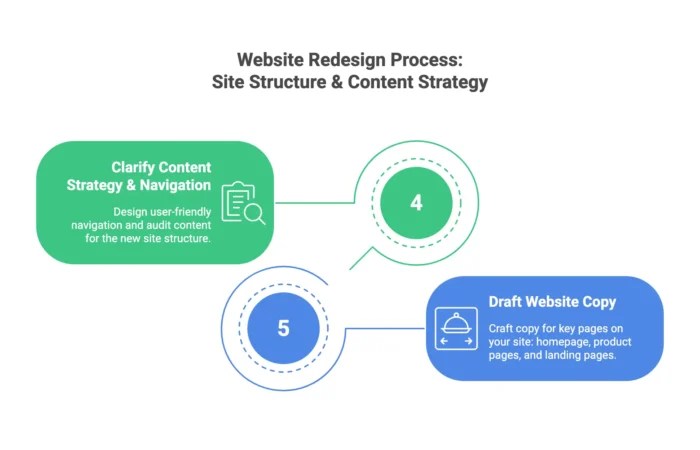
A graphic detailing site structure and content strategy parts of the website redesign process.

Step 4: Confirm the Navigation and the Content Strategy

Put your research to work. Design navigation that prioritizes user goals so your target audience can easily use the site. Add user-friendly navigation menus to simplify how they access important content.

Don’t forget about SEO best practices. Use a logical hierarchy that organizes content into categories. Make sure most content is no more than three clicks from the homepage.

While you’re at it, clarify your content strategy. Audit your existing content and determine if and how it fits into the new site structure.

Make a plan to combine redundant pages, unpublish outdated content, and identify content gaps that you’ll need to fill with new landing pages.

Step 5: Draft Website Copy

Now you’re ready to create or update the content for the most important pages on your website. Start with your homepage and then systematically work through product or service pages, use case pages, and industry pages. Include existing offer pages and conversion pages in this part of your website redesign plan.

Here are a few copywriting best practices to keep in mind as you write:

  • Write for your audience, speaking to their goals and pain points
  • Incorporate your brand voice, including your style and tone of voice
  • Make website copy easy to skim with clear page structure and subheadings
  • Add calls to action (CTAs) that prompt prospects to take the next step

Design and Prototyping

This is where the redesign process gets visual — and when stakeholders weigh in.

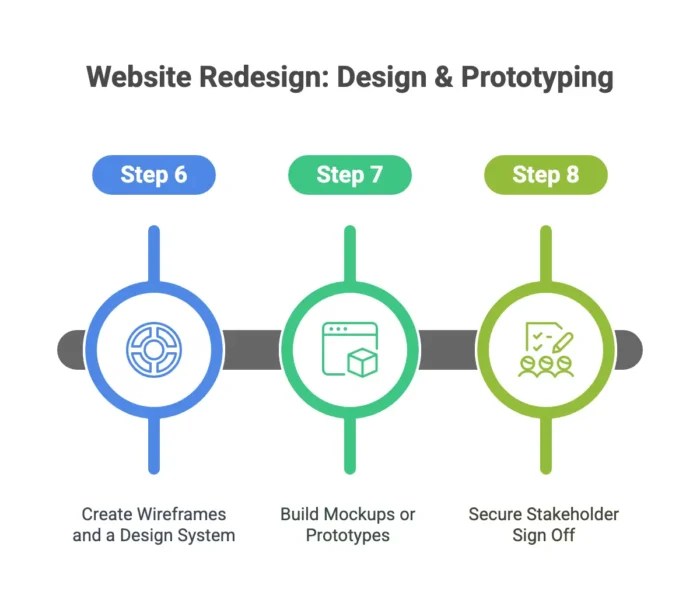
A graphic on design and prototyping parts of the website redesign process.

Step 6: Create Wireframes and a Design System

Design wireframes that show the website navigation, user flow, and content placement. Then, create a design system that shows the color palette, typography, and visual style.

By now, you should start to get a sense of how the new site will look and feel.

I recommend incorporating accessibility into this stage of your website redesign strategy. Choose accessible colors with sufficient contrast and fonts that are easy for site visitors to read.

Step 7: Build Mockups or Prototypes

Next, turn your wireframes and visual guidelines into website mockups or prototypes. Again, start with the most important pages on your website — like your homepage and product or service pages.

Apply the design to actual content drafts so stakeholders can see how the web copy will fit on the site, complete with the text hierarchy, white space, navigation, and design elements.

Develop prototypes for various screen sizes. While mobile devices will likely make up a large percentage of your site traffic, they won’t account for all of it. Make sure your site is just as easy for desktop users to navigate.

Step 8: Get Stakeholder Sign Off

The key to a successful redesign is getting everyone on board with your decisions. So once you’ve confirmed major design and copy decisions, present the prototypes to your stakeholders.

Walk them through how users will navigate the site based on typical journeys. Explain why you’ve made certain design decisions or built specific pages.

Gather feedback and make necessary revisions. Document every comment and change throughout the process. Then, get your team to sign off on the design, UX, and copy.

Development and Technical Setup

Set up your new website for success with a strong technical foundation.

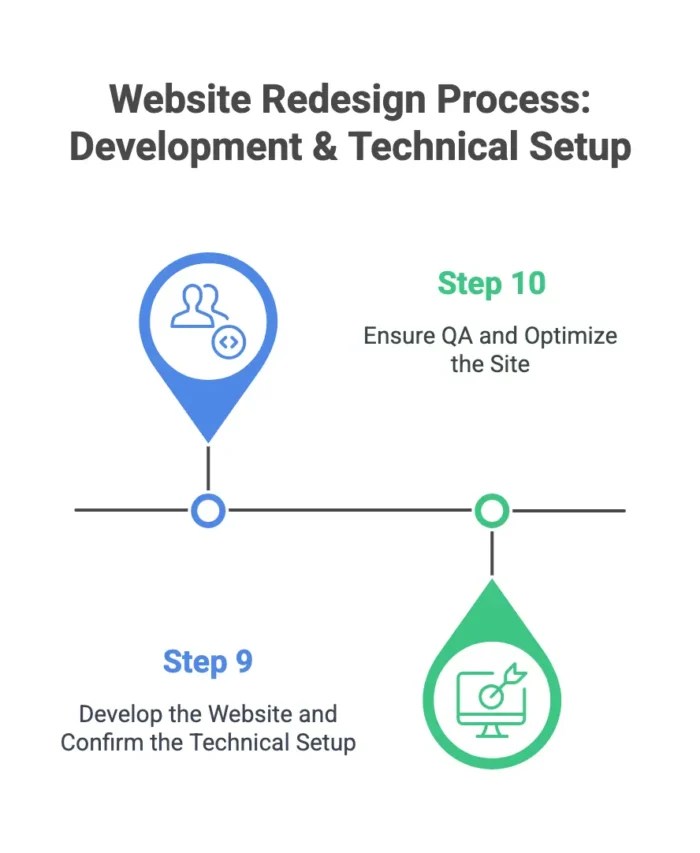
A graphic on development and technical setup portions of the website redesign process.

Step 9: Develop the Website

Now you’re ready to hand off the design to your development team. Work with the website developers to choose a CMS that supports your design, marketing automation, and compliance needs.

Use clean, descriptive URLs with relevant keywords and a logical hierarchy. If necessary, create 301 redirects to update the location of content from your old website.

Optimize for Google’s Core Web Vitals by focusing on:

  • Largest Contentful Paint, which reflects content loading performance
  • Interaction to Next Paint, which reflects the responsiveness of your site
  • Cumulative Layout Shift, which reflects the visual stability of your site

Build SEO foundations into your site so you can easily optimize your content for search engine rankings. Incorporate schema markup and metadata into the backend to help each page rank for relevant keywords.

Step 10: Test and Optimize the Site

Before launching your new site, take time to test it thoroughly. Recruit team members and beta users to check how your site performs on various devices, browsers, and screen sizes. Check for consistent appearance and functionality.

Work with your dev team to create a testing checklist. This way, nothing will fall through the cracks. Here are a few elements to add to your list:

  • Broken links
  • Missing images
  • Formatting issues
  • Faulty integrations
  • Slow loading speeds
  • Form submission issues

Launch and Performance Monitoring

Go live with the new design and monitor performance closely.

A graphic that shows launch and performance marketing portions of the website redesign process.

Step 11: Launch and Monitor the Site

Now you’re ready to launch the redesigned website. With your dev team, go through a complete checklist to set the stage for a successful website launch.

  • Update DNS settings
  • Set up SSL certificates
  • Confirm any 301 redirects
  • Check analytics tracking

Monitor the site closely for the first day or two. Make sure your dev team is available to quickly address any bugs.

Then, regularly review technical aspects like page load speeds, performance aspects like conversion rates, and SEO aspects like keyword rankings. Use your insights to create a plan to continue optimizing your site.

Common Mistakes to Avoid in a Website Redesign

Don’t make the same missteps many web designers do. Watch for these mistakes to make the website redesign process as smooth as possible.

Mistake Phase How to Fix It
Missing Performance Benchmarks Planning Document baseline metrics like website traffic, conversion rates, and page load times before the redesign. Set specific goals for each.
Misaligned Goals Planning Set clear goals at the beginning of your redesign process. Communicate them to stakeholders and provide regular updates.
Navigation Issues Strategy Test the proposed navigation with a group of real users. Monitor how they use the site and where they get stuck.
Poor Mobile UX Design Use a mobile-first design, then scale up to a desktop design. Test for usability issues before launching the website.
Inconsistent Branding Design Create a style guide with branding guidelines, including hex codes, typography, font size, and spacing rules.
Ignoring SEO Essentials Development Establish your new URL structure and create 301 redirects as necessary. Implement structured markup and metadata.
No QA Process Development Assign a QA lead and recruit real users. Follow a clear checklist to test the site and make it easy for users to report bugs.
Post-Launch Neglect Post-Launch Use analytics and SEO tools to monitor site performance. Schedule 30-, 60-, and 90-day reviews and plan for continuous optimization.

FAQs

What is a website redesign?

It’s a full rebuild of your site, going beyond just a visual update. You’re reworking the design, structure, content, and functionality so your site works better for your users and supports your business goals.

How do you redesign a website?

Start by figuring out what’s working and what’s not. Talk to users. Check your analytics. Map out a new site structure and write better copy. Then design, develop, test, and launch. Keep it focused on solving real problems instead of chasing trends.

How often should you redesign your website?

Whenever your site stops pulling its weight. That might be every few years or sooner if your tech, brand, or audience changes. If it’s slow, confusing, or outdated, it’s time.

Why redesign a website?

Because the old one isn’t doing its job. Maybe it’s hard to use. Maybe it’s off-brand. Maybe it just doesn’t convert. A redesign lets you fix what’s broken and build a better experience for the people you want to reach.

Final Thoughts on Website Redesign

Many businesses make design decisions on a whim — no plan, no discussion, and no website redesign goals. This can lead to underwhelming results. Or worse, ongoing updates that leave customers confused.

But with a clear workflow to follow, your website redesign doesn’t have to be overwhelming. Use my 11-step approach to set clear goals, get everyone on board, and design a new website that gets the results you want.

Read more at Read More

20 Landing Page Examples to Learn From

Would you rather have a beautiful website or a website your customers love?

From a business perspective, you shouldn’t choose either. You should want a high-converting website, instead. And this is where landing pages are so important.

A landing page is a key component in any marketing campaign. Whether you’re running a digital ad, sending an email letter, or posting on social media, you need a webpage that you can send interested visitors to that can help generate leads and conversions.

Many people get caught in the trap of creating designs they like without thinking about what their prospective buyers want and need. Unfortunately, this creates a leaky funnel that’s hard to fix.

But if you want to buck that trend and create landing pages that convert, I’m here to help. In this article, we’ve compiled a list of 20 landing page examples you can gather inspiration from.

We’ll go over each one’s strengths and weaknesses, so you’ll be able to walk away knowing what it takes to create a high-converting landing page for your business.

Key Takeaways

  • A landing page is a webpage created with a singular purpose—to generate a conversion, whether that’s a lead, sale, subscription, etc.
  • There are five main elements that every successful landing page should have—a bold headline, consistent copy, social proof, one singular offer, and a call to action.
  • Looking at landing page examples can be a great way to gather inspiration before you start building out your own landing pages.

What Is a Landing Page?

A landing page is a single webpage designed with a single goal in mind. That goal could be:

  • Selling a product
  • Signing customers up for a service
  • Promoting a product feature
  • Sharing an e-book, report, or white paper
  • Increasing newsletter subscribers

Potential leads or customers “land on” the webpage, giving it the name “landing page.” It’s a simple page that dives fully into a single offering with the intent of selling the visitor whatever it’s promoting.

5 Elements of an Effective Landing Page

As you scroll through the landing page examples we share below, you might notice that they all appear to follow a similar formula. That’s because you don’t fix what isn’t broken, and the key landing page elements are not broken.

There are five main elements that any high-converting landing page needs to include:

  • Bold value proposition at the top of the page. The top of the landing page should clearly state what it’s promoting and why the webpage visitor needs it.
  • Messaging consistent from the ad or post that led to the landing page. Upon clicking to your landing page, viewers should see a consistency in messaging from the ad or social media post that initially led them there. That messaging should clearly communicate what the page is promoting, giving further information than the bold heading at the top.
  • Social proof, case studies, reviews, testimonials. Social proof is where people tend to lean towards choices that they’ve seen others make, which is why reviews and testimonials can make such a big impact. Include this type of social proof on your landing page to convince people to take action.
  • One single, hyper-focused offer. You should be focusing your landing page on one single topic or offer, whether you’re promoting a single software feature, a single service, or a single lead magnet.
  • A clear call to action. What do you want people who visit your landing page to do? Use that as your call to action. Make it clear, bold, bright, and easy to click.

20 Amazing Landing Page Examples

Need some inspiration for your next landing page? Check out these 20 examples that you can get inspiration from.

1. GetResponse

A GetResponse landing page.

Source

GetResponse is an email marketing platform. This landing page is highlighting a key feature—email signup forms meant to help businesses build their email lists. Powerful headline, check. Eye-catching image, check. List of current clients, check. List of features, check, You get the idea.

It’s quite long, but that just gives the Get Response team more to convince you to create a free account. And there are plenty of CTAs along the way in case you missed the one at the very top of the page.

Three takeaways from GetResponse’s landing page:

  • Highlight your copy to make it even more impactful. GetResponse highlights important words and phrases throughout the landing page, drawing your attention to them and making their copy pop.
  • Use social proof. The landing page includes a slideable widget filled with customer testimonials that mention this specific feature and how well it works.
  • Use multiple CTAs. Because GetResponse’s landing page is so long, they scatter it with CTAs at the end of every section.

2. Slack

Slack landing page example.

Source

Slack is always on top of its game when it comes to creating some of the best landing pages. They are constantly optimizing for conversions, and that’s the best way to find your winning landing page. This landing page showcases one of its features—voice or video huddles that happen in real time, letting team members essentially call each other to hash something out quickly.

Three takeaways from Slack’s landing page:

  • Keep your navigation bar bare. Slack only includes the most important elements in the navigation bar on this landing page: letting current user login and prospective users talk to sales.
  • Show the difference between free and premium. If you have a popular free version, use your landing page as a chance to show what users are missing out on by not upgrading.
  • Take advantage of multimedia. The page includes looping animated videos that showcase each of the main features, letting interested users see them in action before signing up.

3. CrazyEgg

Intercom landing page example.

Source

This landing page for heatmapping software CrazyEgg showcases a specific feature that the software offers. In this case, it’s the ability to create website pop-ups to increase conversions.

The page leads with a demo link and breakdown of the feature, before you see more detailed information on how it works further down on the page.

Three takeaways from CrazyEgg’s landing page:

  • Provide basic instructions. The landing page includes a basic step-by-step for how users can set up pop-ups using the CrazyEgg tool, showing just how quick and easy it is and further selling them on the software.
  • Show versatility in applications. The use cases section shows how a variety of different industries can benefit from using this tool.
  • Use trust badges. CrazyEgg’s landing page is dotted with trust badges from the likes of G2 and Capterra, adding instant credibility to their offering.

4. Lyft

Lyft landing page example.

Source

Lyft has been growing in the past years, and its website, landing page, and overall online funnel is a driving force, too. They focus on attracting new drivers that want to control their own life.

Once again, we see a giant, attention-grabbing headline that entices users. Now check out the button “Apply to drive.” It implies that it’s not 100 percent sure you’ll be able to get the position — which makes it even more enticing while also stopping candidates from getting carried away.

Three takeaways from Lyft’s landing page:

  • Make a point with your images. I’d bet Lyft wants to attract female drivers, which is exactly why they’ve chosen the feature image on the landing page.
  • Customize data requests. Most landing pages ask for an email. But because Lyft is an app, it asks for your phone number instead.
  • Link off to learn more. You don’t want to overwhelm users with information on a landing page, that’s why linking to other pages (as Lyft has done) can be a useful strategy.

5. Zoho

Zoho landing page example.

Source

Zoho’s landing page is a great example of a more full-on, but still extremely powerful messaging. They use more text than the average landing page in the industry, but that’s not necessarily bad. It just means users have more information to make a decision. And in a crowded industry like the CRM space, that can be a highly effective thing.

Three takeaways from Zoho’s landing page:

  • Give your users a why. Don’t let users guess how your software stands out. Show them exactly why they should use your software.
  • Show how you compare. Comparison tables are a highly effective way to stand out in a crowded marketplace.
  • Talk price. If price is a USP for your brand, then mention it. Zoho shows how much users can save by using them instead of a competitor like Salesforce.

6. Squarespace

Squarespace landing page example.

Source

Squarespace is a contender for the shortest landing page ever. Seriously, there’s not much more to it than the screenshot I’ve taken above. But that doesn’t mean it isn’t effective.

Rather than trying to get you to create an account, all Squarespace wants you to do here is look at the templates. I reckon they know that once you see how good the templates are and how easy the platform is to use, you’ll be hooked.

Three takeaways from Squarespace’s landing page:

  • Short can be sweet. You don’t have to have a massive landing page to convince users to take action. A couple of enticing benefits may be all you need.
  • You don’t need much color. Everyone knows color can be used to convey emotion to users. But it’s not essential. And because it’s not on-brand for Squarespace, it’s not used.
  • The rule of three. Three is a magic number in marketing and Squarespace uses it to get across their core USPs.

7. ActiveCampaign

Active campaign landing page example.

Source

If there’s one thing you can’t fault ActiveCampaign’s landing page for, it’s brevity. They get straight to the point with the key benefit of their platform and encourage you to start a trial by entering your email address. Scroll down further and the rest of the page is similarly pared back, only including key information users need to know.

Three takeaways from ActiveCampaign’s landing page:

  • You don’t need fancy graphics. There are no eye-catching images above the fold and only two in total.
  • Lean on an authority. Are you highly rated by a trusted authority like G2? If so you can do what Active Campaign has done by showcasing all of your badges.
  • Show how your platform works. Images are great, but showing how to use your platform can make a huge difference in your conversion rate.

8. HubSpot

Hubspot landing page example.

Source

Cost is a big hurdle for any small business looking to purchase a CRM. That’s why HubSpot makes such a big deal of its free offering in this landing page. But just because you get the software for free doesn’t mean it’s limited. That might be your first thought, but HubSpot assuages those fears by showing all of the features you get below.

Three takeaways from HubSpot’s landing page:

  • Get your point across fast. The first three words users read on this landing page will be exactly what they are looking for: free CRM software. They don’t need to know much more to get started.
  • Reiterate your USP in your CTA. You can use your CTA to back up your headline by tacking on a short message or reason to take action as HubSpot has done here.
  • Use white space. HubSpot’s landing page isn’t too busy or crowded. There’s loads of white space, which makes it super easy to read.

9. Shopify Plus

Shopify plus landing page example.

Source

Shopify Plus isn’t designed for bootstrapped e-commerce stores or side hustlers. It’s an enterprise product and that shows in this landing page. It talks directly to big businesses, addresses their specific concerns, and shows them the kind of results they can achieve. Best of all, it’s topped off with a piece of ultra-professional video marketing that’s also designed to appeal to the brand’s target audience.

Three takeaways from Shopify Plus’s landing page:

  • Tailor your CTA. Enterprise customers aren’t going to make a purchase straight away. That’s why Shpoify encourages them to contact their sales team rather than book a demo.
  • Use statistics. The landing page gives hard data about how much better stores can perform by using Shopify Plus. This is much more powerful than a throwaway comment.
  • Speak to your customer’s values. Shopify devotes a large chunk to talking about the performance of their platform — something enterprise companies care about deeply.

10. Webflow

Webflow landing page example.

Source

There’s a reason designers aren’t web developers — most don’t know how to code. That doesn’t stop them from designing great-looking websites, but it does mean they need help. Not if they use Webflow, however. Webflow lets designers design and code powerful websites without having to write any themselves. And because the company knows its target audience, everything on the landing page is designed to appeal to designers — from the images to the testimonials to the copy.

Three takeaways from Webflow’s landing page:

  • Tailor your landing page to your target audience. This landing page won’t appeal to anyone who can’t design. But that’s the point. Those people won’t use Webflow, designers will.
  • Double down on social proof. Webflow understands the power of social proof, which is why they highlight their existing customers multiple times on the page.
  • Show, don’t tell. Webflow ends the landing page by showing designers exactly the kind of sites they can create with the platform.

11. ClickFunnels

Click funnels landing page example.

Source

The goal of the ClickFunnels landing page is to get you to start using its software. They know that once they’ve got you on their platform, you are way more likely to start paying. With that in mind, everything on the page is geared at showing how easy it is to get started and what you can accomplish with the software. There are dozens of testimonials of high-profile salespeople who have made serious bank with the software and copy that challenges any preconceived ideas you have. It’s a masterclass in persuasive landing page design.

Three takeaways from ClickFunnels’s landing page:

  • Let your customers sell for you. Testimonials are so powerful. If you have them from the right people (the kind your prospective customers want to emulate) then they’ll do most of the hard work for you.
  • Attack objections early. ClickFunnels does a great job of overcoming common objections (like you need to have good computer skills or your business isn’t a good fit) above the fold.
  • Use CTAs liberally. There is a CTA banner after every section on this page, giving users every opportunity to convert.

12. Conversionlab

Conversionlab landing page example.

Source

Conversionlab has been using this landing page design for years now. I’ve noticed they split test different button CTAs, like book a call, get a free consult, and many more. Keeping their Founder on the main page of the website builds a long-term relationship many businesses nowadays miss out on. They clearly state their services through their persuasive headline and, even if you’re not ready to book a consultation, a pop-up will appear collecting your email.

Three takeaways from Conversionlab’s landing page:

  • Put your team front and center. You can build instant relatability with users by putting your team members on your landing page.
  • Don’t be afraid to give it all away. Conversion Lab’s landing page explains in detail what it’s like to work with them, so every prospect knows exactly what to expect.
  • Try twice to convert. Following up with an email (collected via pop-up) is a great way to ensure that a high percentage of prospects that land on your website will end up booking a call with you.

13. Semrush (404)

SEMrush landing page example.

Source

Semrush is an SEO platform. Here’s a landing page example for their tool that showed up as an ad in organic search. The button is bright (and on-brand) and makes it clear what your next step would be. The main headline focuses on the benefit — grow your online visibility — and the third line focuses on another key benefit — you only need one platform. That’s appealing to marketers who are juggling a ton of tools.

Three takeaways from Semrush’s landing page:

  • Know your audience. The landing page’s CTA focuses on a known pain point of digital marketers: that they have to juggle dozens of different tools.
  • Roll out the big guns for testimonials. Semrush lists some of their biggest customers prominently on the homepage. If these massive companies use the platform, surely you should, too?
  • Use variety with your CTA buttons. Each of the CTA buttons lead to the signup form, but the copy is different in each one, ensuring they hit the pain point that will get someone to click, no matter where they’re at on the page.

14. HelloFresh

Source

HelloFresh is a meal-kit delivery service, and this landing page is another ad-based page that’s focused entirely on its offering, with no additional navigation.

Like other landing pages, the content is limited. They use a heading, CTA, and images to show how the platform works and some of the user options. However, I suspect that’s on purpose — after all, the premise is relatively simple, it’s more about showing how the service fits into people’s lifestyles.

Three takeaways from HelloFresh’ landing page:

  • Strategic discounts make a difference. The page is offering a discount, but it’s automatically applied the second someone clicks on the page, creating an enticing offering that requires no additional effort on the customer’s side—they just have to click “Redeem” or “Get Started.”
  • Use high-quality visuals. HelloFresh prides itself on high-quality, fresh ingredients, and the images here present these front-and-center.
  • Strategic link placement. The carousel at the bottom is neatly aligned with different dietary needs and preferences, helping move users down the sales funnel.

15. Doordash

Door Dash landing page example.

Source

Doordash probably doesn’t have to worry as much about getting customers as it does about recruiting new drivers to meet demand. That’s the goal of this landing page that shows users what they stand to gain from becoming a Dasher. It’s on-brand, carefully lays out the benefits of becoming your own boss, and shows you how much you could earn. The only thing it’s missing is social proof.

Three takeaways from Doordash’s landing page:

  • Put the user front and center. Everything on this landing page, from the copy to the images revolves around the user. It’s about what they can achieve and speak directly to them.
  • Pre-qualify users on your landing page. Doordash clearly lists the requirements drivers have to meet, meaning they’ll need to spend less time vetting candidates in the future.
  • Don’t rule out the impact of social proof. The lack of testimonials from current Dashers really lets this page down. The experience of current drivers is probably high on a prospective driver’s checklist.

16. Airbnb

AirBNB landing page example.

Source

Want to know how much you could rent your property for on Airbnb? That’s exactly what the company’s landing page helps you to understand. This fun and interactive landing page gives users a taste of what they can earn by renting out their property on Airbnb and then shows them how easy the process is.

Three takeaways from Airbnb’s landing page:

  • Dynamic pages can work a dream. As soon as you land on Airbnb’s landing page it automatically changes the content depending on your location. That creates a highly personalized and interactive experience that’s more likely to convert users.
  • CTAs don’t have to take center stage. The CTA to create an Airbnb account is tucked away in the right-hand corner of the page. But that doesn’t make it any less prominent or visible.
  • Make it interactive. Users can play with the slider bar to see how much they could earn by renting out their property for longer. The more you slide, the bigger the number gets, and the more tempting it is to create an account.

17. Zillow

Zillow landing page example.

Source

Every homeowner wants to know how much their property is worth. It’s that simple desire that Zillow capitalizes on with this landing page, which aims to generate leads for the company’s mortgage business. It’s short, simple and incredibly alluring for both curious homeowners and buyers looking to understand the potential value of a new home.

Three takeaways from Zillow’s landing page:

  • Eye-catching imagery can play a big role. The biggest element on Zillow’s landing page isn’t the CTA, but the image behind it. It’s doing a lot of legwork creating an aspirational feel to the page.
  • Clearly contrast copy and images. There’s a danger that the overlay copy on the background image could get lost. But Zillow does a great job of ensuring the contrast is clear and the copy is readable.
  • Give users more information, but only if they want it. There’s a tendency for the best landing pages to overwhelm users with information. Zillow avoids this by providing FAQs that only appear if users click on them.

18. Visme

Visme landing page example.

Source

Visme is a graphic design tool that offers a number of templates for different types of business-centric designs, like presentations, infographics, e-books, and the like. This landing page is all about the fact that you can create e-books with the tool, highlighting only e-book templates and other features related to e-book creation.

What I like:

Three takeaways from NP Digital’s landing page:

  • Brand consistency matters. All of the copy and images are related to this singular type of design. This page is perfect for ebook-related ads but also a great SEO play as well.
  • Showcasing different product. The examples section does a great job showing off the variety of different e-books that this product can make.
  • CTAs after key features. The page design here places the CTA button after all the different breakdowns of major features, meaning that the user can buy as soon as they see the feature that matters most to them..

19. Wix

Source

Wix is a website builder, and this landing page goes all in on its website design capabilities. It showcases all features related to getting a new website up and off the ground.

Three takeaways from Wix’s landing page:

  • Don’t neglect the visual factor. As you scroll, you’re met with colorful blocks that each highlight its own feature, making this a visually appealing landing page that keeps users engaged the entire time.
    Show your work. The examples section here does a great job of showing the full breadth of sites that Wix can help build.
  • Use FAQs (when it makes sense). FAQs can be very useful for helping go into greater detail about a product without clogging up the page experience. They are great for SEO, too!

20. NP Digital

NP Digital landing page example.

Source

Let’s end with one of the best landing page examples from my digital marketing agency, NP Digital. Unlike some of the other examples in this list, the goal of this landing page isn’t to get people to buy a product or sign up to a service. I want users to download a market research report my team and I created.

As you can see, it’s quite a bit shorter than a normal landing page. That’s because it doesn’t need elements like social proof or loads of images. All I want to get across is a snapshot of what you can read in the report and how you can download it.

Three takeaways from NP Digital’s landing page:

  • Don’t let users enter fake information. I email the document to the address you provide in the form. That means you have to enter your correct email address to get the document and I don’t have to waste time scrubbing fake emails from my database.
  • Sometimes you can ask for more information. Your opt-in form doesn’t have to be tiny in order to convert. Because I’m giving away a lot of information for free, I can ask for more information in return.
  • Long landing pages don’t necessarily make the best landing pages. If you don’t want users to waste time scrolling, don’t make them. Only give them the information they need to convert.

7 Tips for Creating Killer Landing Pages

You’ve seen the best of the best. Now you’re ready to create a landing page that drives business growth. These seven tips will help you create the high-converting landing pages you’ve been dreaming of:

  1. Include clear calls to action. Your call to action should be specifically tied to your goal and should be supported by everything else on your page, from the headline and body copy to the images and overall layout. Avoid bland CTAs like “Submit” that don’t explain the next steps.
  2. Keep your landing page forms simple. Only require users to provide the minimum amount of information they need, usually just their name and email. Asking for too much information early on decreases the chances a user will complete the action you want them to take.
  3. Ensure your copy is clear and concise. The best landing page copy should be clear, easy to read, and make a specific point. Use bullet points, headings, and bold font to make content easier to read. Every single sentence and word on your landing page should serve a purpose, and that purpose should be to support your call to action. If it doesn’t do that, cut it.
  4. Include vital information above the fold. That includes a benefit-focused headline and a CTA. Hopefully, at least a small percentage of your visitors will be ready to buy as soon as they arrive on your landing page.
  5. Ensure your landing pages look the same as your campaign ads. If your page is tied to an email or PPC campaign, make sure the landing page echoes the look and feel of the ad or email. The easiest way to do this is to carry over fonts, images, and colors from your campaign to your landing page. This is especially important for paid ads, as it can increase your quality score.
  6. A/B test your landing page. A/B testing means running two different landing pages and changing just one element to see which performs best. For example, you might use two different images and see which one drives the most conversions.
  7. Use fewer images and a large font. Visual clutter detracts from the message and CTAs. Larger font sizes are also a good idea to keep visitors’ eyes focused on what matters and reduce eye strain. Just don’t go overboard and put everything in a headline-size font — no one wants to be yelled at.

In general, a great landing page includes:

  • A strong heading that includes your main keyword
  • A subheading that clarifies the heading
  • Copy that explains the offer
  • An image, video, or illustration that supports the offer
  • A form or CTA button where the user can convert

You might also include social proof or trust symbols, such as reviews, testimonials, and logos of previous customers.

Building Out Your Next Landing Page

While there are some consistent elements between all strong landing pages, the exact design will depend on your goals, your business, and your industry.

Let me ask you a couple of questions that will guide you in the right direction.

What do you want to accomplish with your landing page?

The most common landing page goals are:

  • Getting people to opt-in in exchange for free value on a subject.
  • Selling a low-ticket product like a book or a mini-course.
  • Promoting a free trial offer for a monthly service or software.

You’ve got to know exactly what offer you want to present on your landing page before creating it.

Are you committed to this project or are you just trying out an offer?

Building a high-converting landing page is not an overnight effort.

You might find yourself optimizing a non-profitable landing page for months before it starts generating real returns. If you’re not ready for that, then I recommend you quit before you even start.

Yes, you can get lucky and hit a home run on your first try, but don’t count on it.

Be ready for the long game so you catch the long-term gains that are so much sweeter than a short-term spike in traffic.

What’s your budget?

Before you begin designing your landing page, you need to prepare a solid budget.

You can’t expect everything to go smoothly throughout the process. Problems are going to occur and most times the easiest and fastest way to solve them is to pay someone who is an expert in the field.

That can be a developer, a funnel designer/builder, an ad specialist, or a CRO consultant. Either way, you should be ready to pay someone to do it right so you don’t face the same problems over and over.

In marketing and life, one of the best ways to test the quality of your work is to put it in front of an audience. For landing pages, you can do that by running ads to see if the traffic converts.

If it does, you raise your ad budget and try to scale. If it doesn’t convert at first, then you should let a professional take a look at it.

Even if you already hired someone to build it for you, don’t expect them to help you here. Yes, they could optimize your page, but you’ve got to keep in mind that people have an emotional attachment to their work.

That’s why you need a third party to help you out.

When it comes to optimizing a landing page for conversions, think about hiring an agency.

Big marketing agencies nowadays have had hundreds if not thousands of clients who have been in your exact situation. That’s why hiring a marketing agency to help you increase your conversion is the best bet.

Talking about CRO (conversion rate optimization) there’s no better choice than NP Digital.

I might be biased, but I think it’s the best marketing agency for both SEO and CRO.

If you’re at the stage where you want to optimize your existing landing page but you don’t know exactly how to do it, then book a quick call with a member of my team who can unravel the secret conversion optimization methods your business needs.

Frequently Asked Questions

What is a landing page?

A landing page is a specially designed page intended to encourage users to complete a specific task (i.e., convert.) They work by highlighting key points, using social proof or case studies to build trust, and providing a CTA to encourage conversion.

Who needs a landing page?

Any business with a website should have a landing page of some sort to encourage users to take an action like booking a demo, calling for a quote, or signing up for an email list, etc.

What makes a good landing page?

There are several elements that make a landing page effective. First, a clear and compelling headline that instantly communicates the value proposition is essential. Second, concise and persuasive copy that highlights the benefits of your product or service. Third, it needs a visually appealing design that is easy to navigate and optimized for mobile devices. Fourth, a strong call-to-action that is prominent and directs users to take action. Finally, I recommend trust-building elements such as testimonials or social proof to instill confidence.

Conclusion

I hope these best landing page examples can serve as an inspiration to create a high-converting landing page. To get the most out of your landing page, be sure to:

  • Find what your best customers struggle the most with and then solve this problem with a short and punchy headline.
  • Use credibility and videos if possible.
  • Know your goals — Is it to get their email or phone number? Have them call? Start a free/paid trial or something else?
  • Use clear and easy-to-follow calls to action.

Finally: always, always optimize your landing pages.

You can NOT be perfect from day one. Every business on this list tests its pages dozens if not hundreds of times before finding the best landing page.

Even then, they still optimize.

Read more at Read More

What is off-page SEO?

Off-page SEO is everything you do outside of your website to help it rank better in the SERPs. On-page SEO focuses on content, site structure, and technical improvements, but off-page SEO looks at building credibility from outside. There are many ways to get there, from link building to social media to earning those coveted brand mentions.

What does off-page SEO mean to you? 

With off-page SEO, you try to gain trust and credibility for yourself or your business. A big part of this strategy concerns link building, which involves getting other websites to link back to yours. Doing this shows search engines that your content is helpful and worth looking at. 

Remember that it’s about the quality of links, instead of the quantity. A few high-quality links from trusted websites will help more than lots of links from low-authority ones. But links aren’t the only signals that matter. 

Mentions of your brand name or domain from other websites also help build authority. Even without direct links, consistent references in articles and forums show that people are engaging with your brand.  

Social media builds on that exposure. Sharing content where your audience spends time can boost visibility, which in turn can lead to more mentions, traffic, and backlinks. 

Local SEO is another area of off-page SEO. Using tools like Google Business Profile and getting reviews helps your business appear in location-based searches. It’s especially useful for service businesses or companies with physical locations. 

You can also experiment with creating content for different audiences to naturally attract attention. Reusing content in different formats, like videos, blog posts, or infographics, keeps your reach wide. You can also work with experts or influencers, as these can introduce your brand to new audiences and help build visibility. 

Why off-page SEO matters for your site 

Search engines want searchers to see trustworthy content. With off-page SEO, you can prove your site is dependable, and the quickest way to do this is when others refer to or recommend it. Good links from strong websites act like references, building confidence in your content’s value. 

Even unlinked brand mentions help. When your name keeps coming up across the web, algorithms pick up on it. A strong digital presence makes a difference, whether that’s engaging with others online, through media coverage, partnerships, or content sharing.  

While not directly tied to rankings, increasing your online visibility can lead to more searches, shares, and links, which can lead to increased traffic. 

All these efforts support the broader goal of demonstrating that your website is run by real people with knowledge and experience. They help search engines judge how much they can rely on your content. 

Link building is a big part of off-page SEO 

Links from other websites tell search engines that your content is worth showing. That’s why link building is one of the key parts of off-page SEO, but not every link is equal. 

Search engines find links from high-authority, topic-relevant sites more important. Getting those kinds of links usually means creating content that people want to reference, such as guides, studies, or tools. 

Outreach plays a role, too. You can connect with other websites, offer guest posts, or share original insights. Over time, this builds relationships and can lead to higher-quality backlinks. 

PR and content marketing also help, whether you contribute expert opinions to news outlets or create something worth citing. It’s more effective than mass emailing or buying links, the latter of which you shouldn’t do anyway. 

Part of your job should be managing your existing links. SEO tools such as Ahrefs and Semrush can monitor broken or lost links and help fix or replace them. 

If you are successful, link building can be more than just a tactic. It can show that others recognize your site as trustworthy, and that recognition, measured through linking, can improve rankings and drive traffic. 

Social media’s impact 

Social media doesn’t directly affect ranking, but it helps people discover and share your content. That kind of exposure can lead to links, searches, and increased brand familiarity. 

Platforms like LinkedIn, X, Reddit, and Instagram let you speak to your audience and encourage interaction. When people find value in what you publish, they tend to share it or come back to it. 

In time, these interactions build brand recognition. While this might not have a clear SEO metric attached, it does support and improve your visibility. Collaborating with influencers expands your audience even more. If they share something you’ve created, it can get picked up and linked to by others. 

Video is playing an increasingly important role in this. Research from BrightLocal shows that many U.S. consumers are drawn to video content directly from businesses discussing their products or services. Over a third of consumers prefer this type of video, even more than those shared by friends, influencers, or typical social media reviewers. Additionally, 31% of individuals find value in watching videos from regular social media users. 

Use insights from these platforms to spot what your audience cares about. That helps shape better content, which can trigger organic shares and mentions. 

Local SEO as an off-page SEO strategy 

For locally oriented businesses, off-page SEO means being easy to find and well-reviewed locally. Start with accurate business info across online directories, so make sure that your name, address, and phone number (NAP) are consistent. Search engines use this to match your business to search results. 

Your Google Business Profile needs regular attention, so photos, updates, and timely responses to reviews all help. In that same BrightLocal research, 89% of respondents say they expect merchants and business owners to reply to all types of reviews. 

Encourage satisfied customers to leave public reviews. New reviews show search engines and potential visitors that your business stays active and involved. A complete, active listing stands out to local customers and improves your chances of appearing in map results. 

Try building links from other local businesses or organizations. These carry weight in local SEO. Sponsoring events or working with local publications can lead to mentions and coverage. 

Being visible in your area is not just about what local content you have on your site, but also about how your local audience views your business online. 

Carefully replying to your reviews manages your online reputation

Expertise and trust 

With off-page SEO, you have many opportunities to show your expertise. Sharing your knowledge can build trust, which in itself can create useful input for search engines. 

Guest posting on reputable websites reaches people already interested in what you have to say. If those sites link back, it’s a plus for SEO, except when shady things happen, of course. 

You can also take part in forums and Q&A sites. Offering useful, relevant insights gets your name out and sometimes leads to mentions from others who find your content helpful. 

Podcasts, webinars, and speaking events work the same way. Participating in discussions in your space helps establish expertise and can result in new traffic or backlinks from media coverage or event promotions. 

Collaborating with other professionals through research or shared content introduces your work to their audience and can lead to more recognition and links over time. 

You shouldn’t just focus on creating more content, but try to actively lead in your field. If your business is perceived as the go-to place, this builds trust with both your audience and search engines. 

How off-page SEO impacts AI-driven search 

Search is changing quicker than ever. Beyond the classic search results, people are now using AI tools like Google’s AI Overviews and AI Mode, Perplexity, Microsoft Copilot, and chat assistants like ChatGPT to find answers. These tools use large language models (LLMs) to pull information from across the web, and off-page SEO plays a role in how your content shows up. 

When your brand or website appears on high-quality, trusted sites, it increases the chances that AI tools recognize your content as reliable. Structured citations, strong backlinks, and consistent brand mentions all help LLMs “see” your site as a good source. This can lead to your content influencing or being featured in AI-generated summaries and answers. 

Authority, trust, and topic alignment are all important. The more your content is referenced or quoted by reputable sources, the more likely it is to appear in conversational search results or be used to answer common questions. Find out how to optimize content for AI LLM comprehension using Yoast’s tools.

Off-page SEO now supports not just link-driven visibility, but also discoverability in AI search and chat tools. It helps improve your overall presence, so it doesn’t matter whether someone uses Google, social media, or an AI chatbot to find information about you. 

Off-page SEO helps widen the scope 

Off-page SEO works together with on-page work to strengthen your website’s reputation across the web. First, it helps your users, but it also helps search engines and AI tools recognize your content as trustworthy and relevant. 

Whether you’re earning backlinks, encouraging brand mentions, engaging on social platforms, or building local visibility, each off-page signal adds to your authority. Collaborations, reviews, and expert participation show real experience behind your site. 

These strategies now also influence how content surfaces in AI-generated results. That means off-page SEO doesn’t just support traditional rankings, but it also helps your brand stay discoverable in new, AI-powered ways. 

The more consistent, trusted, and present your brand is across the web, the more likely it is to show up wherever people are searching, even if they’re not using a classic search engine. Build trust, stay visible, and let your off-page efforts work across search formats, now and into the future. 

The post What is off-page SEO? appeared first on Yoast.

Read more at Read More

How the YouTube Algorithm Works (Data-Backed Answer)

Some YouTube videos gain millions of views, while others struggle to find an audience. The reason often comes down to the algorithm. YouTube’s algorithm isn’t guesswork—it’s a sophisticated system predicting what viewers will most likely watch and enjoy.

Whether you’re a marketer, content creator, or business owner, understanding how the YouTube algorithm works can help you grow your channel and reach more viewers. In this article, we’ll break down how the YouTube algorithm works in 2025 and share strategies to help you succeed.

Key Takeaways

  • The YouTube algorithm in focuses on understanding individual viewers through their behavior, preferences, and watch history.
  • YouTube serves videos in three main ways. The homepage shows videos based on viewer history, suggested videos appear alongside a video being watched, and search results combine relevance and viewer preferences.
  • Metrics like watch time, click-through rates (CTR), likes, comments, and shares are key factors in determining a video’s visibility.
  • Including YouTube Shorts, live streams, and playlists in your strategy can help you connect with wider audiences.
  • Regular uploads and active audience engagement signal to the algorithm that your channel offers value.
  • Features like polls, Q&A sessions, and multilingual subtitles increase engagement and appeal to diverse audiences.
  • Algorithm optimization has seven components: create a click-worthy title, add detail to your description, design an attractive thumbnail, increase watch duration, encourage action after the video, maintain engagement with video series and playlists, and improve content using analytics over the long term.

What Is the YouTube Algorithm?

The YouTube algorithm is a recommendation system that serves videos to users based on their histories and (if they’re actively searching) search queries. The algorithm evaluates over 80 billion signals, according to the official YouTube blog. 

The algorithm matters because YouTube is a powerful organic channel. Understanding how to increase the reach of your videos can increase revenue significantly.  

In fact, research conducted by my team at NP Digital found it’s the top organic social channel, outperforming sales from all other platforms by a large margin. 

A graphic that shows how many conversions organic social really drives.

YouTube provides recommendations in four main areas:

  • Homepage: Features videos based on viewer history and content performance.
  • Suggested videos: Highlights related content next to the video being watched.
  • Search results: Combines relevance and viewer preferences to rank results.
  • Shorts: Shows short-form videos in the shorts feed based on user history. 

Let’s look at each of these in detail. 

Recommended Videos: A Whopping 70% of All Views

Recommended videos appear on the homepage and alongside videos on “watch pages,” on-screen at the end of videos, and in the suggested videos sidebar.

Recommended videos on YouTube.

YouTube’s recommendation algorithm drives 70% of views, according to a study by the Institute of Strategic Dialogue

A mixture of personalization factors—based on the user’s history—and individual video performance signals are used to make recommendations. 

Search Results: The Web’s Sixth Biggest Search Engine

Results page videos are served in response to YouTube search bar queries. The algorithm uses a mix of relevance (in relation to the search phrase) and personalization to rank videos. 

Search results for Digital Marketing Tips.

Despite accounting for only 30% of views, the number of searches on YouTube is still high enough to make it the sixth largest search engine on the web. My research found that YouTube has 3.3 billion searches every day. 

Daily searches per platform.

Shorts: Casual Scrolling

The “shorts algorithm” serves videos based on user history, in a similar way to the homepage and watch page suggestions. However, videos are viewed in a scrolling format, typically on mobile. 

A YouTube short.

My team and I looked at the engagement levels of different types of content and found that shorts account for 31.3% of all social media content engagement, beating every other category. Shorts are excellent for building your audience, and I publish them regularly on my channel. 

Content that generates the most engagement.

Trending: What’s Hot In Your Country

The “Trending” tab in YouTube displays videos that are going viral and generating high viewing figures. According to the YouTube Help Center, “Trending isn’t personalized and displays the same list of trending videos to all viewers in the same country.”

The Trending YouTube tab.

The YouTube Algorithm’s Evolution

The YouTube algorithm has evolved significantly over the years. Early versions rewarded videos based on view counts alone, encouraging clickbait tactics. In 2012, the focus shifted to watch time, prioritizing videos that kept viewers engaged for more extended periods.

In 2025, AI-driven personalization will play a central role. The algorithm analyzes viewer behavior to recommend videos that align with individual preferences. Metrics like watch time, click-through rates (CTR), and satisfaction surveys have a major impact on video ranking.

Short-form videos, like YouTube Shorts, are now a major factor in discoverability. They grab attention quickly, making them effective for engaging new viewers. Creators who include Shorts in their strategy often see significant growth in views and subscribers.

The evolution of the algorithm shows that success on YouTube depends on adaptability. Content that engages viewers across formats and metrics is more likely to gain visibility.

How the Algorithm Works: A Complete Overview

So, how does the algorithm work? 

Let’s look at official and reputable third-party sources to piece together an understanding of what YouTube looks at to recommend and rank videos.

Official YouTube Documentation: Personalization and Performance

YouTube has stated that it uses a comparison system on its official blog: 

“…we start with the knowledge that everyone has unique viewing habits. Our system then compares your viewing habits with those that are similar to you and uses that information to suggest other content you may want to watch.” 

YouTube has also explicitly said that it measures user activity

“Our algorithm doesn’t pay attention to videos, it pays attention to viewers. So, rather than trying to make videos that’ll make an algorithm happy, focus on making videos that make your viewers happy.”

In addition, a paper published in 2016 titled Deep Neural Networks for YouTube Recommendations explained that the YouTube recommendation model works in two stages. Although it has evolved since the paper was published, there’s a strong likelihood that the underlying ideas have remained the same. 

First, the algorithm goes through a “corpus” of millions of videos to retrieve a subset of videos that match the user’s preferences based on their history. Second, it evaluates multiple video and user factors to rank these candidates, returning what it determines to be the best-fit recommendations. 

A Discussion Between YouTube Insiders: No One “Number”

In early 2025, YouTube Creator Liaison Rene Ritchie and Todd Beaupré, who leads the Growth and Discovery team, discussed the YouTube algorithm in depth. 

Rene Ritchie asked, “We often hear from creators, ‘What’s the one number? Is it click-through rates? Is it watch time?” How do creators optimize for all of these factors?”

Beaupré answered by saying, “One thing to understand is there’s no single answer to that question, as much as creators would love to have one. But the reality is that we’ve enabled the system to learn that different factors have different importance in different contexts.” 

He also added, “While we do look at how long people watch videos, it’s only one of the factors we consider…we introduced this concept of satisfaction…where we’re trying to understand not just viewers’ behavior but also how they feel.” 

The key point is that YouTube considers a wide range of context-dependent factors. But the emphasis is on user “satisfaction.” Factors like relevance, watch time, and engagement all fit neatly into this category. 

7 Key YouTube Algorithm Signals

A mix of official documentation and third-party testing highlights seven key areas that YouTube looks at in order to evaluate what Todd Beaupré calls “satisfaction.”

Here’s a working roundup of YouTube algorithm signals:

  • Content characteristics: The algorithm uses metadata, such as titles, descriptions, and transcripts, to determine a video’s relevance to a viewer’s query. Optimized metadata increases a video’s chances of being recommended.
  • Watch time: Longer viewing sessions suggest valuable content. While there is significant variance across topics, my team and I found that 3.06 minutes is the average watch time on YouTube, and this is a good benchmark to keep in mind for longer videos. 
A graphic showing average watch time for long-form videos by platform.
  • Click-through rate (CTR): This is the percentage of impressions that turn into clicks.  Attractive titles and thumbnails draw more clicks and indicate relevance. 
  • Likes, comments, and shares: Viewer interactions show the content’s relevance and appeal. Videos with strong engagement are more likely to be promoted.
  • Viewer behavior: Content is prioritized based on individual viewing history, likes, and repeated interactions. It also considers patterns among viewers with similar interests to recommend content.
  • Relevance: Research by the Pew Research Center found that 32% of adults in the US use YouTube to stay up to date with current events, making it one of the web’s most popular news platforms. Because of this, the relevance of news-related content is likely a strong ranking factor. 
  • Handling misinformation: Channels with authority and consistent, trustworthy content are favored. The algorithm also flags and limits the reach of misleading videos, so aligning with YouTube’s policies is critical. According to YouTube, consumption of “borderline content” recommended by the algorithm is lower than 1%. This is content that doesn’t violate YouTube’s terms of service but comes close.  

How to Improve Your Organic Reach: 7-Step Framework

Improving organic reach on YouTube is about focusing on three factors: engagement, relevance, and viewer satisfaction. 

A graphic showing how to improve organic reach on YouTube.

Creating useful, attention-grabbing content should be your priority. However, there are also powerful tweaks that can give your rankings an extra lift.

1. Pick a Catchy Title

YouTube looks at your video’s title to understand what it’s about. A well-crafted title makes it more likely that you’ll be recommended to users and appear in search results for relevant queries. 

Here’s how to nail your video titles:

  1. Pick a primary high-volume keyword: Enter the core topic of your video into the YouTube search bar to generate specific keyword variations and pick one of these for your title. You can also run potential keywords through a tool like Ubersuggest, as there is significant overlap between Google and YouTube search term volumes. 
Results for Social Media Marketing.
  1. Describe a clear benefit: A catchy title isn’t just for telling the algorithm what your video is about. It’s also for building interest and driving clicks. Articulate a clear, precise outcome or benefit, as I have done with “social media mastery” in my video below. “How to” titles also work very well on YouTube. 
Results for Social Media Marketing 2025.
  1. Don’t get too hung up on tags: There’s no harm in adding tags in the Show more section of the Details page of the upload window. However, don’t worry too much about these as their value is limited. Three or four keywords that describe your video will do the job.

2. Optimize Your Description

Descriptions do more than summarize your video—they help the algorithm understand and categorize your content.

Here’s how to create a killer description:

  • Focus on the first two lines: These appear in search results. Start with an engaging preview that highlights what viewers will learn.
  • Provide details: Outline key takeaways and include timestamps for longer videos. Use bullets in your description to make it easy for readers to skim. 
  • Add calls to action (CTAs) where appropriate: Direct viewers to related videos or encourage them to subscribe when it’s appropriate to do so. 

Here’s an example of a helpful description from one of my videos. It’s comprehensive—giving plenty of info to YouTube—and pulls readers in with a clear description of what they’ll learn. 

An example YT video description.

3. Create a Captivating Thumbnail

Your thumbnail is an invaluable opportunity to stop scrollers, restate the benefits of watching your video, and encourage clicks. And if you’re not a natural designer, AI tools can fill the gap.

Here’s how to create thumbnails that get noticed: 

  • Reiterate the benefit in a different way: Use the thumbnail as an opportunity to reiterate the main promise or learning of your video in a slightly different way to attract viewers that may not have found your title compelling. 
  • Include a picture of your face: Research shows that we’re drawn to content that includes human faces.
  • Keep your design professional (without breaking the bank): Platforms like Canva and Adobe Express, which now have AI features, create professional-looking thumbnails that grab attention.
  • Split Testing: Test different thumbnails across your videos to see which combinations perform best.

You can see a selection of thumbnails for my videos below. In all cases I include my ugly mug—ahem, beautiful visage—and reiterate the main promise of the video in a slightly different way to the title. 

Neil Patel thumbnails.

4. Aim for Longer Watch Durations

The algorithm rewards content that keeps viewers watching from start to finish. Strong video storytelling holds those eyeballs and boosts watch time.

Here are my four top tips for improving average watch duration:

  • Start strong: Hook your audience in the first 10 seconds with a clear and engaging statement.
  • Match expectations: Align your video content with what the title and thumbnail promise. 
  • Add chapters: Divide longer videos into sections with timestamps so viewers can skip to the parts they’re most interested in. 
  • Modify your strategy based on feedback: Analyze audience retention graphs in YouTube Studio to see where viewers drop off and refine your content strategy accordingly, removing sections that might be seen as boring or not useful. 

I hit all these criteria in my video “I’ve Closed $100M+ in Sales, Here’s How to Sell Anything to Anyone.” It opens strong, provides exactly what it promises (with practical examples), includes chapters, and cuts all nonessential fluff. 

Oh, and don’t be afraid of creating lo-fi (or low-fidelity) videos if your audience is already engaging with content that’s more casual. This content isn’t overly polished and is designed to communicate authenticity. My research found that it tends to outperform high-fidelity content. 

Lo-fi vs Hi-fi content.

5. Don’t Skip the Conclusion

How you end your videos matters. A good conclusion keeps viewers engaged and encourages them to either subscribe, watch another video, or visit a landing page. 

Add all of the following to your conclusions:

  • End screens: Add an end screen with a CTA and a link to your landing page or subscribe button. 
  • Verbal calls to action (CTAs): Suggest specific videos or playlists that viewers can watch next.
  • Add cards: Reference related content from your channel and use clickable cards to drive traffic to it.

Here’s an example of a video from Russell Brunson with an end screen that includes a CTA, a card of a related video, and links to his channel page (the picture of his face) and his commercial website. 

A Clickfunnels YouTube endscreen.

6. Create Series and Playlists

Serial content keeps viewers engaged for longer and increases session time as they watch the whole series, which the algorithm values. Creating binge-worthy videos also encourages viewers to subscribe to your channel.

There are two ways to offer serial content:

  • Playlists: Group related videos into playlists that autoplay. This keeps viewers watching without needing to search for the next video.
  • Episodic, well-labeled series: Structure your content in a way that builds anticipation, such as a step-by-step tutorial or a multi-part series that is clearly labeled—“Part One,” “Video One,” etc. 

When signing off from videos in a series, don’t underestimate cliffhanger endings. A teaser for what’s coming next can make all the difference in keeping viewers watching. 

Here’s an example from my SEO Unlocked course on SEO fundamentals, with a link at the end of the video to part two. 

A video from Neil Patel's SEO Unlocked course.

7. Monitor Analytics to Find Opportunities

YouTube Studio offers tools to analyze your performance, refine your strategy, and align content with audience preferences.

Here are the key metrics to track in YouTube analytics:

  • Audience retention: Identify drop-off points and adjust your content to keep viewers engaged.
  • Click-through rate (CTR): Measure how well your titles and thumbnails attract clicks.
  • Engagement metrics: Look at likes, comments, and shares to understand what resonates.
  • Demographics and traffic sources: Learn about your audience and adjust to appeal to core groups. 
YouTube video analytics.

Bonus Tip: Make the Most of YouTube Shorts

As we’ve mentioned before, YouTube Shorts are a powerful way to reach new audiences and promote your main content. Their quick, engaging format is perfect for grabbing attention. But they work slightly differently from long-form videos. 

Follow these best practices for maximizing the reach of your shorts:

  • Focus on one idea: Keep it simple and clear. Shorts are most effective when they focus on a single concept.
  • Use captions: Many viewers watch without sound, so captions help convey your message.
  • Repurpose content: Highlight key moments from your long-form videos to attract new viewers.

Here’s an example from my YouTube channel. In under a minute, it delivers a quick lesson on social media engagement.

Adapting to Trends in 2025

Staying competitive on YouTube in 2025 requires keeping up with audience expectations and platform trends. Interactive content and a focus on sustainability and inclusivity shape how creators connect with viewers.

Interactive Content

Interactive features like polls, Q&A sessions, and community posts help you connect with your audience on a deeper level. These tools encourage participation, making viewers feel more connected to your content. This engagement also signals to the algorithm that your videos resonate with your audience.

Here’s an example of how Marvel used a poll:

Source: Clipchamp

A poll from Marvel's YouTube channel.

This simple and easy addition makes the video more engaging and can even spark future conversations and video ideas.

Live streams are another way to build engagement. Use live chats to answer questions or collect feedback directly from viewers. These real-time interactions create a sense of community and keep your audience coming back for more.

Sustainability and Inclusivity

Audiences are increasingly drawn to creators who reflect their values. Content incorporating sustainable practices, like reducing waste during production, can appeal to eco-conscious viewers. Inclusivity is equally important. Multilingual subtitles, diverse representation, and accessible formats help you reach a broader audience while improving viewer satisfaction.

Focusing on these areas can strengthen your brand and improve your chances of gaining visibility on the platform.

Is AI Changing the Way the Algorithm Works?

I believe that the future looks bright for YouTube creators in the age of AI. 

The algorithm has evolved significantly over the years. Early versions rewarded videos based on view counts alone, encouraging clickbait tactics. In 2012, the focus shifted to watch time, prioritizing videos that kept viewers engaged for more extended periods.

In 2025 and beyond, AI algorithms will continue to focus on relevance, watch time, click-through rates (CTR), and satisfaction. My view is that it will get better and better at measuring these signals, which means that high-quality content is the best path to success. 

In addition, my team and I have found that AI engines often cite YouTube videos, with a 414% uptick in citations in AI overviews since launch. This points towards continued growth in the consumption of YouTube videos as AI search becomes more pervasive. 

A graphic on YouTube Citations Growth in AI overviews since launch.

FAQs

How does the YouTube algorithm work?

The YouTube algorithm matches videos to viewers based on relevance, engagement, and personal preferences. It analyzes metadata, watch time, and viewer behavior to recommend content that keeps audiences engaged.

What is the YouTube algorithm?

The YouTube algorithm is powered by artificial intelligence (AI) and machine learning (ML) to determine which videos to recommend to users. It evaluates individual preferences, engagement metrics, and channel authority to prioritize content.

What 4 things does the algorithm prioritize on YouTube?

Watch Time: Videos with longer viewing durations and those contributing to session watch time perform better.

Engagement: Likes, comments, and shares improve visibility.

Relevance: Titles, tags, and descriptions matched to user queries.Viewer History: Recommendations based on past watch and search behavior.

Conclusion

Mastering the YouTube algorithm is about creating engaging content that connects with your audience. The algorithm prioritizes watch time, relevance, and engagement, so aligning your videos with these factors is critical.

Focus on building quality content that addresses viewer needs, optimizing it with strong YouTube SEO practices. Use features like interactive tools, live streams, and Shorts to connect with your audience and expand your reach. Embracing sustainable and inclusive practices can also strengthen your brand and attract diverse viewers. Whether you’re improving your video marketing strategy or experimenting with new formats, staying focused on your audience will keep your channel growing.

Read more at Read More

LLM Seeding: A New Strategy to Get Mentioned and Cited by LLMs

I asked ChatGPT: “What are the best resources to learn SEO in 2025?”

The response mentioned Backlinko twice.

ChatGPT – Best resources to learn SEO

Here’s the thing: We don’t rank #1 in Google for “best SEO resources.” (Ads, Reddit, and AI Overviews take up that real estate).

We haven’t even optimized for “best SEO resources,” but we got mentioned anyway.

That’s LLM seeding in action.

Organic traffic is dropping across the board. Large language models (LLMs) are now answering your audience’s questions directly, quietly hijacking the clicks you used to count on.

Maybe you’ve already seen the dip. Maybe you see the writing on the wall.

Either way, it’s time to fight back — with a new kind of visibility strategy.

In this guide, you’ll learn:

  • What to publish so LLMs actually cite you
  • Where to seed your content for maximum pickup
  • And how to track whether your brand is showing up

Get your brand into the conversation now — so you don’t get left behind.

What the Heck Is LLM Seeding?

LLM seeding is the practice of publishing content in the formats and places LLMs are most likely to scrape, summarize, and cite.

Here’s an example of a Backlinko article that encourages scraping with an LLM-friendly format:

Backlinko – LLM friendly format

In other words: You’re not just optimizing for Google.

You’re optimizing for ChatGPT, Claude, Perplexity, and any other LLMs or AI search engines your audience uses.

Here’s how it works:

You create AI-friendly content, such as comparison posts with tables and FAQ sections.

And publish it in places LLMs look for information. (More on this later.)

When people ask LLMs for information related to your industry, they mention your brand in the answer.

Often, they don’t include a link to your site.

Still, that mention sticks.

Users notice it, remember it, and later search for your brand directly.

Over time, these citations drive more branded searches, direct traffic, and trust in your name.

How does LLM Seeding Work

While LLM seeding is a new strategy, you’re not starting from scratch.

It builds on everything you already know about SEO, content marketing, and PR.

The difference? It requires a fundamental mindset shift.

You’re no longer optimizing for clicks. You’re optimizing for citations.

You’re building brand awareness, not backlinks.

And instead of trying to rank #1, you’re influencing what AI tools say about your brand.

LLM Seeding vs. Traditional SEO

Adopting this new approach means rethinking how you show up online.

But it’s how you’ll stay visible and influential as search continues to evolve.

3 Big Benefits of LLM Seeding

Still chasing backlinks and rankings?

According to a Semrush study, AI search traffic will surpass traditional search by the end of 2027.

Projected Annual Visitors by Source

Shift your focus to LLM seeding now to stay competitive.

And prepare for a zero-click, LLM-driven world.

1. Brand Exposure Without Traffic Dependence

Here’s the problem:

Searchers no longer have to click search results to get the information they need.

Google’s AI Overviews and AI Mode provide detailed answers to questions and step-by-step instructions.

Google Search – AI Mode – How do I start a niche blog

LLMs allow searchers to bypass Google and other search engines entirely.

They provide product recommendations, summaries, answers … you name it.

Perplexity – Recommendations, Summaries, Answers

For many site owners, this is resulting in a noticeable decline in traffic.

So, what’s the answer?

Becoming the answer.

When LLMs cite your brand, you become part of the conversation.

Which helps your brand stay top of mind, even without the click.

2. Authority by Association

One of the biggest wins of LLM seeding? Instant credibility.

When large language models mention your brand alongside industry leaders, it boosts your authority.

Case in point: I asked ChatGPT to recommend products for dogs with leaky gut.

It suggested Purina and Zesty Paws, two huge brands.

ChatGPT – Recommends products for dogs

But it also recommended Adored Beast, a much lesser-known pet brand.

ChatGPT – Lesser known recommended product

That’s the beauty of LLM seeding.

You don’t need a massive budget or a #1 ranking.

You just need to publish content that LLMs want to cite.

3. Leveled Playing Field

In traditional search, the highest-ranking content wins.

But LLMs work differently.

They prioritize the best answers, no matter what page they’re on.

In fact, almost 90% of ChatGPT citations come from positions 21+, according to Semrush’s study.

Ranking Positions of LLM-Cited Search Results

So, your comparison post on page 4 could get cited more than a competitor ranking in Google’s top 5 — if your content provides better answers.

Sounds good? Now, I’ll cover how to create LLM-friendly content.

What to Publish (So You Get Cited by LLMs)

LLMs are citation machines. But they need content from credible sources.

Here are the formats that consistently get picked up:

Structured “Best Of” Lists

Both readers and LLMs appreciate a “best of” list — especially ones with clear structure and useful comparisons.

For example, I asked Perplexity what the best mattresses are for back pain.

And review site Sleep Advisor was one of its sources.

Perplexity – Sleep Advisor as Source

This site publishes “best of” articles often and has a rigorous testing process, two important components of LLM citations.

But to get cited, your list needs to go beyond the basics.

Start by explaining how you selected the items on your list.

LLMs prioritize content that shows transparent, well-reasoned decision-making. (Just like your readers do.)

This added context also helps LLMs match your content to the questions people are asking.

Sleep Advisor includes details about its testing process upfront in articles so readers (and LLMs) can’t miss it.

Sleep Advisor – Testing process

Another AI-friendly component of a “best of” list?

Giving each item a “best” rating that matches search behavior:

  • Best for freelancers on a budget
  • Best for advanced analytics
  • Best all-in-one solution for remote teams

If you’ve used LLMs, you know they quote these phrases in responses.

But it also helps users self-identify, which can increase leads and conversions.

For instance, Sleep Advisor awards mattresses with targeted “best” ratings.

Like “best mattress for upper back pain” and “best mattress for stomach sleepers with back pain.”

Sleep Advisor – Targeted best ratings

Now, consider your content’s structure.

This is where semantic chunking comes in.

Semantic chunking means organizing your content into short, clearly labeled sections that focus on a single idea or answer.

Why does it matter?

Chunked content with natural language headers makes it easier for AI to parse, understand, and pull relevant snippets into responses.

Use the same layout for every entry. A repeatable structure signals credibility and makes your content easier to extract and cite.

For example:

  • Item name + best rating
  • Quick summary
  • Key features or standout capabilities
  • Pros and cons
  • Pricing

Sleep Advisor – Natural language headers

Take it even further by adding scoring systems or ratings.

Sleep Advisor awards a 1-to-5-star rating based on hands-on testing across categories like pressure relief, motion isolation, cooling, and responsiveness.

That kind of structured, criteria-based scoring makes your content more credible … and easier for LLMs to cite.

Sleep Advisor – Rating system

Overall, anything that makes your content easier to skim and read will also help make it LLM-friendly.

This includes bullet lists, tables, and summary boxes.

Sleep Advisor – Pros & Cons

First-Person Product Reviews

Authentic, hands-on reviews are another format LLMs tend to favor.

Why?

Because real testing equals real credibility.

LLMs surface these types of reviews because they:

  • Include measurable outcomes
  • Follow repeatable testing processes
  • Use specific, quotable phrasing

Let’s look at Wirecutter’s electric standing desk review, for example.

They have a “Why you should trust us section” that states they’ve tested 40+ adjustable desks since 2013.

This is a clear, measurable signal of expertise.

NY Times – Wirecutter – Desk review

So, get granular and provide all your testing details:

  • Explain how many items you tested
  • Describe who did the testing, what their credentials are, and when it was conducted
  • Outline your methodology or criteria

This shows LLMs and your audience that your review is authentic.

Short, declarative lines are also important to include because they’re extract-friendly.

Here’s an example from the Wirecutter article:

The Branch Duo Standing Desk is a good option if you have limited space or are over 5-foot-8. But it doesn’t offer nearly as many customizable features as the Uplift, and there’s no option to upgrade to an advanced keypad.


Did you notice it includes both positives and negatives?

Balanced statements show you’re giving a fair, experience-based evaluation, not a sales pitch.

That kind of transparency helps establish trust with users and LLMs.

Comparison Tables (Especially Brand vs. Brand)

Mid-funnel users use AI platforms to help make purchasing decisions.

This is why it’s crucial to create content that compares your product to alternatives.

The key?

Present it in a clean, structured format, such as a table or chart.

Like this Backlinko article that includes a table to help readers choose the best PPC tool for their needs.

Backlinko – Best PPC Tools – Table

To make your comparison tables citation-worthy, focus on three things:

  • Use-case verdicts: Don’t just compare features. Tell readers which option is better for freelancers, agencies, enterprise teams, and more.
  • Highlight tradeoffs: Include both strengths and weaknesses for each option to add credibility
  • Citation-ready phrasing: Make each recommendation easy to cite. Instead of “Tool A is more feature-packed,” write “Tool A is the best choice for teams on a budget that need features like multi-user logins and grammar checking.”

This kind of clarity makes it easy for LLMs to quote your content when users ask: “Which one is better for [my specific use case]?”

FAQ-Style Content

LLMs are trained on Q&A content from platforms like Quora, Reddit, and other public forums.

So, it’s no surprise that FAQ formats perform well. They match the structure LLMs were built to understand.

For this reason, you’ll want to add FAQ-style posts to your content rotation.

You can identify customer questions in the following ways:

AnswerThePublic – SEO – Wheels – Questions

Once you’ve chosen your questions, structure them as subheadings in your article.

And write concise responses that start with a direct answer.

Semrush’s SEO FAQ article is a good example of this LLM-friendly format.

It includes questions as clear subheadings, including:

  • What Is SEO?
  • How Long Does It Take to Rank on Google?
  • Why Has My Organic Traffic Dropped?

This is the type of post that probably wouldn’t rank super well in Google.

But is EXACTLY what LLMs use to train on.

Importantly, the content provides clear, direct answers to the questions.

Semrush – Example of LLM friendly format

Adding structured data is another smart way to help AI search engines and LLMs better parse and interpret your content.

WordPress plugins like RankMath and Yoast can automatically add FAQPage structured data to help increase your citations.

Opinion‑Led Pieces with Clear Takeaways

Want to increase LLM citations? Come up with a unique take on something in your industry.

This could be a contrarian industry opinion or a surprising prediction — anything works when it’s done well.

The caveat?

You’ll need industry authority, experience, and evidence to support your stance.

But remember — structure matters more than ever before.

Ensure it’s well-structured and easy to summarize.

Otherwise, it’s unlikely to stand out (or get cited).

For example, in a YouTube video (yes, LLMs can pull from video transcripts and descriptions), digital growth marketer Grace Leung challenges outdated content strategies.

She explains why they’re holding brands back and what to do instead.

YouTube – Video – Content Marketing

Her format is viewer- and AI-friendly with defined sections and actionable takeaways.

And she shares a strong opinion throughout the piece that is backed up by her expertise.

Want to do the same?

Include details that help LLMs understand and trust your content:

  • Author credentials: Briefly explain who you are and why you’re qualified to cover the topic. This adds credibility for both readers and LLMs.
  • Content overview: State what the piece covers early on (in your blog post intro or video description) so it’s easy to parse and summarize
  • Internal links: Link to related posts or supporting content to signal depth and strengthen your topical coverage

In Grace’s case, her video’s description includes all of the above (and more): a video summary, quick author bio, newsletter link, and related content.

YouTube – Grace's video description

Visuals with Clear Captions and Context

Visual content keeps readers engaged.

But it’s also another way to give LLMs more context about your content.

Make your visuals LLM-friendly with these tips:

  • Write full-sentence captions that explain what’s pictured and why it matters. Think: “Peach cobbler cookie from Good Cakes and Bakes, one of Detroit’s most beloved bakeries,” not just “Cookies on a plate.”
  • Reference visuals directly in your copy. Instead of skipping over an image, say, “As you can see in the photo, this bakery’s seasonal peach cobbler cookies are a local favorite.”
  • Add alt text that reflects both the subject and its importance. Try: “Peach cobbler cookie at Good Cakes and Bakes, a popular Detroit bakery known for seasonal desserts.”
  • Use descriptive file names, like detroit-good-cakes-peach-cookie.jpg, to reinforce meaning for AI crawlers.

Cup of Jo – Descriptive file names

Tools, Templates, and Frameworks

Offer valuable resources that solve real problems to get referenced in LLM conversations.

For instance, I asked Perplexity how I can check keyword rankings for free.

And it recommended Backlinko’s free Google Keyword Rank Checker.

Perplexity – Check keyword positions for free

Depending on your industry, you might create free templates, frameworks, calculators, or interactive tools.

To make your resource citation-worthy, give it a clear, descriptive title that matches how users search.

Like “Budget Calculator for Freelancers” and “Free Grammar Checker.”

Include an intro that explains who it’s for, what it does, and how to use it.

Then, add supporting content (like examples, FAQs, or use cases) so LLMs understand its context and value.

The more useful and well-structured your resource is, the more likely it is to earn mentions from your target audience and AI platforms.

For example, our free rank checker lets users check rankings in seconds.

Backlinko – Rank Checker

The tool’s design is clean and user-friendly.

And the description sums up the tool’s benefits well, which is important for scraping:

Discover who’s linking to you and your competitors to find the latest opportunities and enhance your backlink profile.


Since the tool is both easy to use and genuinely helpful, it’s recommended by third parties in blogs and forums.

These mentions are vital because LLMs pick up on them when deciding what to cite.

ThimPress – Best free keyword rank checker tools

Where to Seed Your Content for Maximum LLM Pickup

Publishing great content is only half the battle.

The other half? Getting it in front of the right crawlers.

Publish in places that LLMs trust, crawl frequently, and find easy to parse.

Here’s where to focus your efforts:

Third-Party Platforms

Certain third-party platforms are LLM magnets.

Why?

Their clean layout, clear headings, and consistent quality make them easy for AI to read and cite.

Medium – Third party platforms as LLM magnets

This includes:

  • Medium: Repurpose your long-form blog content here. Medium’s minimalist layout and semantic structure make it ideal for LLMs. Include section headers, summaries, and internal links for added context.
  • Substack: A great home for newsletter-style content and thought leadership commentary. Its emphasis on editorial voice and topical depth adds authority and makes your content easier for AI to recognize as expert-driven.
  • LinkedIn articles: These articles are indexed well and often tied to real profiles (which gives your content a credibility bonus in LLMs)

Trusted Industry Publications

LLMs are more likely to trust and cite content that comes from respected industry sources.

So, create a strategy to share content and quotes in high-impact publications to boost your LLM visibility.

Here’s how:

Create Guest Posts

No, guest posting isn’t dead — it’s just not all about the links anymore.

It’s about visibility.

HubSpot – Blog Request Form

Choose topics that align with popular LLM prompts (like product comparisons, trends, or how-tos).

And format your content clearly with subheads, summaries, and data points.

Offer Expert Quotes

Reach out to journalists, editors, and bloggers in your niche.

Provide non-promotional, insight-driven quotes to increase your chances of being featured in articles that LLMs frequently reference.

Tools like HARO or Featured.com can help you find opportunities to share your expertise.

Help a Reporter – Homepage

Get Featured in Roundups

As you’ve learned, LLMs love “best of,” “top tools,” and “expert tips” formats.

Pitch to writers creating these lists — whether newsletters, LinkedIn posts, videos, or blog posts.

And make it easy to include your brand by providing a concise, structured blurb with supporting context or proof points.

WIRED – Best viral TikTok gadgets

User-Generated Content Hubs

Why do LLMs and AI search engines love user-generated content hubs?

Because they’re full of real people asking real (often long-tail) questions. And subject matter experts providing highly specific, detailed answers.

Ones you often won’t find elsewhere.

That makes these platforms powerful spots to seed your expertise.

Reddit – Powerful spot to seed your expertise

Here’s where to focus:

Reddit

LLMs cite Reddit more than any other source, according to Semrush.

So, if Reddit wasn’t on your radar before, it should be now.

Participate in relevant subreddits where you can highlight your expertise and add genuine value.

Answer questions and respond to comments.

And then do it all over again.

Make Reddit a part of your regular rotation to boost your chances of LLM citations.

Reddit – Boost your chances of LLM citations

Quora

Reddit may be the darling of LLMs, but Quora isn’t far behind.

For this reason, you’ll want to add this platform into the mix as well.

Side note: Quora is the most commonly cited website in Google’s AI Overviews, according to Semrush’s AI search study.


Provide comprehensive answers to industry questions.

Include specific examples, comparisons, or step-by-step explanations to increase your chances of LLM citations.

But don’t let formatting slide just because you’re on an informal platform.

Add clear headlines, subheads, and bullet points to increase your chances of LLM scraping.

Quora – Clear headlines, subheads & bullet points

GitHub Discussions

Have a technical brand?

Get involved in community discussions beyond your product.

Share helpful bug fixes, answer questions, and offer support.

GitHub Community – Discussions

Building credibility makes it easier to reference your tool or solution when it’s genuinely relevant.

Niche Forums and Public Facebook Groups

Don’t overlook specialized communities.

LLMs scan niche forums and public Facebook groups for in-depth, experience-based insights.

Look for active, topic-specific forums like:

  • ContractorTalk: Home improvement and construction professionals
  • Chronicle Forums: Equestrian and horse care advice
  • GardenWeb forum: Gardening and plant tips and advice
  • AVS Forum: Home theater and tech product discussions

AVS Forum – Home theater & tech product discussions

Contribute regularly with meaningful, non-promotional input.

Answer niche questions, clarify common misconceptions, or share first-hand experience.

These authentic contributions increase your chances of getting cited in AI-generated responses where nuance and expertise matter most.

Editorial-Style Microsites

Want to boost your chances of getting cited by LLMs? Build an editorial-style microsite.

These standalone sites tend to carry more credibility than heavily branded company pages.

Why?

Because you can structure them like independent publications.

Like this microsite IKEA built to highlight original research:

Life at Home – IKEA – Microsite

The goal is to create a trusted, well-organized resource that covers your entire industry, not just your own product.

For example, IKEA’s microsite includes statistics on happiness and enjoyment at home, which ties into its core offering: home products.

Life at Home – IKEA – Statistics

To earn trust (from both readers and LLMs), focus on E-E-A-T signals.

Include author bios with credentials, cite reputable sources, and make your editorial policies easy to find.

Clearly state who’s behind the site and why it exists.

Comparison and Review Sites

Content from review platforms is often cited in LLMs, and for good reason.

Sites like G2, Capterra, and TrustRadius follow a formula that attracts LLMs:

Feature breakdowns + pros & cons + user reviews = LLM-friendly content


You can’t always control how your product is described on these platforms, but you can influence how well it performs there.

Start by actively encouraging customers to leave honest, detailed reviews.

Encourage them to explain why they chose your product and what results they’ve seen.

Follow up with power users, beta testers, and long-term customers.

Prompt them with questions like:

“What specific feature helped you solve a key problem?” and “How does this tool compare to others you’ve used?”

G2 – Reviews platform

The more detailed and context-rich the reviews, the more useful your listing becomes to buyers and LLMs.

Social Platforms

Just like us, LLMs have clear preferences when it comes to social media platforms.

Particularly the ones that attract valuable content that’s easy to parse and cite.

To increase your chances of LLM citations, always use clear, searchable language on the following platforms:

  • X: Educational threads tend to perform better than quick takes. Focus on multi-post insights that break down processes, strategies, or frameworks
  • YouTube: Boost your chances of being referenced by including descriptive titles, detailed titles, video descriptions, and accurate captions
  • Pinterest: Ideal for visual brands — but only if your pins include rich descriptions and link to structured content
  • Instagram: As of July 2025, Instagram posts (if opted in) can be indexed by search engines and LLMs. Add captions, alt text, and hashtags to help shape how your brand appears in AI platforms.

X status – Aleyda Solis – Valuable content

How to Track LLM Seeding Success

Here’s where things get tricky.

Understanding LLM impact isn’t as straightforward as tracking clicks or traffic.

So, how do you measure this influence?

Here are a few smart ways to assess your brand’s visibility across LLMs.

Branded and Direct Traffic Growth

Noticed something weird going on in Google Search Console lately?

Your impressions are increasing … but clicks are decreasing.

LLMs might be to blame.

For example, at Backlinko, our impressions increased by 54% over the past three months, while our clicks decreased by 15%.

GSC – Backlinko – Performance compare report

Here’s what’s happening:

Users see your brand mentioned in AI responses, make a mental note, then research you directly days or weeks later.

They’re not clicking through immediately. They’re bookmarking your name in their minds.

ChatGPT – Brands mentioned in AI response

This creates declining organic clicks paired with stable or growing branded searches. And it’s the signature pattern of LLM influence.

Here’s how to spot it in your data.

Open Google Analytics (GA) and go to Reports > Acquisition > Traffic Acquisition.

Compare your direct traffic trends over the past three to six months.

If your direct traffic increased, this is a positive sign that LLMs are mentioning your brand.

GA – Traffic Acquisition – Direct traffic increase

Next, compare these patterns to your organic traffic changes in Google Search Console (GSC).

Go to Performance > Search results.

Declining clicks + growing direct traffic = LLM visibility.

If your data is pointing to LLM influence, this is a good thing.

But it’s important to verify your findings with manual prompt analysis.

Pro tip: Getting branded traffic? Great. Now, ensure your branded SERP is optimized so users searching for your name land on high-converting pages. Like product quizzes, comparison guides, or testimonials.


Brand Mentions in AI Tools

The clearest way to gauge your LLM visibility is to see if (and how) your brand shows up in AI-generated answers.

Run manual prompts across different tools like ChatGPT, Claude, Perplexity, and Gemini.

Use a private or incognito browser to avoid skewed results from past queries or personalization.

Then, search the way your audience would … naturally and with clear search intent.

Try prompts like:

  • Best project management tools for remote teams
  • What is the best project management software for startups
  • Top budget-friendly productivity tools for small businesses

Perplexity – What is the best project management software for startups

Document the sentiment and context of each mention.

Are you positioned as a budget option? A premium choice? The innovative newcomer?

Do certain LLMs recommend your product more or less?

Perplexity – Summary table

Document these results monthly in a spreadsheet or tracking doc.

Include the tool used, the prompt, the exact language cited, and your position in the response.

This lets you identify shifts in brand positioning, message clarity, and which prompts consistently trigger mentions.

Not showing up yet?

You’ll still learn what LLMs are citing so you can reverse-engineer how to get included.

Pro tip: Make your LLM citations work harder. Add email capture opportunities to your top pages. (Especially ones on topics LLMs are likely to mention.) Use content upgrades, templates, and discounts to turn visitors into subscribers.


Unlinked Brand Mentions

Not every brand mention includes a link to your site, making this influence harder to track.

But since LLMs weigh authentic, third-party references heavily when determining what content (and brands) to trust and cite, these mentions are vital.

Use tools like Semrush Brand Monitoring, SparkToro, or Google Alerts to track brand mentions.

Set up alerts for your brand name, product names, and key team members.

Google – Alerts

As you get mentions, dig into the context.

  • Are you being cited as an expert?
  • Recommended as a tool?
  • Compared to a competitor?

If you’re not getting many mentions, look for opportunities to contribute.

Pitch newsletter authors or podcast hosts with useful, non-promotional content that fits their audience.

Join relevant discussions, offer expert insights, and speak at industry events.

LinkedIn – Michael Ofei – Post

Continue tracking mentions over time to measure whether your efforts result in increased LLM visibility.

LLM Visibility Across Platforms

We’re all used to tracking rankings and referral traffic.

But those signals no longer tell the full story.

Tracking your performance across AI platforms is now a core part of measuring your success.

But you’ll need specialized tools for this.

Semrush’s Enterprise AIO lets you track how your brand is perceived and cited in popular AI platforms.

Once you set it up with the AI models and prompts that you want to track, it’ll tell you how your LLM visibility compares to competitors.

Semrush AIO – Backlinko – Brand Changes & Rankings

That’s just scratching the surface. You can also track your brand’s overall market share, sentiment, and consumer engagement across AI platforms.

Semrush Enterprise – AIO Overview

Semrush’s AI Toolkit also lets you track how your domain and overall brand are perceived by individual models. It’s not super customizable yet, but you can still gain a lot of insights.

Semrush AI Toolkit – Dashboard – AI Strategic Insights

From there, individual reports break those metrics down by platform.

This gives you a clear view of where you’re gaining traction. And where you may be falling behind.

For example, pet company Petlibro currently holds a much smaller market share in ChatGPT than its competitors.

Semrush AI Toolkit – Petlibro – Brand Performance – Platform – ChatGPT

But in Google’s AI Mode, Petlibro significantly outperforms those same brands.

This is important data because it shows that performance can vary widely by platform.

And tells you where to focus your efforts.

Semrush AI Toolkit – Petlibro – Brand Performance – Platform – Google AI Mode

The toolkit also provides sentiment analysis reports so you know how AI platforms describe your brand.

Whether positively, neutrally, or negatively.

This gives you a clearer picture of how LLMs frame your brand in their responses.

Petlibro, for instance, has a 64% favorable overall sentiment score, indicating generally positive positioning.

But also room to strengthen how it’s perceived.

Semrush AI Toolkit – Petlibro – Brand Performance – Overall Sentiment

You can drill down further to see what’s behind your sentiment score.

Both the positives and the pain points.

For Petlibro, strengths like convenience, automation, and food freshness drive favorable mentions.

On the flip side, app connectivity issues and limited advanced features are flagged as recurring concerns.

This insight tells you what to highlight in content.

And identifies potential fixes to maintain or improve sentiment.

Semrush AI Toolkit – Key Sentiment Drivers

You’ll also learn the types of queries users ask about your brand. And the intent behind them.

For Petlibro, the majority are educational, followed by research-based queries.

Semrush AI Toolkit – Petlibro – Brand Performance – Query Intent Distribution

This tells you exactly what types of content to prioritize in your LLM seeding strategy.

For Petlibro, the toolkit suggests creating comparison charts, highlighting smart features, and showcasing testimonials that reinforce brand strengths.

Audience & Content – Al time-Critical Shifts

As you gather data, refine your seeding strategy.

Double down on what’s working, whether it’s a specific content format, platform, or message.

And use gaps in visibility or sentiment as signals for where to publish, what to say, and how to position your brand for maximum LLM impact.

Make LLMs Work for You, Not Against You

Moral of the story? Don’t fight the machine — work with it.

AI isn’t coming. It’s here.

And it’s already changing how your audience discovers, evaluates, and chooses brands.

The brands that get cited in AI answers will win mindshare — even if they never rank #1 or get a single click.

That’s what LLM seeding is about.

You’re not optimizing for traffic. You’re engineering trust.

You’re not chasing backlinks. You’re earning brand mentions.

So, if you want to stay relevant?

Get your brand into the conversation now so you don’t get left behind.

Then, use our Search Everywhere Optimization guide to expand that visibility across every surface your customers trust — from AI to Amazon and beyond.

The post LLM Seeding: A New Strategy to Get Mentioned and Cited by LLMs appeared first on Backlinko.

Read more at Read More

How to Build a Customer-Focused Content Strategy (6 Steps)

Random content creation is the top reason you won’t see ROI from your content marketing.

One week, you write blog posts. The next week, you film some YouTube videos. Then, you stop publishing for three months.

With a strong content strategy, you’ll make consistent content based on real customer preferences, pain points, and historical data.

Organic Research – World Wildlife – Organic Pages

Creating a content strategy has many benefits, including:

  • Focuses your efforts on content your audience actually wants
  • Saves you time by eliminating guesswork and random content creation
  • Drives consistent traffic through strategic topic selection
  • Builds authority in your industry with purposeful, high-quality content
  • Increases conversions by aligning content with your audience’s needs

Ready to learn how to create a content strategy?

Let’s start with the most important element: your customers.

Step 1: Align Your Content Strategy with Customer Awareness Levels

Every content decision you make should map back to the customer awareness levels:

  • Unaware
  • Problem Aware
  • Solution Aware
  • Product Aware
  • Most Aware

This includes the topics you cover, formats you use, and where you publish.

Why?

Because people at different awareness stages need completely different content.

Someone who has never heard of your solution needs education, while someone comparing options needs proof that your product is best.

But forget what you’ve been taught in the past.

Start with people ready to buy (most aware) and work backward.

This sets you up for faster wins, better conversion rates, and less competition.

Customer Awareness Levels

Here’s what this looks like in practice.

Most Aware

People in the “Most Aware” stage are VERY close to buying your product or service.

They’ve likely already inquired about your offering, requested pricing info, and used your free trial.

Now, they just need that final push.

Design your Most Aware content to remove hesitation and make the next step feel obvious.

Semrush Features

Content that works best for this stage includes:

  • Customer success videos
  • Live demos and Q&As
  • Pricing guides and ROI calculators
  • Email campaigns with time-sensitive offers

For example, Semrush has a dedicated “Success Stories” page.

Each story highlights how companies use the platform to improve their online visibility, rankings, and content.

Semrush – Success Stories Page

Even better? They all end with a free trial offer.

That’s textbook Most Aware content: high trust, low friction, and a clear next step.

Semrush – Free trial offer at the end

Product Aware

People in the Product Aware stage know they need a solution and are shopping around.

They’re comparing features, reading reviews, and weighing pros and cons.

They may have even started free trials with your competitors.

Your job? Make your solution the obvious choice.

Semrush – Request demo

Product Aware content includes:

  • Product walkthrough videos
  • Comparison posts and tools
  • Influencer or customer reviews
  • Webinars with customer case studies

Pro tip: Make comparison content a priority in your content strategy. This is where prospects make their final decisions.


Solution Aware

At this stage, prospects know they have a problem — and that solutions exist.

But they’re still figuring out what kind of solution they need.

They’re asking questions like “What is SEO software?” or “How do others solve my same problem?”

Semrush Blog – What is SEO software

Your job is to guide them through the decision.

This is where you earn trust and shape buying criteria.

Solution Aware content includes:

  • Case studies
  • How-to guides and educational content
  • Podcast episodes or blog interviews
  • Interactive tools or quizzes to assess needs or priorities
  • Video testimonials from customers

YouTube – Semrush – Solution Aware Content

Problem Aware

In this stage, prospects know they have a problem. They just don’t know what to do about it yet.

They’re asking questions like:

  • What’s causing this issue?
  • How serious is it?
  • Am I the only one dealing with this?
  • Is there a fix?

At this point, they’re digging into Google and large language model (LLM) results, Reddit threads, YouTube videos, and niche forums.

Reddit – Thread – Problem Aware

They’re looking for answers and insights — not product hard sells. That’s where your content comes in.

Your job here is to validate their problem and help them understand it more clearly.

Content that works best in this stage:

  • Blog posts that explore the root causes of common problems
  • Social content that highlights signs, symptoms, or overlooked issues
  • YouTube videos breaking down key pain points
  • Forum posts or comments that share useful perspectives

Use tools like Google’s Autocomplete, People Also Ask, and Semrush’s Keyword Magic Tool to find real questions your audience is asking.

Keyword Magic Tool – Keywords – Keywords

Then, plan content that empathizes with your audience’s problem and hints at the types of solutions that exist.

Build trust in this stage, and you’ll stay top of mind when they’re ready to buy.

Unaware

Unaware prospects don’t know they have a problem — yet.

They’re not searching for solutions. They’re not asking questions. They’re not even looking.

That makes this audience the biggest and the coldest.

Your goal here isn’t to sell. It’s to spark that light bulb moment where they realize there’s a problem worth solving.

And you’ll want to do it in a way that feels helpful, not pushy.

The best content for this stage is light, relatable, and built for discovery.

X – Semrush status – Evergreen Content

Think:

  • Short videos or animations on social platforms
  • Blog posts tied to lifestyle or work challenges
  • Paid ads that highlight common frustrations in a simple way

For example, Semrush uses TikTok to create short, relatable videos aimed at digital marketers.

TikTok – Semrush short videos

One important note: Don’t expect immediate returns from Unaware content.


This is all about brand awareness and building trust.

But when these prospects eventually realize they have a problem, guess whose brand they’ll remember?

That’s right — yours!

Step 2: Find and Prioritize High-Impact Content Ideas

Strategic topic selection is more important than ever.

Content demands have skyrocketed. Channels are crowded. And your audience is drowning in options.

AI and LLMs have also fundamentally changed how people discover content.

Using a process called query fan-out, they break one search into multiple related questions and topics to anticipate the user’s needs.

That’s why it’s important to think in content clusters, not just individual topics.

Here’s how to find (and prioritize) topics in a smart, scalable way.

Start with Customer and Client Research

Before you open a keyword tool, review your inquiries, support tickets, and sales calls to see what questions come up again and again.

This reveals high-intent problems your audience is actively trying to solve, which makes it perfect for your content strategy.

If you have existing customers, send short surveys to them by email.

Ask questions like:

  • What’s your biggest challenge with [topic]?
  • What would you search for when looking for [solution type]?

You can also run polls on LinkedIn, Instagram, X, and more.

And consider offering a small incentive to encourage responses.

Instagram – Customer research

As you get responses, group them by themes to plan for content clusters.

This lets you capture the full search journey around each topic. And will help increase your visibility in traditional and AI search engines.

Audit Your Existing Content for Hidden Winners

Look at your existing content to assess what’s already working. And find content gaps worth filling.

Here’s how:

First, log in to Google Analytics to see which topics and formats drive the most valuable traffic to your site.

Then, go to “Reports” → “Engagement” → “Landing Pages”:

GA4 – Reports – Engagement – Landing page

This report shows you which pages users land on first when they visit your site.

So, you know which topics and pages attract them the most.

GA – Landing Pages – Backlinko

Look at performance metrics like sessions, average engagement time, and key events to identify top performers.

Next, identify what those pages have in common in terms of:

  • Format: Are they how-to guides, listicles, case studies, or something else?
  • Topics: What themes or subject areas dominate?
  • Length: Are they comprehensive deep-dives or quick reads?
  • Content angle: Do they focus on beginner tips, advanced strategies, or industry news?

Once you spot the patterns, you can plan to create more content that fits these winning formulas.

For example:

A while back, we noticed that definitive guides brought in a ton of traffic.

So, we decided to publish more definitive guides as content pillars.

Backlinko – Guides – Collage

And those new guides helped increase my blog’s traffic by 87.91% compared to the year before:

Backlinko organic traffic – 2019. vs 2020.

The biggest takeaway? Your existing data already shows you what your audience wants.

You just need to give them more of it.

Run a Cross-Platform Competitive Analysis

Want a goldmine of validated topics and format inspiration?

Spy on your competitors, platform by platform.

This can be anything from social media accounts and blogs to podcasts and videos.

For example, if your competitors are on YouTube, filter their content by “Popular” to see which topics get the most views and engagement.

YouTube – Channel – Moz – Videos

Over on LinkedIn, you can scan your competitors’ profiles for posts with high comment or repost counts.

Find their company page, click “Posts,” and start scrolling.

LinkedIn – Moz – Posts

Competitor blogs are also a great source of topic inspiration.

For example, a while back, we looked at what content performed best on the Moz blog:

The Moz Blog

And we noticed that content about “site audits” tended to do REALLY well:

Moz Blog – Goodbye Generic SEO Audit

So, we created a blog post called: “The 18-Step SEO Audit Checklist.”

Backlinko – SEO Site Audit

Because this post was based on a proven topic, it was a huge hit on day 1.

And quickly cracked the first page for my target keyword:

Google SERP – SEO Audit Checklist

Podcasts are another amazing (and somewhat untapped) source of topic inspiration.

Check out your competitors’ episode lists on Apple Podcasts or Spotify.

SE Ranking – DoFollow Podcast

This can reveal some killer topics you’d be hard-pressed to find any other way.

SE Ranking – DoFollow Podcast – Killer topics

Once you’ve done a manual review, use competitive research tools for deeper analysis.

For this task, I’ll use Semrush.

Here’s how you can follow along:

First, sign up for a free 14-day Semrush trial.

Then, start with the Organic Research tool.

Enter one of your top competitors’ domains and click “Search.”

Organic Research – Moz – Search

You’ll see an overview of their top-ranking keywords.

And which pages attract the most traffic.

Organic Research – Moz – Overview

Switch to the “Position Changes” tab on the menu for a deeper look at the keywords your competitor has won and lost.

Organic Research – Moz – Position Changes

One strategy?

Start by reviewing your rivals’ keyword losses and add any relevant topics to your strategy.

Why?

So, you can swoop in with better content and take those rankings for yourself.

Click “+ Add filter” and “Position changes.”

Organic Research – Moz – Position Changes – Add filter

Check “Declined” and “Lost.”

Click “Apply.”

(You can also check “New” and “Improved” to see their ranking keywords instead.)

Organic Research – Moz – Position Changes – Declined & Lost filter

Next, switch to “Topics” on the menu to view your competitor’s highest-performing topics.

Including estimated traffic, keywords, volume, and average keyword difficulty.

Prioritize topics with at least decent search volume but lower difficulty scores.

These give you the best chance of ranking quickly.

Organic Research – Moz – Topics

Another helpful tool for identifying high-value topics?

Semrush’s Keyword Gap.

Enter your domain and up to four competitors’ domains. Click “Compare.”

Keyword Gap – Backlinko & competitors – Compare

Scroll to the “All keyword details for [your site] report.”

Pay attention to the following:

  • Missing: Keywords that all the other domains rank for, except you
  • Untapped: Keywords that at least one of the other domains ranks for, except you

Keyword Gap – Backlinko – All keyword details for

This reveals content gaps where your competitors are already succeeding.

Instead of guessing what topics might work, you’re targeting proven winners with a strategy to outrank them.

Mine Online Communities

Online communities are GREAT for finding your customers’ burning questions.

For example, say you have a recipe blog and want to create content for specific diets.

Head over to the Paleo subreddit, and you’ll notice lots of questions about dessert:

Reddit – Questions about topic

Why is this important?

Most people ask questions on Reddit because they couldn’t find their answer on Google.

Or because the answers on Google don’t feel authentic enough.

This means there’s a HUGE opportunity for you to swoop in and answer that question with your content.

Healy Eats Real – Answering content

Pro tip: Use AI tools to analyze thousands of Reddit threads and Quora questions in minutes. Ask AI to identify patterns in customer questions to help you spot common pain points and preferences.


These community questions should become the backbone of your content strategy in two key ways:

  • Pain point mapping: Track which questions appear repeatedly to identify the biggest challenges your audience faces. Then, prioritize these topics in your content calendar.
  • Content format planning: Pay attention to HOW people ask. A “how do I” question might work best as a tutorial, while “what’s the best” questions are perfect for comparison posts or roundups.

You can even create a dedicated FAQ hub on your site that directly answers these community questions.

This approach builds trust fast because you’re solving real problems your audience is actively searching for.

You can follow this same process using Quora:

Quora – Paleo

You can also use Answer the Public to scale this task.

AnswerThePublic – Homepage

It’s a free tool that hands you popular questions that people have around your topic:

AnswerThePublic – Paleo – Questions

Prioritize Your Content Ideas

By now, you likely have a lot of potential topics.

Here’s how to separate the winners from the noise:

Ask yourself if the topic ties back to your product or service. Content that can’t connect to your business goals is just busy work.

Next, check for proven demand using a keyword research tool.

Prioritize topics with solid search volume, clear search intent, and manageable difficulty.

Keyword Overview – How to qualify sales leaads

Then, consider if your team can realistically create quality content on this topic.

Do you have the expertise, resources, and time to do it justice?

Finally, think about your differentiation opportunity.

Can you add a fresh angle, better examples, or unique insights that competitors haven’t covered?

If a topic checks all four boxes, green light it.

Once you’ve validated your topics, assign each one to its corresponding awareness stage:

  • Most aware topics: What questions do prospects ask right before buying? What final objections need addressing? Turn these topics into pricing guides, comparison pages, and tutorials.
  • Product aware topics: Are competitors ranking for “best [solution category]” terms? Create your own version with honest comparisons and clear differentiators.
  • Solution aware topics: Are people asking “how to choose” or “what type of [X]”? Build educational content that explains the options and subtly positions your solution as the best fit.
  • Problem and unaware topics: What recurring pain points did you identify in your topic research? Turn those insights into content that validates the problem and builds awareness.

Pro tip: Want to reach more customers on more channels at all stages of their journey? Experiment with different content types. Try blog posts, videos, lead magnets, ebooks, infographics, success stories, interactive content, and more.


Step 3: Create Comprehensive Content Briefs

Coming up with high-impact topics is only half the battle.

The other half?

Turning those ideas into content that actually performs. That’s where a content brief comes in.

Content briefs eliminate guesswork and align your entire team on what you’re creating and why.

They prevent scope creep, reduce revisions, and ensure every piece of content serves a clear business purpose.

And they can be as short or detailed as you like.

My vote? Make them comprehensive.

The more direction you provide upfront, the less time you’ll spend on revisions.

And the more likely your content will resonate with your audience.

Every brief should include the basics. Like the topic, primary keyword, and article format.

Backlinko – Content Brief Template

But creating truly helpful content requires doing more than the minimum.

That’s why we include audience insights like the following in our briefs at Backlinko.

  • Target audience level: Beginner, intermediate, or advanced
  • Awareness stage: Where are they at in their journey?
  • Primary goal: Traffic, leads, conversions, brand awareness
  • Reader pain points: The challenges your audience faces

Pro tip: Ask your product, sales, and support teams to contribute to briefs. They can flag upcoming features, share common prospect questions, and identify knowledge gaps worth addressing.


This context helps writers match their tone, examples, and approach to your specific audience.

Backlinko – Content Brief Template – Audience Insights

Another essential brief component? SERP analysis.

Include the most notable competitors’ URLs in the brief for writers to use as inspiration. And leave notes on any gaps you can fill to outrank your competition.

Backlinko – Content Brief Template – SERP

Speaking of outranking your competitors…

Every brief should include your plans for information gain.

(Aka the unique value your content will provide that readers can’t find elsewhere.)

This includes:

  • Expert quotes or SME insights from industry leaders
  • Original data, research, or case studies from your own experience
  • Interactive tools like calculators, templates, or checklists
  • Fresh angles or perspectives that competitors haven’t covered

Backlinko – Content Brief Template – Information Gain

Finally, I highly recommend baking your content repurposing plans into your brief.

Getting the most from your content efforts shouldn’t be an afterthought.

Plan to turn every article or blog post into multiple formats: social content, videos, email series, podcasts, and more.

This lets you build full-funnel coverage from day one. And ensures you maximize your investment.

Backlinko – Content Brief Template – Multi-Format Strategy

Step 4: Focus on Creating Amazing Content

Here’s the reality:

It’s getting harder to make your content stand out.

The audience decides within seconds whether your content is worth their time. If you don’t grab them immediately, they’re gone.

That’s why we developed the Hook & Hold Method at Backlinko.

It helps us create content that captures (and keeps) attention.

The Hook & Hold Method

The first part of this method is the hook.

Your hook has one job: get people to start reading.

Here’s how:

  • Craft a compelling headline: Use specific numbers, strong emotions, or unique angles that make people stop scrolling and click
  • Start with their biggest pain point: Address what’s keeping your audience up at night in the first paragraph to create an instant connection
  • Promise clear value upfront: Tell readers exactly what they’ll learn or achieve to signal immediate value and relevance

Then, you hold their attention with five key elements: Authority, Research, Visuals, Examples, and Statistics.

Let’s walk through each element.

Authority

You don’t have to be the only voice in your content.

In fact, bringing in expert perspectives builds authority and improves user experience.

Or as I like to say:

If you want an article about how to unclog a toilet, don’t hire a freelance writer.

Hire a plumber.

For example, Nerd Fitness quickly grew to be one of the most popular blogs in the fitness space.

NerdFitness – Homepage

How?

Steve wrote about his personal experience of trying different diets and workout routines:

NerdFitness – Beginners Guide

And he filled in any gaps in his knowledge with research from nutrition experts:

NerdFitness – Beginners Guide – Experts

This demonstrated experience and expertise to their target audience and search engines.

Which then inspired trust.

And helped Nerd Fitness establish authority.

That’s E-E-A-T (experience, expertise, authoritativeness, and trustworthiness) in action.

What is E-E-A-T

You can also source expert insights through:

  • Journalist outreach platforms like HARO or Featured
  • Industry interviews, podcasts, or videos
  • Social media posts from credible people in your niche
  • Direct outreach to experts

Expert quotes break up visual flow while adding credibility and fresh perspectives to your content.

Pro tip: If you use AI tools to support content creation, inject original insights, quotes, and real-world examples to maintain your authority and trust.


Research

Great content is built on great sources.

While trustworthy sources vary by industry, prioritize these sources as a general rule:

  • Academic research and peer-reviewed studies
  • Government data (.gov sites)
  • Industry surveys from recognized research firms
  • Industry-leading websites and blogs
  • Company earnings calls and official statements

Fill in knowledge gaps with expert insights and quotes.

At Backlinko, we often feature expert input from industry veterans to add unique insights and authority to our content.

Backlinko – Ecommerce Website Optimization – Authority quote

Visuals

There’s no way around this:

If you want people to read and share your content, it needs to look GREAT.

This is why we go the extra mile to use high-res screenshots.

These crisp, annotated screenshots prove you’ve actually done what you’re teaching.

And make complex processes instantly understandable.

Charts and data visualizations transform boring numbers into compelling stories that support your key points and make them stick.

We also use custom-designed guides to differentiate my content from competitors.

And boost perceived value.

Backlinko – Custom designed guides – Collage

Examples

When it comes to content, there’s one thing I’ve found to be true almost 100% of the time:

People LOVE examples.

When you hear the words “for example,” your brain breathes a sigh of relief.

It makes learning easier and more relatable.

That’s why we include TONS of examples in every post:

Collage examples

Including examples makes your content easier to understand.

But it also signals E-E-A-T to readers and Google.

Even better? AI can’t replicate it.

When you share specific examples, you demonstrate real-world experience that generic content simply can’t match.

Backlinko – Best Free SEO Tools – Example

Does adding examples take more work than simply saying, “do this”?

Sure.

Is it worth it?

Definitely.

Statistics

Nothing builds credibility faster than strong statistics.

When you back up claims with data from reputable sources, it sends trust signals to both readers and Google.

But not all statistics are created equal. The key is finding data that’s both credible and compelling.

Original data works even better than citing existing studies.

Orbit Media Studios – Blogging Statistics

Whether it’s a full-scale study or a LinkedIn post, it attracts readers and backlinks.

And gives you a serious competitive edge.

Here are the best ways to source original data:

  • Conduct surveys of your audience or industry
  • Analyze your customer data for trends and insights
  • Compile industry benchmarks from multiple sources
  • Track performance metrics over time
  • Interview experts and quantify their insights

Pro tip: Don’t focus solely on new content in your strategy — revisit and refresh older posts, too. Add new stats, update examples, and optimize for today’s search behavior to give them a second life.


Step 5: Promote Your Content

Without strategic promotion, even your best content might never reach your target audience.

The question is: How do you promote your content the right way?

Here are a few simple strategies that actually work.

Create Email Newsletters

This is HUGE.

An email list is the #1 content promotion tool on the planet. Period.

In fact, there isn’t even a close second.

Remember:

Your subscribers are made up of people who LOVE your stuff.

In other words:

They’re people who are very likely to spread the word about your content.

That’s why we share most of our posts with our email subscribers:

Brian email

As you can see, our email doesn’t look like a stuffy corporate newsletter.

In fact, the email looks like it could be from a friend.

This is EXACTLY how you want your emails to look.

So, how did it do?

That single email generated 14,067 total visitors:

Aweber Email Visitors

Nice!

Curate Content Roundups

In case you’re not familiar with them, roundups are posts that curate (or “round up”) awesome content from the week.

The best part?

There are roundups in almost every niche, shared everywhere from social media to email marketing.

For example, this is a LinkedIn roundup from the digital marketing niche:

LinkedIn – Roundup from the digital marketing niche

Here’s why promoting your content to link roundups works so well:

Your pitch actually makes their life easier (yes, really).

I’ll explain…

Roundup curators struggle to find content to include in their roundup.

And when you suggest your new post, you deliver awesome content on a silver platter.

This means there’s no arm-twisting required to get a link.

For example, here’s a LinkedIn roundup that featured one of Backlinko’s articles:

LinkedIn – Roundup featured Backlinko's article

Step 6: Track and Measure Performance

Now it’s time to see how well your content strategy is working.

The question is: How do you know if your content “worked”?

The key is organizing your metrics into two categories that actually matter: business impact and engagement.

Business Impact Metrics

These metrics directly connect to revenue and business growth.

Conversions and Revenue

ROI. Business goals. KPIs.

Whatever you want to call it.

Basically, you’re answering the question:

Is content helping us get more sales?

Measure conversions in Google Analytics.

And consider creating goals for each awareness level.

Conversion events by channel

For example:

  • Most Aware content: Demo requests, pricing page visits, free trials
  • Product Aware content: Comparison page visits, feature page engagement
  • Solution Aware content: Guide downloads, newsletter signups
  • Problem/Unaware content: Blog subscriptions, social follows

If you see conversions moving up, it’s probably a sign that your content marketing is working.

So, you want to add more of that content type to your editorial calendar.

That said:

It’s sometimes hard to track content’s indirect sales impact.

For example:

Brian Dean’s (Backlinko’s founder) conversions that come directly from YouTube were super low:

Analytics – Conversions – YouTube

And if he ONLY looked at Google Analytics, he’d probably say: “YouTube is a waste of time.”

But when he dug a little bit deeper, he could see that his YouTube channel was a HUGE driver of subscribers and sales.

Customers cite his YouTube channel as the main reason that they decide to make a purchase:

STW Survey Monkey responses

This shows that YouTube content is paying off.

Leads Generated

Not all leads are created equal.

Track qualified leads your content generates — people who fit your customer personas and have buying potential.

For example, use UTM parameters on content links to see which pieces drive the most leads.

Campaign URL Builder

If you have a CRM, tag leads by source, so you know which content influenced them.

And score leads based on engagement. Did they read one post or download three guides?

Connect this back to the awareness stages from Step 1:

  • Most Aware content should generate high-intent leads ready for sales conversations
  • Product Aware content should generate leads actively evaluating solutions
  • Solution Aware content should generate leads seeking education and guidance
  • Problem/Unaware content should focus on list building and brand awareness

If your content isn’t generating the right leads for its stage, reassess the intent and quality.

Traffic Quality

Raw traffic numbers mean nothing if visitors bounce immediately.

Focus on engaged traffic — people who actually consume your content and take the next steps.

Key metrics to track:

  • Pages per session: 2+ indicates genuine interest
  • Average session duration: Benchmark against your industry average
  • Bounce rate by content type: Identify which formats keep people engaged
  • Return visitor rate: Shows you’re building an audience, not just attracting one-time visitors

GA4 – Retention – Overview

That said:

Content marketing and SEO can take time to kick in.

For example, look at the traffic numbers from the early days of Backlinko:

Analytics – Backlinko – Early Traffic

As you can see, it took about six months for things to really take off.

And if we gave up early on because content “wasn’t working,” we wouldn’t have seen the huge traffic spike that got us going:

Analytics – Backlinko – Early Traffic – Spike

Backlinko has only continued to grow since.

Persistence pays off when you combine strategic content with consistent execution.

Engagement Metrics

These metrics show how well your content resonates with your audience and predicts future business impact.

Views and Reach

Track how many people your content reaches across different platforms and channels.

What to track:

  • Platform-specific reach: YouTube views, LinkedIn post impressions, blog sessions
  • Audience quality: Use analytics to see if viewers match your ideal customer profile
  • Cross-platform performance: Which channels drive the most engaged traffic to your site

Search Visibility and Rankings

Search visibility is more volatile than ever.

But position tracking remains crucial for monitoring your content’s performance.

Here’s what to monitor:

  • Keyword clusters: Are you ranking for related terms beyond your primary keyword?
  • Featured snippets: Track snippet wins and losses and identify opportunities using a tool like Semrush’s Position Tracking
  • SERP features: Monitor video carousels, image packs, and People Also Ask boxes
  • Click-through rates: Use Google Search Console to see if higher rankings actually drive more clicks
  • LLM appearances: Are LLMs driving people to your site? Check Google Analytics’ traffic acquisition report to see referral traffic from ChatGPT and other AI platforms.

GA – Traffic Acquisition – Session source medium

Time Spent and Watch Time

Monitor how long people stay engaged with your content.

High engagement time signals that your content provides real value.

For example, check your average engagement time per blog post.

GA – Average engagement time per active user

Compare your top performers to identify patterns in the topics that resonate most with your readers.

If you’re on YouTube or another video platform, monitor watch time and audience retention. This will tell you where viewers drop off to improve future videos.

Use this data to find your stickiest topics. Pay attention to the subjects that make people read multiple pages or watch entire videos.

If engagement drops at specific points, you know where to strengthen your content.

Audience Interaction

The best content gets people talking, sharing, and coming back for more.

Start by looking at the comments on your blog, videos, and social media posts.

Comments that ask follow-up questions or share personal experiences signal real engagement, not just passive scrolling.

LinkedIn –Semrush post / comment / response

Then, check the native analytics data for any social platforms you’re on.

For example, Pinterest tells you how many times your pins are saved to boards.

Pinterest Analytics – Saves

And Facebook tells you how many times users interacted with your content.

Along with providing details on views and follows/unfollows.

Facebook Page Report

Don’t forget to monitor brand mentions across social platforms.

Tools like Semrush’s Brand Monitoring, Mention, or even Google Alerts can catch when people are talking about your content without tagging you directly.

These organic mentions often indicate the highest quality engagement.

Build Authority into Your Content Strategy

Creating a content strategy takes work, but the ROI is worth it.

When you align content with customer awareness levels, prioritize high-impact topics, and measure what matters, you stop guessing and start growing.

Your next step?

Build topical authority.

The more comprehensively you cover a topic, the more likely you are to show up everywhere that matters.

Including AI search, traditional search, social media, videos, and much more.

Read our Topic Clusters 101 guide to learn how to create clusters that boost visibility and conversions.

The post How to Build a Customer-Focused Content Strategy (6 Steps) appeared first on Backlinko.

Read more at Read More