Nowadays, SEO AI tools are a dime a dozen. There’s always a new platform vying for our attention and offering the best of the best in SEO analysis. But…
https://i0.wp.com/dubadosolutions.com/wp-content/uploads/2025/07/best-AI-SEO-tools-1-1024x551-puDtVd.png?fit=1024%2C551&ssl=15511024http://dubadosolutions.com/wp-content/uploads/2017/05/dubado-logo-1.png2025-07-25 06:42:002025-07-25 06:42:0030 Best AI SEO Tools in 2025 (Free & Paid)
A meta description is a short text that tells the reader what’s on the page before they click.
You’ve probably heard they’re important for SEO.
But are they really?
That’s what you will learn from the article. I will also share 11 actionable tips on how to write effective meta descriptions and answer a few common questions.
Key takeaways
Meta descriptions don’t affect rankings directly but they can do it indirectly by improving click-through rates and user experience.
Google rewrites ≈70% of all meta descriptions, but it still recommends writing quality descriptions.
Good meta descriptions concisely summarize the page, include target keywords, align with search intent, and encourage searcher clicks by showcasing page value.
What is a Meta Description
Meta description is a short HTML tag that summarizes the page content.
Here’s what it looks like for my blog:
Readers can’t see meta descriptions on the page without inspecting the code.
But they can see it in the snippet on the search engine results page, below the page URL and title.
Its job: to show readers what the page offers and persuade them to click. That’s why people often call it a page’s elevator pitch.
Are meta descriptions still important for SEO?
The short answer: meta descriptions aren’t very important for SEO.
Surprised? I bet you aren’t the only one.
After all, writing meta descriptions has always been one of the core on-page SEO best practices.
Let’s unpack why.
Meta descriptions aren’t a ranking factor for Google.
However, many SEO believe they improve rankings indirectly.
This is based on the assumptions that:
Compelling meta descriptions improve click-through rates (CTRs).
CTRs are a user signal that Google considers when ranking pages. More people clicking on your page signal to Google it satisfies their search intent.
Well-written meta descriptions improve the user experience. They show readers what they can find on the page and help them decide if they want to visit on it or not. If they do, they’re less likely to bounce, and bounce rates are a quality signal for Google.
All sounds logical but no recent large-scale studies confirm the positive impact of meta descriptions on CTR or traffic.
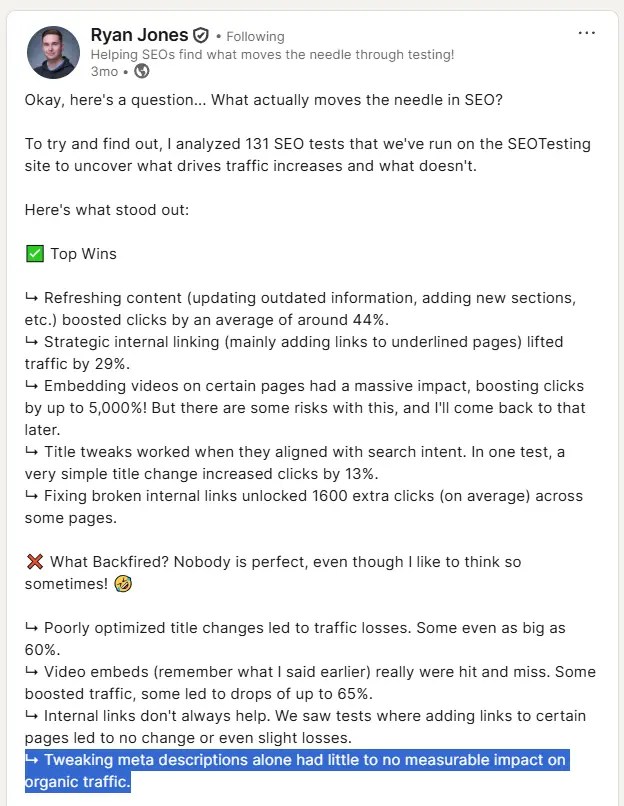
Experiments conducted by SEOTesting earlier this year indicated that optimizing meta descriptions barely affected traffic and a 2023 case studies by SearchPilot showed that removing them improve CTRs.
Google Rewrites Most Meta Descriptions
One reason why meta description optimization has limited impact is that Google replaces about 70% of them with content directly from the page.
Let me show you an example from one of our recent articles:
As you can see, the meta description tag reads “Discover what GPTBot is, how it works, and what its presence means for your website’s SEO, privacy, and AI data usage policies.”
However, if you search for “GPTBot,” that’s not what you find in the result snippet:
The snippet above was taken from the Key Takeaways section.
The Verdict: You Should Still Write Meta Descriptions
If Google rewrites most meta descriptions and they don’t move traffic, why bother with them?
First, social media platforms like Facebook still display the original meta description when users share the page. So, by skipping it, you reduce its visibility and shareability.
Secondly, Google itself still recommends it as means of “controlling the snippet.” Essentially, Google may use it in the SERP snippet if it answers the user query better than what Google finds on the page.
So although adding meta descriptions isn’t critical for SEO, still do it.
Yes, Google often replaces them. But you have a 30% chance that it doesn’t. If you skip the tag, you give up control of the first impression your page makes in SERPs without a fight.
How to Write a Meta Description: 11 Top Tips.
With the theory out of the way, here are 11 tips for writing meta descriptions that searchers (and Google) will like.
Stay Under 156 Characters and Front-Load
To ensure readers can see your meta description, don’t go over 156 characters and put the most key info in the first 110 characters.
Google cuts off the snippet based on pixel length: 960 pixels on desktop and 680 pixels on mobile. That’s roughly 145-155 and 110-130 characters, respectively.
Writing tools, like NeuronWriter below, feature snippet simulators, so you can preview it as you’re crafting your description, so you don’t overflow.
Check Existing Snippets
Analyzing the snippets for your keyword helps understand what kinds of descriptions Google prefers.
For example, all the meta descriptions for “motorcycle helmet” feature words like collection, range, or selection, kinds of helmets (full face, open face, flip up, etc) and brand names.
Mimick it when crafting your homepage or category page descriptions.
Satisfy Search Intent
Your meta description must reflect the search intent. Or in other words, it spell out what need it satisfies or problem that it solves.
For example, the article ranking #1 for ”keto diet’ has a definition of the diet and a brief explanation of how it works because the keyword has informational intent and that’s the kind of information users are after.
In contrast, the meta description for the homepage of Next, the UK retailer, aligns with the transactional/navigational intent. Anyone looking for ‘Next’ is likely shopping, so “Shop the latest women’s, men’s and children’s fashion…” nails it.
Highlight the Benefits
To win searchers’ clicks, show them what they will gain.
For a blog post or a guide, state what they will learn.
Like the meta description for the guide to fitting kitchen worktops, which promises to show the reader how to install it themselves without hiring a professional fitter.
For a product page, show potential customers its unique value proposition and how it will change their lives for better.
Slack’s meta description is a perfect example. It explains what the product does (“is a new way to communicate with your team”) and shows its advantages over alternatives (“faster, better organized and more secure than email”).
Use Active Verbs & Add a Compelling CTA
An effective meta description drives user action through a compelling CTA.
For a blog article, this could be “visit to learn”, for a software product page, “start free trial now”, and for a car, “Book a test drive today,” just like in the Toyota Yaris example.
The Toyota meta description starts with an imperative “enrich” which is also a common tactic to prompt readers to act.
Clearly Describe the Page Content
Effective meta descriptions summarize the page content accurately to tell the potential readers what they can find in the article to help them decide if it’s relevant.
That’s what the meta description for the BBC Gardeners’ World Magazine article on how to build a garden pergola does. It tells them what the article includes (advice, ideas) and how it’s structured (a list).
Inaccurate or misleading meta descriptions backfire: if the reader expects something else from the page, they bounce. This hurts the page rankings by signaling Google that the page isn’t relevant.
Include Primary Keywords Naturally
Including target keywords in your meta description is another way to signal relevance and help the meta description stand out.
How so?
Google boldens words and phrases related to user query in the snippet.
For example, when I searched for “climbing shoes,” it returned multiple results with the keyword boldened, including the one from Rock + Run product category page.
But embed the keywords naturally.
Keyword stuffing makes no sense because A) meta descriptions aren’t a ranking factor, B) Google considers it a spammy practice will most likely replace such descriptions.
And it will do it for your own benefit because it makes text hard to follow, negatively affecting the user experience, which may harm your brand perception.
Make Your Meta Descriptions Stand Out
Stand-out meta descriptions catch user attention and stop them from scrolling past.
You can achieve this with:
Eye-catching phrases
Sensory descriptions
Rhythm and rhyme
Alliterations
Witty puns, jokes and idioms (like “make a splash” in the M&S description).
Beware of clickbait — sensational wording, contrarian opinions, or half-truths. These might be fine for certain sectors, like celebrity news sites, but won’t cut it in ecommerce or SaaS.
Likewise, spammy claims like “best in the world” don’t inspire confidence while misleading and overpromising can bite you back: users won’t get what they expect and will bounce.
Match Your Brand Voice
Whatever the vibe of your home or product pages, match it in the meta descriptions. If you nail, you will improve brand recognition. If you get it wrong, you will undermine visitor trust.
For example, Naked Coffee’s home page tag perfectly mirrors the tone of its site and social media content.
Write Unique Descriptions for Every Page
Google recommends writing unique meta descriptions to differentiate pages.
Duplicate meta descriptions confuse readers and don’t help them choose the right page.
They also signal that you may not care much about the user experience (read “you’re lazy”).
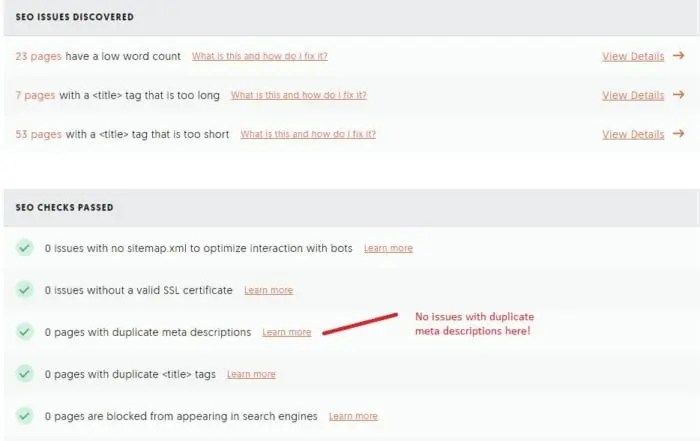
You can quickly identify meta description issues like duplicates by running the SEO Audit with Ubersuggest.
Be Consistent Across the Website
A consistent meta description format across your website provides a predictable user experience.
Mind you, it doesn’t mean ALL pages across the whole website should follow the same format.
But definitely pages of the same category. For example, all category pages and all product pages within the same category.
How to Write Meta Descriptions At Scale
For large websites with hundreds or thousands of pages, writing meta descriptions manually isn’t always feasible.
The solution?
Write them manually for the mission-critical pages, like your homepage, category pages, or top-converting product pages.
And generate the rest automatically, using:
Programmatic SEO: Create content from templates using data from structured databases or spreadsheets. Setting it up requires a certain level of technical expertise but once done, you can generate thousands of meta descriptions within minutes.
AI chatbots: Build a spreadsheet with all your pages, for example, by downloading it from the SEO tool, and prompt ChatGPT, Claude or Gemini to create the descriptions. Make sure to provide all the details, like the desired length and what it should include. The downside is that you still need to import these to your CMS.
CMS plugins: Install a plugin like AI for SEO (WordPress) or Metagen (Shopfiy) to generate meta in bulk. You can do it either with AI or by inserting variables, like
Whatever approach, always review and edit the descriptions manually to avoid embarrassing misfires.
FAQs
To finish, let’s answer a few frequently asked questions about meta descriptions.
What is a meta description in SEO?
It’s a short summary that shows up under your page title in search results. It doesn’t help you rank directly, but it can boost clicks by telling people what they’ll get if they visit your page. Think of it as your page’s pitch, fast, clear, and built to earn the click.
How to write meta descriptions for SEO?
To write an effective meta description, consider including relevant keywords and phrases that accurately describe the content on your web page. Additionally, ensure: Your meta description is unique and compelling. You use active language. That you highlight the benefits or solutions visitors can find on your page. You include a call-to-action.
Do meta descriptions affect SEO?
While Google doesn’t count meta descriptions as a ranking factor, meta descriptions still play a vital role in your SEO. Why? The brief summary you provide in a meta description gives users an idea of what to expect. This entices viewers to engage as they can see that your content meets their needs. Optimized meta descriptions can also enhance click-through rates.
How long should a meta description be for SEO?
The standard length for meta descriptions is 155 characters, but up to 160 is acceptable. Don’t forget to check the pixel widths of your meta descriptions to avoid truncated results. For mobile aim for 680 pixels, and for desktop 960 pixels.
Conclusion
Meta descriptions aren’t very important because they aren’t a ranking factor and Google rewrites most of them.
But if you don’t provide a meta description, you voluntarily surrender control over how users see your page in SERPs. This means missed opportunities to attract users and shape your brand image online.
That’s why writing meta descriptions is still one of the core SEO best practices.
Google AI Mode is search with a brain. It uses AI to answer questions directly, so it’s no longer about just blue links. Type, talk, or upload a photo, and it gives you a useful summary plus follow-ups. Here’s how it works and why it matters.
Google AI Mode is a feature in Search that uses generative AI to deliver full, conversational answers instead of just showing a list of links. It breaks questions into parts, pulls information from across the web, and presents a direct, useful response at the top of the results page.
This new feature doesn’t replace traditional search just yet, but it does build on it. As a result, it changes how people explore information and how content gets surfaced.
Are you curious about how this works? Check out the video below to see Google AI Mode in action while planning an autumn trip to Banff, Canada.
Search becomes a lot smarter
AI Mode handles different types of input, not just text. You can type a question, say it out loud, or upload a photo, and it works out what you mean. That flexibility makes it easier to search however and whenever it makes sense, whether you’re speaking into your phone, typing at your desk, or pointing your camera at something you want to learn more about.
It also uses what Google calls query fan-out. That means it quietly rewrites your question into a bunch of related ones and looks for answers across those variations. Ask something broad, like “best credit card for travel,” and the system may branch off behind the scenes, looking at fees, perks, user reviews, and so on.
AI Mode also pays attention to context. It keeps your previous queries in mind and follows the thread. You can ask follow-ups and get refined answers without starting from scratch.
An example of a search in Google AI Mode
How Google AI Mode works in practice
Using Google AI Mode feels different from standard search, and that shows up in how it delivers answers.
When someone asks a question, AI Mode doesn’t just take the words at face value—it tries to understand the intent behind them. It rewrites the query in several different ways behind the scenes, each one focused on a specific angle.
For example, a search like “what are the best places to travel in fall” might also trigger more specific questions in the background, like “pleasant weather and fewer crowds,” “fall foliage and scenic beauty,” or “unique experiences and cultural events.” AI Mode runs all of those in parallel, scans multiple online sources for useful information, and pieces together a response that covers what the user likely meant, even if they didn’t spell it out.
The response doesn’t look like a typical search results page. Instead of a list of links, users see a short summary stitched together from different sources. It reads more like an answer than a directory and can include images, maps, and more.
With AI Mode, you can also keep the conversation going. You could ask follow-up suggestions like “compare destinations in Canada,” “check visa requirements for Canada,” or “see average weather in British Columbia”. It helps users toward the next thing they might want to know without making them start over. The video at the top of this article shows this in practice.
The opening screen of Google’s AI Mode where you enter your questions
Behind the scenes, AI Mode uses passage-level retrieval. Rather than ranking entire pages, it scans individual sections, like a single paragraph, list, or sentence, to find the parts that answer specific pieces of the question.
That means a well-written section buried halfway down a product guide or FAQ could be surfaced, even if the full page wouldn’t normally show up high in the results.
This alone could make us rethink visibility. It’s less about a page’s overall ranking and more about whether any part of it directly addresses what someone is asking.
The focus of content is changing
AI Mode shifts how content gets discovered. It’s less about ranking in the traditional sense and more about providing answers that are both useful and directly relevant to what someone is asking.
The system is looking for content that fits into a specific response. That means structure matters, like clear headings, focused sections, and formatting that makes key points easy to extract. But usefulness on its own doesn’t guarantee visibility. The content has to align with the intent of the query in a very specific way.
Covering a topic from different angles helps. It gives your content more chances to match how people frame their questions, even when those questions vary in wording, detail, or focus. Visibility often depends not just on quality, but on precision.
Google AI Mode does several searches at the same time, while also looking at a large number of sites
What does Google AI Mode mean for SEO?
Google AI Mode could shift what we aim for. Visibility now depends on whether your content can deliver value right away, often in small, specific pieces. Google’s pulling answers from across the web: a sentence from one page, a stat from another, maybe a checklist from a support article.
That might feel limiting, but it opens up opportunities. If others are still optimizing for old patterns, there’s space to improve. Recognizing this shift early can give your brand a real advantage.
It also rewards a stronger understanding of how people search. Pages, tools, and features that directly answer real questions and make that answer easy to find stand a better chance of getting picked up.
Google added an AI Mode button to its search homescreen
Where it’s going
Google is folding AI Mode into regular search experiences. On some questions, especially ones that ask for a comparison, a definition, or a plan, it’s already showing AI-generated results first.
That approach is expanding. More queries will likely trigger this kind of response over time, which means the way content gets surfaced will keep shifting. Long, keyword-heavy pages won’t offer the same payoff they once did. What works now is content that’s clear, helpful, and flexible enough to match how people explore a topic.
Chances are, AI Mode isn’t a side feature for long. It’s looking more and more like the future of Google Search.
How to access Google AI Mode
AI Mode is rolling out now in the U.S. and India. If you’re using Google Search or the Google app, you’ll start to see a new AI Mode tab either at the top of the results page or right in the search bar. This gives you access to more advanced AI responses, improved reasoning, and a deeper view of web content through follow-up questions and linked sources.
If you don’t see AI Mode yet, it’s likely still rolling out. Expect it to appear automatically soon. Once it shows up, you can use it without any special sign-up or activation. Once Google figures out monetization, we’ll see it roll out AI Mode to more countries soon.
You can also access it from search results. If Google thinks your query fits, a “Try in AI Mode” option may appear automatically. Trying it out firsthand gives the clearest insight into how responses are built and how your content appears.
Meet Google’s AI Mode
Google AI Mode signals a shift in how search works. It’s not just about rankings anymore. It’s about how helpful your content is and how easily it can be used to respond to real questions.
This change gives SEO and content teams a reason to look at their work differently. Clear structure, focused writing, and alignment with how people search all play a bigger role in visibility.
It’s a good time to step back, reassess what’s working, and explore areas you may have overlooked. For many, this is a chance to improve useful content, refine formats, and meet search expectations in new ways.
http://dubadosolutions.com/wp-content/uploads/2017/05/dubado-logo-1.png00http://dubadosolutions.com/wp-content/uploads/2017/05/dubado-logo-1.png2025-07-24 12:00:002025-07-24 12:00:00What is Google AI Mode?
We’re excited to announce the Google Trends API alpha test. This new API will help
Researchers, Journalists, and Developers to understand Search behaviors and patterns.
While Trends data is available through the Trends website, the API provides new ways to
use the data inside your organization in a scalable way.
https://i0.wp.com/dubadosolutions.com/wp-content/uploads/2021/12/web-design-creative-services.jpg?fit=1500%2C600&ssl=16001500http://dubadosolutions.com/wp-content/uploads/2017/05/dubado-logo-1.png2025-07-24 04:00:002025-07-24 04:00:00Introducing the Google Trends API (alpha): a new way to access Search Trends data
LinkedIn is the best platform for building professional connections, finding B2B leads, and job hunting. But in order to make the most of the platform, you need a LinkedIn headline that’s going to stand out.
Below, we discuss what a LinkedIn headline is, how you can write a good one, plus showcase 20 amazing examples you can use for inspiration.
Key Takeaways
A LinkedIn headline is like a quick elevator pitch showcasing what you do professionally.
To write a good LinkedIn headline, you want to start by perusing different examples to get an understanding of what your headline should include.
Make sure to incorporate things like your current role, your biggest skills, industry keywords, and other important information in your own headline.
What Is a LinkedIn Headline?
A LinkedIn headline is a short description of who you are/what you do that sits at the top of your LinkedIn profile. As you can see below, my LinkedIn headline is “Co-Founder at Neil Patel Digital.” Short, sweet, and to the point.
There are a number of ways to write your LinkedIn headline. You can keep it simple like mine, share a bit more about what you do, or infuse some personality into it. Just make sure it matches your overall personal brand—more on that later.
How to Write a Good LinkedIn Headline
To craft a LinkedIn headline that grabs attention and really showcases who you are, there are a few key elements you want to include. Follow along with these steps to write a good headline that properly details who you are and what you do.
Look at Examples Before You Start
Before you even put a single word in your headline, look around the platform to see how others describe themselves. You can also scroll down just a bit to see 20 amazing LinkedIn headlines we’ve hand-picked to share with you.
Looking around at how other users have written their headlines can be a great way to get the creative juices flowing in your brain. Plus, you can figure out styles that don’t suit you, giving you some parameters to start with.
Include Your Current Role
Now let’s get down to business. It’s time to start writing your LinkedIn headline. And the first thing you want to do is write down your current role.
Keep it simple. Something like “VP of Marketing at Company” or “Dev Lead.” And if you’re currently unemployed and job hunting, you can share that, as well, by writing out something like “Searching for a role in the HR tech space.”
Add Your Skills and Expertise
Next, include any relevant skills and expertise you have that will help you stand out. This can be really simple and in list form, like “Content Strategy, Product-Led SEO.” Or you can be a bit wordier and write something like “I build landing pages that convert.”
Including your best skills and experience can help you stand out, especially if you’re job hunting, looking for new clients, or aiming to expand your professional network.
Incorporate Industry Keywords
One major component of LinkedIn is its search functionality. And to make sure you appear in search results when people are looking for someone with the type of experience you have is to incorporate the right keywords into your headline.
You don’t want to create a keyword-stuffed, jargon-filled LinkedIn headline. But you do want to incorporate enough keywords that they sound natural while still helping you boost your profile’s ranking in search results.
Promote Yourself
Don’t be afraid to show off a bit with your headline. You’re good at what you do. Let it be known. For example, you could include something like “Built a channel with 1M+ YouTube subscribers” or “Building a bootstrapped SaaS product.”
Or, you can talk about what you do for clients. Like, “I write high-converting website copy,” or “I create social media ad campaigns that get results.”
LinkedIn is a professional social networking platform. The goal is to increase your online network, whether that’s finding new clients, making new colleagues, or meeting new industry professionals. And one great way to do that is to really sell what you can do.
Let Your Personality Shine
Just because LinkedIn is a professional platform doesn’t mean you can’t still let your personality come through in your headline and in your content. Include a line that provides a bit more context into who you are as a person—and not just as a professional.
We’ve included a few examples below of how some users have chosen to showcase their personality, even while remaining professional.
Make It Short and Sweet
You only have 220 characters to sum up exactly what you do and who you are in your LinkedIn headline. It’s like the shortest elevator pitch ever. So you need to find the right words to introduce yourself to other LinkedIn users in a really short, concise way.
Another pro tip: Keep the most important part of your headline at the beginning. In both search results and the LinkedIn feed, people will only see the first several words of your headline. They have to click to your profile to see the entire thing.
Make your headline short and sweet, but also, make them want to click to see more about what you have to offer.
20 LinkedIn Headline Examples to Steal
If you want to create your own impactful LinkedIn headline, you first need to look around and see how others in your industry are composing there. Here are 20 different ideas you can steal for your headline to get you started.
Similar to my headline, you can choose to just be straightforward, sharing nothing but your existing role. Don’t worry about any added fluff—just include what you do and where you work so your new connections know exactly what to expect from you.
Or, you can choose to have some fun with your LinkedIn headline. Infuse your personality into it, creating a headline that’s still relevant to what you do but also lets you showcase a bit of who you are.
This example, “I live on LinkedIn for a living,” works because Kate is a LinkedIn content creator. So she’s able to put a bit of who she is into her headline while still remaining true to her professional work.
In this example, we see the freelancer has included companies she’s worked with in the past right inside of her LinkedIn headline. This is a great way for potential clients to see if she’ll be a good fit right off the bat.
Consider incorporating some of your past or current clients within your own headline, especially if you only work with companies within a specific industry. It can help narrow down your incoming work requests to more relevant brands.
With this example, Olly has let his followers and connections know exactly what to expect from him and his content. He’s building in public, sharing his experience, and providing content that others in the same boat might be interested in.
Use your LinkedIn headline as a sort of elevator pitch, promoting yourself and your product or services. In this example, Esha has written that she will write content for your brand that will keep people from scrolling past.
For your own headline, come up with a quick one-liner that perfectly encapsulates what you do so you can use your LinkedIn profile as a way to bring in new work.
Another simple way to use your LinkedIn headline is by simply making a list. List out different roles you have, share a few things about yourself like we see in this example, or list out some of your different skills.
This is a great example because you can use it in any way. Use characters like the “|” or “-” to separate your list items in a visually appealing way that’s easy to follow.
Let new connections know what kind of content to expect from your LinkedIn posts. By sharing the topics you talk about, you can find like-minded connections and colleagues that are going to be much more likely to engage with you on the platform.
Explain exactly what you do so that LinkedIn users understand if they want to connect with you or not. This is also a great way to find new work, by creating a one-two line overview of what you have to offer potential clients.
If you’ve been working on building up your personal brand, make sure your LinkedIn headline matches that voice or branding. In the above example, we can see this creator incorporates all lowercase letters into their overall voice and branding. So of course it makes sense for her to continue that right within her headline.
If you’ve won awards or other accolades that are relevant to your work, why not tout them within your LinkedIn headline? Include major accomplishments right inside your headline to further promote your expertise within your profession.
Again, your LinkedIn headline can be treated like a short and sweet elevator pitch. With that in mind, one great way to use it is by creating a tagline of sorts that shows off what you do within a catchy one-liner that can stick in potential clients’ minds.
This example is great because not only does it share the user’s exact role, but she also added some additional product promotion. So instead of just seeing that Kirsty works at Chameleon, we now know exactly what type of company it is, and she’s included an adjective that helps sell it even further.
What do you have to offer potential clients, customers, or employers? Write out your value proposition and include it as part of your LinkedIn headline. This is another great way to try to promote your product or services and generate new work through the platform.
Take a page out of Liz Willits’ book and just throw some humor into your headline. Just because LinkedIn is a professional platform doesn’t mean everyone’s headlines need to be formal and stuffy. This review from her mom showcases that Liz enjoys infusing humor into her work.
Incorporating buzzwords can be a great way to grab attention. It’s the perfect example in this instance as Scott is a copywriter, so throwing in these big, eye-catching buzzwords not only intrigues potential connections but also showcases a bit of what he can do.
If you have multiple roles you want to promote, include all of them within your headline. We see Lee doing this in the last line of her headline, listing out, “Business owner, author, teacher, and traveler.”
You can include a link within your LinkedIn profile, but why not make it even easier for people to discover where they can learn more about you or your business by sharing a link right inside of your LinkedIn headline? It won’t be clickable, but viewers can easily copy and paste it into their browser bar.
Proud of your professional achievements? Show them off. We see Ben doing just this by sharing that he boosted monday.com’s monthly visitors from nothing up to 231k. Including tangible accomplishments like this can be a great way to showcase what you can do for potential clients and employers.
Showcase your professional mission right inside your LinkedIn headline. In this example, we see Tori sharing that she wants to build five million women’s net-worth and self worth. Sharing this is important as it’s a main part of her overall business goals. It also helps her to stand out to her potential audience.
You don’t need to keep your professional and personal self separated. Feel free to include personal details in your LinkedIn headline—especially if they’re relevant to your professional role. In this instance, we see Maggie share that she’s a mom right inside her headline. This makes sense for her as she’s building a platform focused on transforming parental leave.
FAQs
What is a LinkedIn headline?
It’s the short line of text right under your name on your LinkedIn profile. Think of it like a quick intro. it tells people what you do and why they should care. It shows up in search results, connection requests, and posts, so it’s one of the first things people see.
What should you put in your LinkedIn headline?
Start with your role or title. Then add what you’re good at or what makes you different, including things like skills, results, industry keywords, or a short value proposition. Keep it tight, use natural language, and make sure it actually sounds like you. Bonus points if it sparks curiosity or shows some personality.
Create Your Own LinkedIn Headline
Write your own LinkedIn headline by taking advantage of the tips and examples we’ve included throughout this article. Your headline should showcase what you do professionally, the kinds of content you share, and what your skills are so your new connections know what to expect.To make the most out of your Linkedin presence, check out my guide on LinkedIn marketing next.
Google SERP (search engine results page) is full of handy features and enriched organic results nowadays – the so called rich snippets. In this guide I will show you…
https://i0.wp.com/dubadosolutions.com/wp-content/uploads/2025/07/rich-snippets-CZJ8bI.png?fit=960%2C517&ssl=1517960http://dubadosolutions.com/wp-content/uploads/2017/05/dubado-logo-1.png2025-07-23 11:51:192025-07-23 11:51:1928 Google rich snippets you should know in 2025 [guide + infographic]
That’s a great example of trendjacking, or inserting your brand into viral online conversations.
It felt like every brand — from global airlines to your local coffee shop — jumped into labeling themselves. Some were hilariously on-point and others…well, not so. For every well-executed moment like a wellness brand that tailored their take to be timely, irreverent, and match their core voice, dozens more missed the mark. And like it or not, audiences can tell.
That’s the fine line with trendjacking. What was once a cheeky social media trick has become a high-stakes play for many modern social media marketers. To stand out and not alienate, brands need more than speed. They need emotional intelligence, audience awareness, and restraint to not jump on every viral moment.
How can you harness what’s trending without sounding tone-deaf or jumping the shark? Let’s break down the basics of effective trendjacking and how you can approach it in a smart way.
Key Takeaways
Trendjacking is the practice of inserting your brand into viral conversations in a way that feels timely, relevant, and authentic.
Success requires cultural awareness, audience alignment, and speed. Not every trend is right for every brand.
Smart brands use social listening tools and planned content workflows to catch trends before they peak.
Measuring trendjacking goes beyond likes. Look at sentiment shifts and meaningful engagement.
The future of trendjacking will likely be shaped by AI tools, new platforms, and the growing demand for authenticity.
What Is Trendjacking?
Trendjacking is the practice of injecting your brand into a popular or viral conversation to boost visibility, engagement, or relevance. Brands jump on trending topics like memes, social media challenges, or major pop culture moments to join the conversation in ways that are timely and clever.
Trendjacking really gained traction during the heyday of Twitter (now X), when brands like Oreo seized viral moments (the “You can still dunk in the dark” tweet during the 2013 Super Bowl blackout) and earned massive engagement for real-time creativity. That post was a signal to marketers that being culturally responsive could pay huge engagement dividends.
Trendjacking isn’t a completely new strategy, though. It has its roots in the older PR strategy of newsjacking. Popularized by David Meerman Scott, newsjacking focused on inserting brands’ perspectives into breaking news stories to get media coverage. Trendjacking is just an evolution of that strategy, tapping into a broader range of online moments.
When you do it well, trendjacking can help your brand show personality, relevance, and humor. But it’s not a strategy without risks, especially if you do it without considering nuance or alignment to your brand’s values.
How to Pull off an Effective Trendjacking Campaign
Let’s say you’re ready to drive into trendjacking. How do you do it right? Like many effective social media strategies, the best trendjacking campaigns start long before a trend even surfaces. Success often hinges on preparation and cultural awareness, but the real secret is the agility to act fast without sacrificing your brand’s integrity.
Identify Potential Trends
Trendjacking starts with awareness. The earlier you spot a trend, the better your odds of leading the conversation rather than chasing it.
Start with traditional sources. Social listening tools such as AnswerThePublic, TikTok Creator Search Insights, or Sprout Social can surface what’s gaining traction across different platforms. The latter can help you keep an eye on places like X, Bluesky, TikTok’s trending page, Reddit threads, and even Google Trends to stay ahead of the curve. Using these tools doesn’t just tell you what’s trending. They help you catch the wave before it crests.
Effective trendjacking goes deeper than identifying meme formats or hashtags, though. Ask yourself these questions:
Why is this trending?
What emotion is it tapping into?
What cultural shift or behavioral insight is at play?
Take, for example, the “Girl Dinner” trend. It wasn’t just a meme. It was a commentary on autonomy, wellness fatigue, and the pushback against curated perfection.
In addition to staying on top of developing trends, think ahead. Certain events almost always spawn viral moments: award shows, the Met Gala, political debates, and major sporting events are excellent fodder for trends. Develop a calendar of these events and build a properly resourced team that can act when the internet lights up.
Assess the Trend’s Relevance
Before you jump into the trend, assess whether or not it’s right for you. Ask important, hard questions, like “Does this trend actually align with our brand?” and “Will our audience care?” Finally, will it feel authentic or forced?
Many brands falter here. Chasing a trend that’s off-brand does more than fall flat; it risks damaging your credibility. The Duolingo x Scrub Daddy “cursed collab” worked because both brands share a quirky, unfiltered tone. If a serious financial brand tried the same joke? Cue the confused and cringing followers.
Assess risk, too. Some trends carry baggage, like political undercurrents, social controversies, or rapidly shifting sentiment. Your internal team should include diverse perspectives to help flag possible missteps.
Beyond relevance, hopping on the trend should add to your brand’s story. If it doesn’t connect to your values or content pillars, it might be better to skip it. Not every viral moment is worth jumping into. Restraint is often what separates trend-chasers from trend leaders.
Produce the Content—Quickly!
Once you’ve vetted a trend, it’s “go time.” Timing is everything in trendjacking. Wait too long, and you’re just adding noise to an already crowded feed.
In practice, your team needs a streamlined workflow to move from idea to pressing the publish button in hours, not days. Empower social managers with decision-making autonomy. Maintain a library of pre-approved assets like brand visuals, fonts, and tone examples so your team can capitalize on trends without needing to create a full-scale design from scratch.
Creating internal “trend kits” or rapid response playbooks can help your team execute quickly and safely. Remember: the most memorable trendjacks feel both spontaneous and strategically on-brand because they are.
Creating Impactful Trendjacking Content
Once you’ve identified the right trend and confirmed it makes sense for your brand to participate, the real magic begins: creating content to hit the sweet spot of relevance, creativity, and authenticity. Not every trendjacking post needs to be laugh-out-loud funny or ultra-slick, but it should always bring something fresh and on-brand to the table. Some tried-and-true strategies for creating trendjacking content that resonates include:
1. Customize by Platform
What works on TikTok might not work on LinkedIn, and vice versa. Tailor your content’s tone, format, and visuals to the platform you’re posting on. Wendy’s built their brand on X with snarky one-liners, but the food chain takes a more curated and visual approach on Instagram.
2. Embrace the Weird (Strategically)
Humor, absurdity, and left-field creativity often fuel viral trends. But you can’t force it. Duolingo’s TikTok presence leans fully into weirdness, but it’s consistent with their edgy, millennial-savvy voice.
Add Value. Don’t Just Copy
Don’t simply copy-paste a trending meme format. Add your brand’s POV, a clever twist, or insights that enhance the original. For example, Canva recently leveraged the app’s ability to create color schemes with the growing popularity of Labubu toys.
4. Prioritize Authenticity
Your audience can smell a cash grab a mile away. If the trend doesn’t align with your values or voice, skip it. If you really feel like you need to participate, subtly nod to the trend without trying to dominate it. Engage, like, or reply to accounts that have posted content in the trend without creating new assets on your own.
5. Keep the Content High-Quality
Even in a fast-moving trend cycle, visuals (and sound) matter. Low-res graphics or clunky text overlays can kill your momentum. Use templates or pre-approved brand assets to keep things polished under pressure.
Trendjacking is not the time to let the copywriter have the keys to the Canva account.
When Trendjacking Goes Wrong…
Trendjacking is a real double-edged sword. When done right, it’s clever, memorable, and engaging. When done wrong, it’s also memorable, but for the wrong reasons; it’s tone-deaf, confusing, or even damaging to your brand. Avoid these common pitfalls.
Tone-deaf or Insensitive Posting
Some trends are tied to serious or sensitive events, and misjudging the tone can result in intense backlash. That’s what happened to Pepsi in 2017 for their ad that featured Kendall Jenner, which co-opted protest imagery to sell soda (and promptly got called out for trivializing real social movements).
Just because a topic is trending doesn’t mean it’s safe territory. Assign someone on your team to assess social sentiment and cultural context before engaging.
Jumping in Too Late
Timing is critical. A trend that peaked two days ago may already feel stale, especially if your post doesn’t add anything new. Joining late makes your brand look like it’s scrambling to stay relevant, not leading the conversation.
To avoid this, consider streamlining your approvals process and having brand-safe assets ready to go.
Misunderstanding the Trend
One of the fastest ways to make a brand look out of touch is to misinterpret the trend altogether. Imagine someone at your company wanted to tweet a meme that referenced “Netflix and chill,” without realizing its NSFW subtext. The internet might notice and not in a good way.
Before trendjacking, do a quick sentiment check. What does this trend actually mean to the people participating in it?
Forcing the Fit
If the trend doesn’t suit your brand voice, values, or audience, don’t force it. It’s painfully obvious when a B2B SaaS brand shoehorns itself into a Gen Z meme format meant for fashion or pop culture. This usually results in low engagement at best and audience cringe at worst.
Brands need a straightforward internal process for evaluating the risk of trendjacking campaigns. Who gets to greenlight? What criteria does the content meet? Building a lightweight risk assessment checklist or review board (creative + legal + DEI leads) can help you act quickly and responsibly.
Lack of Crisis Planning
Even with the best of intentions, things can go sideways fast. That’s why it’s smart to develop a basic crisis response protocol before engaging with fast-moving or culturally sensitive trends. Know who will respond, how quickly, and what steps to take if content sparks backlash.
Measuring Success and Finding Learnings for the Future
With your trendjacking content out in the world, it’s time to answer the big question: Did it work?
Start by measuring the basics: likes, shares, reach, and impressions. These top-level metrics help assess immediate visibility and initial audience reaction.
Smart marketers go further, though. The most impactful trendjacking efforts don’t just rack up views. They strengthen brand equity and move the needle on meaningful outcomes. Ask yourself:
Was the engagement meaningful? Analyze the sentiment and depth of conversation in your engagement. Did people share it with thoughtful comments or tag their friends, or was the engagement just a flood of indifferent likes?
Did it shape perception or sentiment? Use social listening tools to see if brand sentiment improved during and after the campaign. Google Analytics and UTM parameters can help tie social moments back to web traffic and conversion goals.
Did it drive real behavior? Track clicks, sign-ups, or sales lifts during and after the campaign. This is another instance where Google Analytics and UTM parameters can help tie those moments back to web traffic and conversion goals.
Did it strengthen community? Great trendjacking does more than entertain. It builds a sense of belonging. If the post sparked DMs, follow-up content ideas, or user-generated content (UGC), that’s a sign your audience is invested.
Want to level up your campaign? Try aligning your trendjacking posts with keyword-focused content or campaign themes. This gives your SEO strategy a boost, especially in a world where Search Everywhere is the norm (and users can Google the trend and stumble onto your brand).
Upcoming Trendjacking Trends
The art and science of trendjacking will only evolve as the digital landscape shifts. Marketers who want to stay ahead of the curve will need to keep a pulse on what’s trending and how those trends take shape and spread. The future of trendjacking will evolve thanks to things like AI, new platforms, and the rise of “unpolished” realness.
1. AI-powered Content Creation
AI is creating massive shifts in real-time marketing as tools like ChatGPT, Midjourney, and Runway help brands generate reactive content faster than ever. From clever captions to custom visuals, the future of trendjacking likely includes AI-enhanced creativity. The big challenge for brands is to remain authentic in the face of automation.
Could ChatGPT help brands jump on the enthusiasm for Labubu without spending the time to go out and source a doll? Possibly.
2. New and Niche Platforms
Instagram, TikTok, and X may reign supreme among platforms, but that won’t always be the case. Bluesky is becoming increasingly popular, and YouTube Shorts has challenged TikTok as a vehicle for short-form video content creation. Expect trendjacking to require more platform-specific fluency, understanding not just the content but the culture of each channel.
3. The Rise of “Unpolished” Realness
Consumers are tired of overproduced content. The next wave of trendjacking will favor brands that show up with honesty, humor, and heart. Even if that means posting something that feels more lo-fi than high-concept. Authenticity isn’t just a “nice to have” anymore. It’s a prerequisite for engagement.
Bobe’s Pizza may be a small Indiana brand, but they lean on authentic content that resonates with their core audience.
The bottom line is that the future of trendjacking isn’t about being fast. It’s about being fast, smart, and real while building systems to let your brand respond with agility and intention.
FAQs
What is the difference between trendjacking and newsjacking?
While both strategies involve jumping into timely conversations, the difference lies in what you’re responding to. Newsjacking is about inserting your brand into breaking news stories — typically through PR or expert commentary — while trendjacking taps into broader online trends, like memes, pop culture moments, or viral challenges. Trendjacking is more social and creative, whereas newsjacking is often more formal and media-facing.
What is an example of trendjacking?
A classic example is Oreo’s “You can still dunk in the dark” tweet during the 2013 Super Bowl blackout. The brand reacted in real time with a witty graphic and caption, and the internet loved it. More recently, brands like Ryanair and Duolingo have gone viral for trendjacking TikTok memes using their unique, offbeat brand voices. The key to successful trendjacking? Speed, creativity, and cultural fluency.
What is the trendjacking strategy?
When done well, trendjacking helps brands increase visibility, boost engagement, and connect with audiences in a culturally relevant way. It shows your brand has personality and a pulse. Beyond racking up likes, the real value comes from building brand affinity, sparking conversations, and staying top-of-mind in an increasingly noisy digital space.
Conclusion
Trendjacking is about moving fast and smart. When you do it right, it can drive massive visibility and deepen brand affinity. It takes planning, awareness, and a clear voice to avoid the pitfalls and stand out in the scroll. Whether it’s memes, moments, or movements, show up with purpose.
http://dubadosolutions.com/wp-content/uploads/2017/05/dubado-logo-1.png00http://dubadosolutions.com/wp-content/uploads/2017/05/dubado-logo-1.png2025-07-22 19:00:002025-07-22 19:00:00What Is Trendjacking & How to Do it for Your Brand
Black Friday is the biggest rush of the year for most ecommerce businesses, and it is right around the corner. The most successful merchants prepare for Black Friday early and follow a structured plan to prepare their stores, ensure visibility, and convert first-time visitors into long-term customers.
This guide breaks down your preparation into three categories: Basic, Intermediate, and Advanced. Each section builds on the last so that you can grow your readiness over time, regardless of your team size or budget.
Basic: Start with what you can control for Black Friday
These actions lay the groundwork for everything else. Without these, no advanced strategy will stick.
1. Optimize your metadata
First impressions matter, and your metadata is the first thing users see in search results. So make it count and leave a lasting impact.
Why it matters: Strong metadata can improve visibility and attract more clicks. When your titles and descriptions align with what shoppers seek, your chances of standing out rise significantly.
Actionable tips:
Prioritize metadata for high-traffic products and category pages.
Include seasonal keywords such as “Black Friday deals” or “holiday gift ideas.”
Keep titles and descriptions concise and compelling.
With Yoast SEO for Shopify and Yoast WooCommerce SEO, you can preview and improve your metadata in real time. The tools flag missing or duplicated fields and guide you on how to write content that earns clicks.
2. Optimize product pages for both humans and search engines
Product pages are the moment of truth. They’re where curiosity turns into clicks and clicks turn into customers.
Why it matters: No matter how great your traffic or ads are, most people will leave without buying if the product page feels confusing or incomplete. A well-structured page improves your chances of ranking in search and helps buyers feel confident in their decision.
Actionable tips:
Lead with benefits, not just specs. Tell shoppers how the product fits into their lives.
Use bullet points and headers to make details skimmable.
Reinforce trust by showing stock levels, customer reviews, and delivery clarity.
Bulk update how you showcase your product on Shopify using Yoast SEO for Shopify Content Templates feature.
Yoast WooCommerce SEO and Yoast SEO for Shopify help your product pages appear cleanly and clearly in search results. They add structured data behind the scenes and check your content for SEO and readability so you can focus on turning visitors into buyers.
3. Use internal links to guide traffic
Internal linking guides customer to surface key pages, maps user behavior, and boosts your site’s SEO.
Why it matters: Internal linking helps search engines understand your site structure, distributes authority to key pages, and guides visitors toward high-converting content. It keeps users engaged, supports SEO, and makes your promotions easier to surface across your site.
Actionable tips:
Link to your Black Friday page from key blogs and evergreen content.
Feature top categories or bestsellers in your navigation.
Use anchor text that aligns with what users are searching for.
Yoast WooCommerce SEO offers internal linking suggestions as you write, making keeping your content connected and strategic easier.
Fast wins and common pitfalls
Once you have set up the basics, some steps can help you boost impact quicker and avoid costly missed opportunities.
Fast wins:
Swap stock photos for original product shots
Double-check coupon logic and expiration dates
Test any gift wrap or personalization options on product pages
Big pitfalls to avoid:
Waiting until November to publish seasonal content
Using duplicate product descriptions from suppliers
Letting broken links or outdated pages remain live
Intermediate: Strengthen your SEO and campaign strategy
Once the technical foundation is stable, it’s time to focus on your content and promotions.
4. Test and improve your site’s speed
Site speed directly impacts user experience, especially during high-traffic periods like Black Friday. Slow-loading pages frustrate shoppers and lead to lost sales.
Why it matters: A fast site supports smoother browsing and quicker checkout. Search engines consider page performance in rankings, and users are more likely to buy when the experience feels seamless.
Actionable tips:
Use performance monitoring tools to identify slow pages.
Compress and resize large images to reduce page load times.
Deactivate unused plugins (WooCommerce) or apps (Shopify).
Clean up excessive code or bulky page elements.
While Yoast SEO is not a speed optimization tool, clean site structure and proper internal linking help improve crawlability and engagement, indirectly supporting performance.
5. Create a focused Black Friday landing page
Your landing page is the command center for your seasonal promotions. It’s where visitors decide to browse further or bounce.
Why it matters: A dedicated page gives your Black Friday campaign direction and cohesion. Instead of scattering your offers across the site, it provides a clear path for shoppers to follow. It simplifies navigation, allows for better internal linking, and gives you a consistent, trackable URL for email campaigns, ads, and site banners. Plus, it’s reusable! Just update the content each year.
Actionable tips:
Create a short, memorable URL like /black-friday-deals and keep it live year-round.
Showcase limited-time offers, bundles, top-selling categories, and exclusive discounts.
Use persuasive headers, quick-loading images, and CTA buttons that lead directly to product pages.
Answer common buyer concerns upfront, e.g., shipping deadlines, return windows, and local pickup options.
6. Segment your email list and automate flows
Email isn’t just another marketing channel during Black Friday; it’s your direct line to customers ready to buy.
Why it matters: Blasting the same message with monotonous tone to everyone no longer works. Crafting compelling emails with personalized messages that resonate with the reader is key to email marketing. People are more likely to open, click, and shop when an email speaks to their pain points and highlights the solution. A segmented email list means you’re talking to people based on what they care about: early access, bundles, or a product they viewed or left in their cart.
Actionable tips:
Break your list into clear segments, e.g., loyal customers, cart abandoners, and holiday-only shoppers.
Map out your flow: teaser email, early access offer, launch announcement, final hours.
Track performance with UTM parameters like utm_campaign=bf25 so you can optimize in real time.
7. Create content that helps people find your deals earlier
Buyers don’t always search for discounts. Many start with questions or ideas like “affordable gifts for coworkers” or “best tech gift under $100.”
Why it matters: Helpful blog posts and gift guides pull in people who aren’t searching for your brand yet. These early touchpoints introduce your products and lead them toward your Black Friday offers.
Actionable tips:
Write guides and roundups tied to real shopper intent.
Use long-tail keywords that match seasonal search habits.
Add smart internal links to featured products or your Black Friday landing page.
Fast wins and common pitfalls
Once your product pages are polished, tighten up the surrounding details.
Fast wins:
Set a calendar reminder for your campaign email and social media schedule
Add an announcement banner linking to your Black Friday page
Test your email signup and welcome flow to catch any issues
Big pitfalls to avoid:
Forgetting to link email campaigns to relevant landing pages
Using inconsistent messaging and UTMs across channels
Launching your Black Friday page too late for indexing and ranking
Buy WooCommerce SEO now!
Unlock powerful features and much more for your online store with Yoast WooCommerce SEO!
Advanced Black Friday preparation: Boost visibility, trust, and retention
If you’re already doing the essentials well, these strategies will help you scale.
7. Improve your chances of showing up in local search
If you offer in-store pickup or have a physical store, don’t miss out on the people searching near you. Shoppers looking for same-day purchases often skip past online-only stores.
Why it matters: When someone searches for a product near them, being present in the results can drive instant foot traffic and build trust before they even walk in.
Actionable tips:
Ensure your name, address, and phone (NAP) are identical across all pages and listings.
Update your opening hours and add clear pickup instructions.
Add content to your site that mentions your location, city, or neighborhood.
Yoast Local SEO is included in the Yoast WooCommerce SEO. It helps you create and manage local schema and landing pages that appear in search. (It is not available for Shopify.)
8. Use structured data to stand out in search
When someone searches for a product and your listing shows price, availability, or reviews, that’s not luck. That’s structured data.
Why it matters: Rich snippets give your products more space in search results, credibility, and clicks.
Actionable tips:
Add structured data (schema) for Product, Offer, and Review to top-selling listings.
Use Google’s tools to check that your schema is implemented correctly.
Use product variant schema to improve your chances of showing in rich search results.
9. Set up post-purchase flows before the sale starts
Black Friday may be over at checkout, but it’s just the beginning of your relationship with a new customer.
Why it matters: People who buy during Black Friday often need reassurance and support. They’re far more likely to come back if they feel taken care of.
Actionable tips:
Set up automated flows for thank-you messages, setup tips, and review requests.
Offer a discount for a second purchase or referral.
Guide people back to your product pages or Google review profile.
Taking care of this now means you can focus on fulfillment and service during the Black Friday rush.
Fast wins and common pitfalls
A thoughtful follow-up and last check make sure you build on opportunities and are ready for what might come your way.
Fast wins:
Recheck your sitemap to ensure new pages are indexed
Update your business hours and contact details in your footer
Enable review requests to trigger automatically post-purchase
Big pitfalls to avoid:
Making last-minute technical changes with no buffer
Ignoring mobile performance and checkout testing
Overlooking schema validation or broken structured data
Final thoughts
Preparing for Black Friday is about being proactive, not reactive. Every SEO improvement you make now, from product pages to local visibility, will help you attract more shoppers and turn clicks into customers.
Yoast gives you the tools to stay ahead: clearer product listings, stronger search visibility, and smart automations that scale with your store. Whether you’re using Shopify or WooCommerce, optimize now to be ready before the crowds arrive.
http://dubadosolutions.com/wp-content/uploads/2017/05/dubado-logo-1.png00http://dubadosolutions.com/wp-content/uploads/2017/05/dubado-logo-1.png2025-07-22 12:40:022025-07-22 12:40:02How to prep your Shopify or WooCommerce store for Black Friday before the rush starts
The summer is well on its way. Should you already start preparing for Black Friday and the holiday season? Yes! They’re the biggest sales of the year, and ranking in Google is something you take time to do. It’s never too early to start getting your deals ready. So, if you are a merchant with an online store or an ecommerce business, let’s start working on your holiday season and Black Friday SEO immediately!
Don’t forget that Black Friday (November 28, 2025) and Cyber Monday (December 1, 2025) are kicking off this year’s holiday shopping season. You can set up a lot of content for all occasions. In this post, we’ll review some things you can do to prepare!
Today, people are used to shopping online. It’s easy and convenient. You don’t have to travel only to find something out of stock. Plus, online stores often offer payment plans. Shopping online is so popular that online sales during the holiday season keep hitting record after record. And the numbers will only continue to rise. That’s why it’s safe to assume that people will buy many (if not most) holiday gifts online this year.
Staying on top of trends to prepare for the holiday season is good. E-commerce is still growing, and consumers expect more every year. Here are some actionable tips for the upcoming Black Friday and holiday season to improve your SEO:
Discount deals and alternative payment options (Buy now, pay later) should be part of your ecommerce strategy
Brands should provide a consistent purchasing experience across digital/online and physical stores
To minimize returns, brands should make their product pages as comprehensive as possible
Holiday season marketing campaigns should be tailored to each platform to ensure maximum effectiveness
Online is where it’s at
Of course, in-store or curbside pick-up will still prove popular. However, most people research their ecommerce purchases online – sometimes weeks in advance! So don’t be surprised when the holiday shopping season starts well before Black Friday and continues for weeks.
Extending Black Friday, Cyber Monday, and other holiday season online deals for a few days or weeks can be a good idea. This is especially true if you want to prevent huge crowds from gathering at your store on a specific day. That won’t be a good shopping experience for anyone involved, so spreading these deals over an extended time is probably better.
Start preparing in time
Dive into the data you amassed during previous Black Friday and Cyber Monday events, and see if you can come up with improvements for your e-commerce holiday season SEO. Bear in mind that it takes a while for content to rank. So, to keep up with the competition, try to get your content in gear at least 45 days ahead. That’s often recommended. Of course, you can always start preparing earlier if that works better for you. Your schedule could look something like this:
45 Days in advance: Post your promotion to your website calendar and post a save-the-date post on social media and in your email newsletter.
7 Days in advance: Post upcoming events/promotions on social media and via email. Try to encourage other (small) businesses to share it with their followers.
1 Day in advance: Post an event reminder on social media.
It’s a good rule to remember these steps and time frames. However, you can do much more than set up new pages and renew old ones. Let’s look at a few practical tips.
1. Do holiday season keyword research
Keyword research is important all year, but especially during the season when your online store starts having big sales. You have probably worked on this research previously, but now is the time to dive in again. There are always things to learn, like developments in your industry, changes in consumer behavior, or new trends and topics to discuss.
Start early with your research to give yourself enough time to produce high-quality, helpful content that helps reach those new audiences. While using generative AI tools to generate holiday season SEO content for your e-commerce business is enticing, please be careful with that. Generative AI can help you do your job, but it can’t replace your valuable insights and opinions.
First, we must consider what category or particular landing pages make sense for the upcoming holidays. You can always set up pages like ‘Best gifts for parents/millennials/teens’, ‘Newest deals for your 6/10/12-year-old’, and ‘Best friend/grandparents/coworker discounts’. You could also think of ‘Top 10 gifts for outdoor/skiing/parasailing enthusiasts’ and ‘Top 3 deals for stay-at-home parents’, etcetera.
To increase the chances of your gift pages ranking, boost their internal linking structure. You can also link the previous all-year holiday season pages, such as specific Christmas landing pages (‘Top 7/10/25 gifts for under the Christmas tree’) to boost these when the time has come. That could be around the 45-day mark, but we would be okay with stretching that to 60 days. You’ll need to give Google and other search engines enough time to follow your links and find your specific holiday season SEO landing pages with deals.
3. Promote on social media and in your newsletter
Social media like X and Instagram can play a massive role in the success of your (online) Black Friday sale. Take Pinterest, for instance. Many people have a Pinterest Christmas wish list. As a merchant, it would be amazing to get your products on people’s wish lists, which can positively impact your reach and maybe even your sales.
While you’re at it, don’t forget to share your Black Friday gift pages on Facebook and other social media. Maybe even make short videos to post on TikTok. In the previous section, we mentioned the top ten lists. We all know these still work pretty well on social media. Yoast SEO can help you optimize your social media posts before you share them.
Email marketing
Last but not least, remember your email marketing! For many companies, newsletters provide a steady stream of income. Be sure to plan a good campaign for your newsletters.
For example, we recommend setting up holiday gift guides and sharing these. You can create an excellent overview of many gifts that many people will enjoy. ELLE and Target have pages like that, and so do more companies.
4. Introduce new products
The holiday season is an excellent time to pitch new products. If you know of potential bestsellers for the upcoming holiday season, start writing content about these products now. You can compare it to tech sites writing about concept iPhones, features that Apple might add, etc.
The more you write about new products upfront, the more likely the sales pages for these products will rank when it matters. You should link all pages you made in advance to that one main page you’ll set up when the product is released and available to buy. Treat that page like cornerstone content.
5. Add structured data to your product pages
When adding or changing your product pages to fit the holiday season, don’t forget to optimize them. Check, for instance, whether you’ve added structured data to your product pages. Rich results that show ratings and prices can give you an edge over your competitors. Our WooCommerce SEO plugin, Local SEO plugin (included in Yoast SEO Premium), or Yoast SEO for Shopify app can help you do this to improve your holiday season!
Example of a product appearing in the search results if you use structured data.
Don’t forget to optimize your e-commerce product feeds for Black Friday and holiday season SEO. This maximizes visibility and sales during this high-traffic online shopping period. Start by ensuring all product information, such as titles, descriptions, prices, and availability, is accurate and up-to-date. Check if the products that need them have relevant Black Friday keywords to enhance discoverability. Use high-quality, clear images to showcase your product.
Use the promotions feature in Google Merchant Center to prominently display special deals and discounts for Black Friday and Cyber Monday. This way, you’ll make your offers more attractive to potential buyers. Please update your feed regularly to reflect real-time inventory changes and fix errors to maintain product visibility.
7. Reuse content
There’s no shame in serving old wine in a new bottle. If you have a Black Friday or a Christmas gift guide for 2024, feel free to reuse it in 2025. Update the year and details like popular brands and products for that year. If the slug of your URL is /black-friday-guide-2024/, change it to /black-friday-guide-2025/ around August next year, and redirect the old URL to the new one. No need to create a new page. It would be a waste of nice inbound links not to reuse that old URL. Of course, this is even easier if you don’t include the year in the URL, so /black-friday-guide/ is also an excellent slug.
In the months before the holiday season, you could even simply repost popular posts from last year (a bit adjusted or updated if needed) on social media. Valentine’s Day might even become Secret Santa. Cyber Monday might match your child’s favorite gifts for Ramadan. These are probably small adjustments; perhaps just adding ‘this Ramadan’ to a meta description or title will do.
It’s a good idea to check and optimize your website for speed and mobile use. Trust us; you’ll get these recommendations from an SEO blog or consultant daily. And with good reason! Mobile, site speed, and user experience are essential to get people to spend money on your ecommerce business this Black Friday. When preparing your online store for the holiday sale season, this is as good a time as any to check your mobile website and site speed, and update or improve them if possible.
Investing in local SEO for Black Friday and Christmas shopping is essential for local businesses aiming to attract more customers. Begin by optimizing your Google Business Profile with accurate business information, including address, phone number, business hours, and any special Black Friday/Cyber Monday hours or promotions. Encourage satisfied customers to leave positive reviews. Use local keywords in your content, focusing on terms your community will likely search for, such as “Black Friday deals in [Your City].” Additionally, engage with your local community on social media by promoting special deals to drive more foot traffic to your store.
10. Create a measurement plan
All set? Remember to make a measurement plan to analyze your success. Write down all your plans, then think about how to track all your actions. This is key to knowing what to focus on next year. For detailed instructions on analyzing your Black Friday, Cyber Monday, or Cinco de Mayo shopping, read our post with five tips to measure your holiday sales success.
What should you do when the holiday season is over?
How do you handle the product pages of holiday gift sets after the holidays? Even if the gift set or product was a great success, and you want to offer it again next year, it’ll take a while for the page to be relevant again. What is the best way to deal with these pages in the meantime?
Our advice: Keep the pages up. However, you don’t necessarily want them visible to people browsing your site. So, have the page up without linking, then link to it again during the holiday season. This is better than deleting it and starting again.
Conclusion on holiday season SEO
In short, now’s the time to buckle down and start writing holiday gift pages and content for new products. Remember to plan your social media promotion and analytics. After all, you can never start too early when your online business depends on the holiday season. Be prepared; begin now with your SEO. Good luck with your holiday season sale!
http://dubadosolutions.com/wp-content/uploads/2017/05/dubado-logo-1.png00http://dubadosolutions.com/wp-content/uploads/2017/05/dubado-logo-1.png2025-07-21 11:00:362025-07-21 11:00:36Holiday season SEO: 10 tips to start preparing!
If you’re not using AI in marketing, you’re already falling behind. Artificial intelligence (AI) tools are becoming more and more prominent, and many have functions specifically designed to help marketers better promote their products and services.
Throughout this article, we’re going to dive deeper into what AI in marketing looks like, sharing the benefits of taking advantage of AI, how AI can be used in marketing, plus some AI marketing tools to get you started.
Key Takeaways
AI can provide a number of benefits for your marketing team, like speeding up tedious tasks, providing you with better insights, and boosting your overall results.
You can use AI as part of your content planning and creation process, to gather competitive insights, to improve your customer service, and more.
There are a number of AI tools that can help you automate processes and streamline your strategy.
Benefits of Using AI in Marketing
Why should you incorporate AI into your marketing strategy? There are so many benefits that these tools can bring to your team—if you use them right.
Speed Up Processes
AI can help marketers speed up processes and spend less time conducting certain tasks manually. According to HubSpot’s State of AI Report, 79% of marketers agree that AI helps them to spend less time on manual tasks, showing just how valuable these new tools can be.
Improve Personalization
AI can analyze customer data at scale, helping you to gather more insights and understand how to better personalize your content and segment your audience. Better personalization can provide your business with better results from your marketing campaigns.
Better Insights
Because AI can analyze data more effectively than humans can, you can get better insights. For example, AI analysis can help you identify trends earlier, forecast sales and customer behavior more efficiently, and help your marketing team make better decisions.
Cost Savings
Incorporating AI tools into your team’s daily processes can save time and resources, resulting in cost savings within your marketing budget. While AI shouldn’t replace core human workers, there are certain tasks that it can take off their plates, letting them focus on things that actually impact your business’s bottom line.
Higher ROI
Because AI tools can help your marketing team better understand customers, personalize campaigns, and ship better content, you’ll see a higher return on investment (ROI) as a result. Start using AI within your day-to-day marketing tasks to see how it can help improve your performance.
How AI Works With Marketing: 9 Use Cases
Because AI is a newer technology, you might not be sure how it works with marketing quite yet. However, there are a number of key use cases that AI can help with.
Content planning: AI chatbots can be a huge help in brainstorming content ideas. Tell the chatbot about your business and your overall content goals and ask for topics that you may not have covered yet. You can then run the ideas through an SEO tool to find top keywords to center your content around.
Content creation: While AI shouldn’t be handling the entire content creation process, it can still provide some assistance. Get help creating a comprehensive outline, get ideas for your introduction, or get AI to start with a summary that you can expand on.
Marketing automation: Incorporate AI tools into your marketing automation workflows to further your team’s productivity. AI tools can be used as a step within your workflows or they can help you set up new workflows, improving efficiency.
Customer service: AI can be a huge help within customer service. Use an AI-powered chatbot on your website to help answer basic customer questions while also escalating issues to a human service representative for larger issues. This can make sure your customer service team is only having to deal with major issues, with AI responding to all smaller queries.
Audience segmentation: AI tools can analyze large amounts of customer data, helping you to segment out your audience in a much more effective way than if your team were analyzing the information themselves. Segmentation can help you create more personalized campaigns and marketing efforts.
Social listening: Incorporate AI into your social listening strategy to more quickly analyze the data, understand overall sentiment, and generate a summary of overall customer conversations. This type of AI assistance can make your social listening strategy much more effective.
Competitive intelligence: Again, because AI is such a powerful tool when it comes to analyzing data, it can be a huge help when looking at competitive insights. Discover how your competitors are faring in comparison to your own performance, plus analyze market trends to see what you can expect in the future.
Predictive analytics: Similarly, AI can also be used to predict customer behavior, taking a look at past campaigns and forecasting future results based on historical data. This can be a huge help when creating new campaigns so that you can make them better than ever.
Administrative tasks: AI is also hugely helpful with basic administrative tasks like data entry, scheduling, pulling reports, and more. Use AI for the boring manual tasks to free up your team’s time for more important work.
3 Examples of AI in Marketing
Let’s look at some real life examples of businesses using AI in ways that market their products or make working with their business feel more appealing.
Spotify
Spotify is a music streaming service that recently launched its own AI product to help its users have a better listening experience. This AI product is called “DJ,” and it analyzes your top songs and plays music based on your past listening habits.
The DJ will play five songs that all come with a similar vibe, then come back onto the “mic” to share your next five songs. If there’s a set of songs that listeners aren’t interested in, they can tap the “DJ” icon to move onto the next set.
It’s a unique experience that really helps to set Spotify apart from other streaming platforms.
Curlsmith
Curlsmith is a beauty brand focused on curl care. It has a chatbot widget on its website to help customers find what they’re looking for.
As you can see, the chatbot responses are all “Automated with AI.” Customers can use this chatbot to:
Find the right products for their curl type
Check in on a recent order
Ask questions about shopping with Curlsmith
Ask about discounts
Change an order
There are programmed responses, but if a user says that they need additional help, there’s a conversational AI chatbot implemented as well that will analyze a user’s response in order to provide them with the best customer service.
Heinz
Heinz put together a creative ad campaign a couple of years ago and used AI to help them build it. The ad told the story of how the Heinz team typed “ketchup” into an AI image generator, and the output was a ketchup bottle with a logo that looked eerily similar to the Heinz logo.
The campaign essentially said, “even AI knows ketchup is Heinz,” and showcased several other prompts the team ran through the AI image generator, all including the word “ketchup,” and the output they received.
This was a creative way to incorporate AI tools in a marketing campaign that also provided an extremely effective result.
AI Marketing Tools to Use
If you want to get started incorporating artificial intelligence into your marketing strategy, you need to find the right tools to use. Below, we introduce you to six different AI marketing tools, each with its own use case.
ChatGPT – AI Chatbot
ChatGPT is an AI-powered chatbot that can provide answers to anything you type into the text box. It can help with things like:
Brainstorming
Outlining
Conducting research
Optimizing content
Analyzing your market
But ChatGPT can honestly help with nearly any request you might have for it. You can also upload Excel files and have it analyze historical data, helping you generate predictive analytics, forecast customer behavior, and gather competitive insights, even without tools that are more catered to those capabilities.
If you don’t use any other AI tool, you should at least have a ChatGPT account under your belt.
Pricing: Completely free for limited (but still extensive) use. To get access to more models and more capabilities, premium plans start at $20/month.
Jasper – Content Generation
If you’re looking for help with your content generation, Jasper is the perfect tool for you. The tool provides an intuitive workspace that makes it easy to generate content at scale, optimize content so it hits every mark, conduct research to fully flesh out your content, and more.
While Jasper is the ultimate content generation tool for marketers, it also offers AI agent capabilities. AI agents are tools that can operate autonomously, helping marketers get more done in less time.
Pricing: Plans start at $39/month/seat.
Midjourney – Image Generation
Midjourney is an AI-powered image generation platform. It was originally built through a Discord server (which still remains active), but now can be accessed through an easy-to-use web app. Users can input any text-based description, upload images for reference, and incorporate some of Midjourney’s built-in parameters to create images for any marketing needs.
Generate realistic images, animated images, surreal art, and more. Midjourney is also starting to delve into video generation, which can be a game changer for creating marketing video ads and commercials.
Pricing: Paid plans start at $8/month.
Hootsuite – Social Copy Generation
Hootsuite is a social media management platform, but it also offers a number of free AI-powered tools that can help marketers get ideas for their social copy and captions. Some of the available tools include:
Caption generator
Tweet generator
Video title generator
Video description generator
Hashtag generator
Username generator
Social media bio generator
Content ideas generator
Blog ideas generator
Take advantage of these completely free tools to help you brainstorm more ideas and captions for your social media content. These free tools are also their own example of AI in marketing, as they help promote Hootsuite alongside providing free value.
Pricing: The AI-powered generators are completely free to access. Hootsuite’s suite of social media management tools start at $99/user/month.
Zapier – Marketing Automation
Zapier is an AI-powered marketing automation platform that makes it easy for marketers to set up automated workflows. Zapier works via “zaps” that connect tools together to create an automation that wouldn’t otherwise be possible.
For example, automatically add leads to your CRM, automatically add your new blog posts to your social media content calendar, or automatically add new customers to a spreadsheet for tracking.
These are some basic zaps, though. Zapier also offers a number of extensive workflows that incorporate their AI capabilities, helping marketers to automate more complex tasks as well.
Pricing: Free for up to 100 tasks/month. For more usage, paid plans start at $19.99/month.
Tidio – Chatbot
Tidio is a chatbot software that enables businesses to create their own AI-powered chatbots for their customers to interact with. Users can get customer support from your AI bot, chat with your bot about product suggestions, and make appointments all through your Tidio chatbot.
Train the Lyro AI assistant with your business information so they can help customers out, while also escalating more serious concerns or more unique questions directly to a human customer service representative.
Pricing: Plans are flexible based on the number of conversations you expect to have per month. Get access to the tool for free for 50 conversations or less. Plans start at $24.17/month for 100 conversations and go up from there.
FAQs
What are some examples of AI in marketing today?
Chat bots, a form of artificial intelligence, are a common occurrence on business websites. Other examples within marketing include ad targeting, dynamic pricing, and ChatGPT.
How is AI changing the marketing industry?
The greatest impact that AI has had on the marketing industry is in the automation of repetitive tasks. This frees up times for digital marketers to focus on larger-scale projects and higher level strategy.
How to use AI in digital marketing?
Use AI where it actually helps. Automate tedious tasks like reporting, scheduling, and customer service. Use it to speed up content planning and pull insights from your data faster. Let AI handle repetitive tasks so your team can focus on strategy and creative work.
Should you trust AI tools?
AI tools, in and of themselves, are nothing to be feared. There is nothing inherently bad about AI or AI tools. However, you do want to review any work that comes out of them to avoid concerns like plagiarism or inaccuracy.
AI Is the Future of Marketing
Artificial intelligence (AI) is a key part of marketing these days. You can use the tools to help generate content for your marketing campaigns, analyze results, predict upcoming trends, and so much more. To get even more ideas for how to use AI in your marketing efforts, check out our arsenal of AI tools.
http://dubadosolutions.com/wp-content/uploads/2017/05/dubado-logo-1.png00http://dubadosolutions.com/wp-content/uploads/2017/05/dubado-logo-1.png2025-07-20 19:00:002025-07-20 19:00:00AI in Marketing: How It Works + Examples